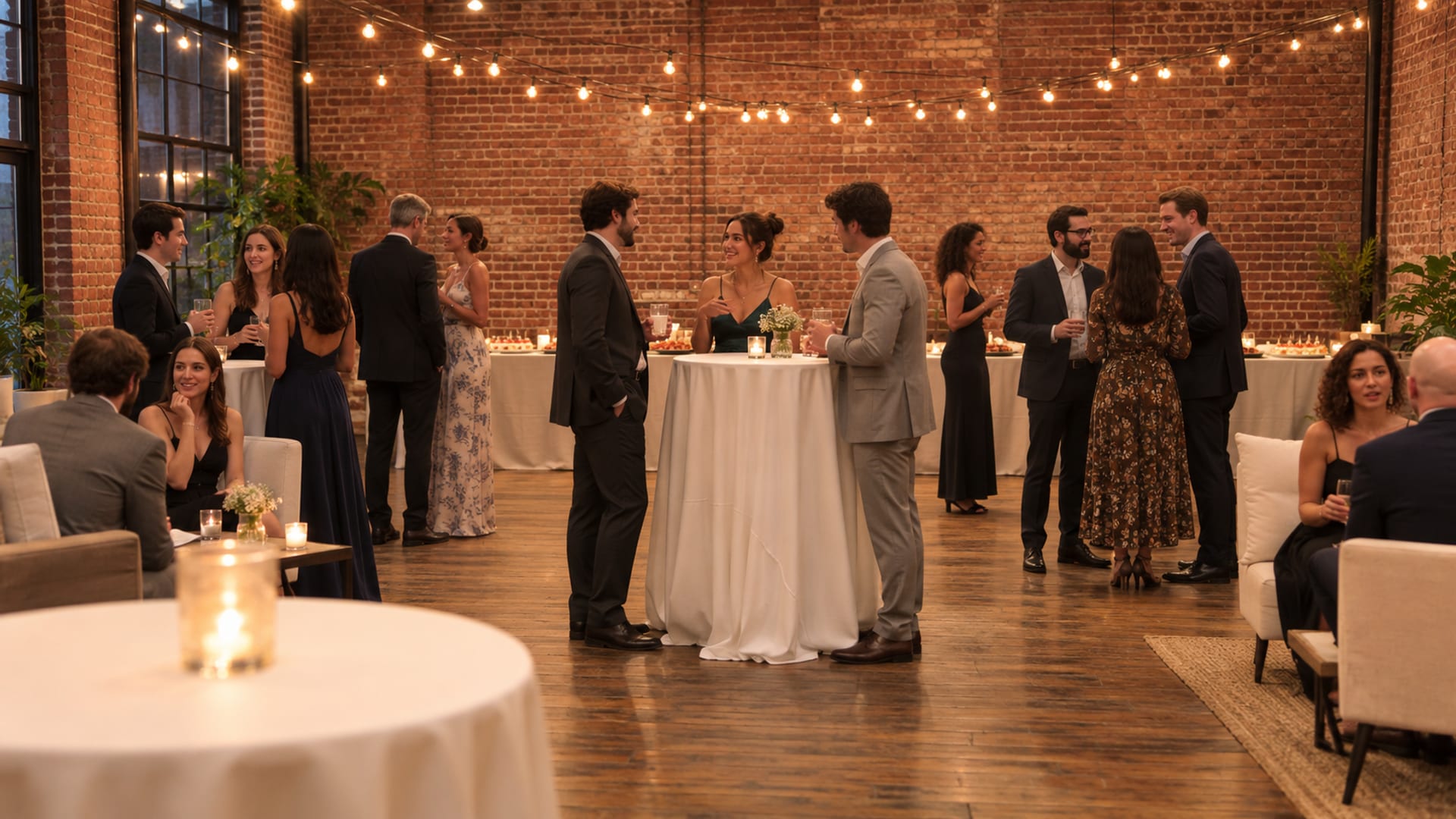
A cocktail-style reception replaces or trims the seated dinner. Instead, you get passed hors d'oeuvres, food stations, grazing displays, drinks and a room set up for mingling. The first decision is whether your guests are getting a full meal from the food, because that one answer sets the quantity, the schedule, the seating and the staffing.
Two caterers publish numbers you can start from, and they are recommendations, not rules. Urban Affairs Catering suggests 4 to 6 pieces per guest for a cocktail hour before dinner and 8 to 12 pieces per guest per hour for a cocktail-only reception. Gotham Catering suggests 10 to 12 pieces when hors d'oeuvres replace a meal.
After that, confirm in writing the standing and seated capacity, the seating, the staffing, the bar service, the permits, the minimums, the tax and the service charge. A cocktail format is not automatically cheaper, and the rest of this page shows where the cost sits.
Key takeaways
Tap a card to bring it forward.
- Decide first whether food replaces dinner; that choice sets quantity, timing, seating and staffing.
- Caterers suggest 4 to 6 pieces per guest before dinner, and 8 to 12 pieces per guest per hour when there is no dinner.
- Ask for the number of servers, bartenders, barbacks and station attendants as separate lines in the quote.
- Standing capacity is not seated capacity; get the number for your exact layout and keep seats for guests who need them.
- Package prices rarely include tax, service charges, rentals or staffing, so compare full proposals line by line.
- Ask the venue who holds the alcohol permit and whether a Place of Assembly permit is in place.
Do you want a cocktail hour or a full cocktail-style reception?
Both get called "cocktail style," but they plan very differently. A traditional cocktail hour is a short stretch before dinner with a bar, passed bites and sometimes a station, and one hour is common in published wedding packages. Faculty House, for example, builds a one-hour cocktail reception into its wedding package.
A full cocktail-style reception takes the place of dinner. Gotham's published durations give a useful range: 1 to 2 hours for pre-dinner service, 2 to 4 hours for an afternoon cocktail party, and 4 to 6 hours when hors d'oeuvres stand in for dinner. These are package examples, not a legal standard, but they show how the length grows with the food.
Your pick changes four things at once. Food quantity rises sharply when there is no dinner. The schedule needs room for speeches, photos and dancing. Seating needs go up as the party gets longer. And you will need more hands for passing food, running stations and keeping the bar moving.
The reception format does not change the marriage license process, so the same plan works after a City Hall or other civil ceremony.
How much food should you plan per guest?
Start with the purpose of the food. If dinner follows, Urban Affairs suggests 4 to 6 pieces per guest during the cocktail hour. If the food is the meal, it suggests 8 to 12 pieces per guest per hour, and Gotham suggests 10 to 12 pieces in total when hors d'oeuvres replace a meal. Gotham also lists 3 pieces per guest alongside a meal and 6 pieces for light cocktail fare.
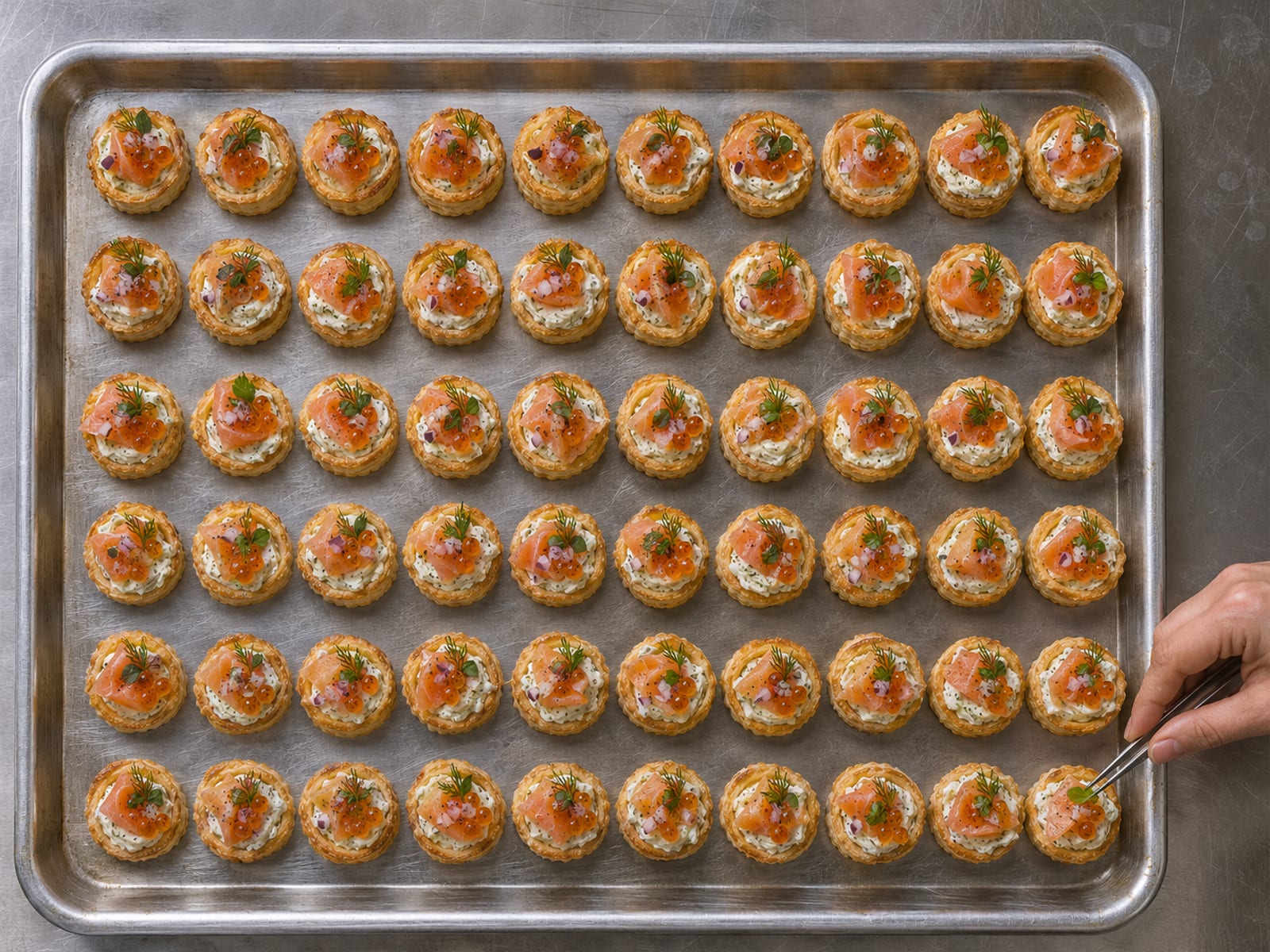
So, for 100 guests in a cocktail-only reception, a caterer working from Urban Affairs' range would plan roughly 800 to 1,200 pieces for each hour of service. Use that as a conversation starter, then ask for the exact count in the proposal.
Urban Affairs also recommends a mix of hot and cold selections, and adds stationary platters to the passed trays when an event runs longer than 90 minutes. Ask the caterer to put the guaranteed pieces per guest in writing, along with the number of menu choices included.
How do passed food and stations work together?
Passed food keeps the room moving and lets guests keep talking. Stations give people something more substantial to stand at, and they spread out the crowd. For a meal-replacement reception, most caterers combine the two rather than relying on passed trays alone.
For passed food, ask how the trays rotate so every corner of the room gets a mix of items through the evening, and not only the first hour. For stations, ask what is on offer, whether a chef or attendant works each one, and when it is restocked.
There is no single published rule for how many stations a given guest count needs. The number depends on guest count, station type, length of service and portions, so ask the caterer to state station count, portions, attendants and the refill schedule in writing.
Two more details are worth requesting. Label food for the dietary needs in your group, such as vegetarian, vegan, gluten-free, halal, kosher and allergy-safe items. And decide whether you want a late-night snack or dessert station, because that is a separate line in most quotes. For more on dietary menus, see kosher, halal and dietary needs at an NYC wedding.
How many servers and bartenders should the quote include?
Urban Affairs publishes one server per 25 to 30 guests for passed food as its standard ratio, and one per 20 guests for high-density receptions, such as a rooftop or a crowded Manhattan room. For 100 guests, that is about four servers at the standard ratio and five at the tighter one.
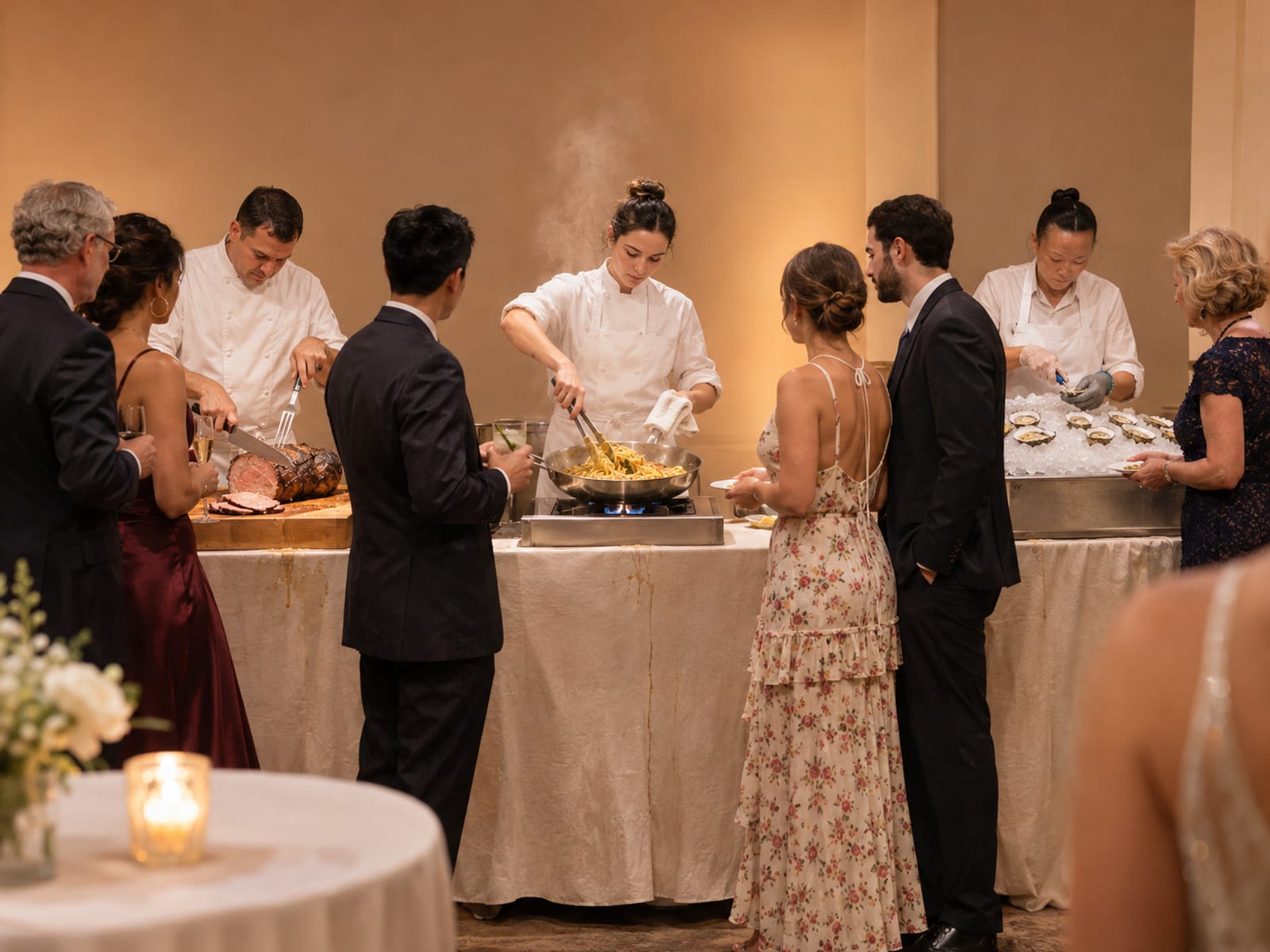
Passed-food servers are only one part of the crew. Ask for separate counts and minimum paid hours for each of these:
- Bartenders and barbacks
- Passed-food servers
- Station attendants or chefs
- Bussers and glass collection
- Setup and breakdown staff
Also ask who handles ice, trash, refills and cleanup. If a proposal uses the same people to pass food, run stations, clear glassware and back up the bar, look at it closely, because those jobs all peak at the same time. No published bartender-per-guest ratio is available, so ask each caterer to state the bartender and barback counts in the written proposal.
How much seating does a standing reception need?
A cocktail layout can use fewer dining tables, but it should not remove seating. Plan seats for guests who need to sit, including older guests, disabled guests, pregnant guests and anyone in formal shoes for several hours. The longer the reception and the more it replaces dinner, the more seating makes sense. No single percentage fits every room, so ask for a floor plan at your guest count.
A good layout usually includes:
- Chairs near food and drink where practical
- Lounge seating with low tables, plus high-top cocktail tables
- A clear accessible route and space for wheelchairs and mobility devices
- A quiet, lower-density place to sit
- Food stations spread out so there is not one long line
- Bars placed away from entrances, exits, restrooms and food
- A dance floor sized after seating, stations, bar and walkways are placed
Speeches and dancing still work without dinner tables. Choose a spot where guests can see you, schedule the toasts between food rounds, and set the dance floor after everything else is placed. For more on the sequence, see your NYC wedding day schedule and wedding floor plans in NYC. If anyone in your group needs access features, planning an accessible wedding in New York City covers them.
How do standing and seated capacities differ, and which venues fit?
Venues often publish two capacities for the same room, and they can differ a lot. Use the number for the layout you plan, not the larger one. Here are venue-published examples, with the layout to confirm for each.
Tap or hover a row to highlight it.
| Venue | Seated | Standing or cocktail | Layout to confirm |
|---|---|---|---|
| VenueNew York City Center, Grand Tier | Seated100 seated dinner | Standing or cocktail200 cocktail reception | Layout to confirmYour date and the cocktail layout |
| VenueGeorgia Room, main listing | Seated120 seated dinner | Standing or cocktailUp to 400 standing cocktail | Layout to confirmWhich section of the space is included |
| VenueGeorgia Room, micro-wedding section | Seated125 seated dinner | Standing or cocktail150 standing cocktail | Layout to confirmThe micro-wedding room and its limits |
| VenueThe Plaza, Palm Court, semi-private areas | SeatedUp to 70 seated | Standing or cocktail100 standing | Layout to confirmWhich semi-private area |
| VenueThe Plaza, Palm Court, full buyout | SeatedUp to 100 seated | Standing or cocktailUp to 350 standing | Layout to confirmBuyout terms and date |
The Georgia Room's two listings show why a single number is not enough. Ask for the exact room, date, layout and capacity in writing, and ask for a floor plan at your guest count.
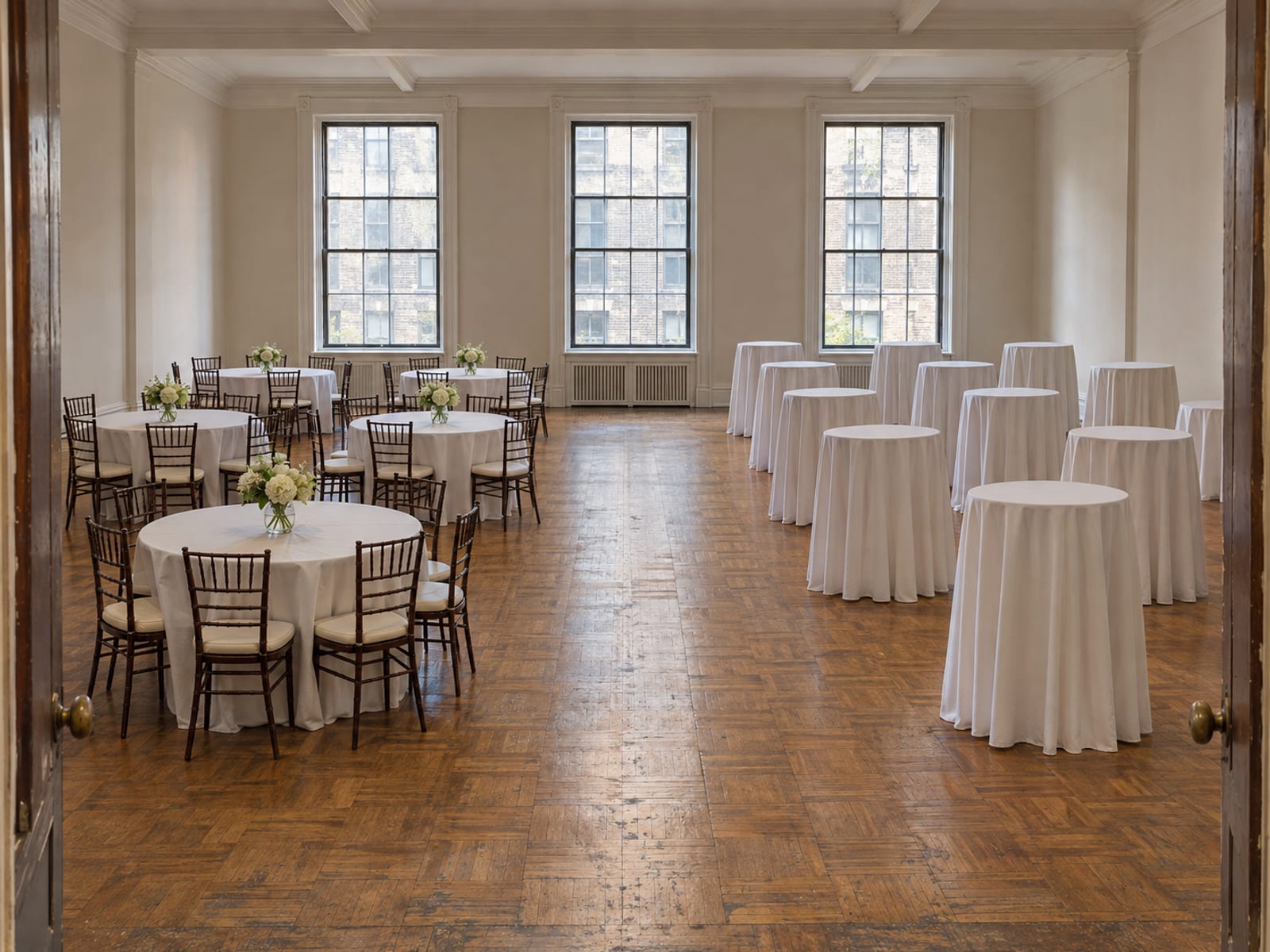
Restaurants, hotels, rooftops, lofts, galleries, private clubs, museums and flexible event spaces can all host this format. For a smaller guest list, see small and micro wedding venues in NYC, and for a full restaurant buyout, see a restaurant wedding reception in NYC.
What should the venue quote show?
Published prices are a starting point, and they cover different things. Faculty House's package, for example, runs from the cocktail hour through dinner and a five-hour premium open bar, while The Hudson and Gotham price the food alone.
Tap or hover a row to highlight it.
| Business | What the price covers | Price |
|---|---|---|
| BusinessFaculty House | What the price coversWedding package with a one-hour cocktail reception, choice of eight butler-passed hors d'oeuvres, five-hour premium open bar and dinner | PriceStarting at $235 per guest |
| BusinessThe Hudson | What the price coversFour passed or stationary hors d'oeuvres | Price$50 per person |
| BusinessThe Hudson | What the price coversEach additional hour of hors d'oeuvres | Price$5 more per person |
| BusinessThe Hudson | What the price coversFormal dinner package with three hors d'oeuvres, three entrées and two sides | Price$80 per person, plus 8.875% tax and 20% service fee |
| BusinessGotham Catering | What the price coversPre-dinner service, 1 to 2 hours, 3 pieces per guest | Price$11.50 per guest |
| BusinessGotham Catering | What the price coversAfternoon cocktail party, 2 to 4 hours, 6 pieces per guest | Price$23 per guest |
| BusinessGotham Catering | What the price coversIn lieu of dinner, 4 to 6 hours, 10 pieces per guest | Price$38.50 per guest |
These packages are not directly comparable. Some include alcohol and a full reception; others cover only hors d'oeuvres, or leave out tax, service charges, rentals, staffing and venue fees. Tax and service charges are contract terms, not citywide rules; The Hudson, for instance, lists 8.875% tax and a 20% service fee on certain packages.
Ask every venue and caterer to show these lines separately:
- Food, with pieces per guest
- Bar, with bartender and barback counts
- Venue fee and any food and beverage minimum
- Service charge, gratuity and tax
- Rentals and delivery
- Staffing for passed food, stations, bussing, setup and cleanup
- Overtime and the latest end time
- Cake cutting and outside-vendor fees
- Cancellation and payment terms
Ask for a dated written quote, since prices and availability change. For menus, formats and caterer selection, see wedding catering in NYC.
Which permits and rules may apply?
You will not usually file these yourself, but you should know who does. Each item below is followed by the question to ask.

- Alcohol catering permit. The New York State Liquor Authority says a catering permit application must be received at least 15 business days before the event, and only active on-premises retail licensees can apply. Food must be provided; finger foods are among its examples. Ask who holds the license and who files.
- Temporary food permits. The NYC Health Department requires permits for food vendors at temporary public events and makes exceptions for certain private social functions. Ask the venue and caterer which category applies to your function.
- Place of Assembly. NYC311 says a Place of Assembly Certificate of Operation and Permit is required when 75 or more people gather indoors, or 200 or more outdoors. Ask whether the venue already has one for your space.
For the alcohol side in full, including open bar and BYOB, read the liquor rules for your NYC wedding.
What should you ask before booking?
Keep this list with the quote and ask each question in writing.
- What is the capacity for my exact layout, seated and standing?
- How many seats, lounge seats and high-tops are included, and can I see a floor plan at my guest count?
- How many pieces per guest are guaranteed, and how many stations, attendants and refills are included?
- How many servers, bartenders and barbacks are included, and for how many paid hours?
- What bar type is included, and who holds the alcohol permit?
- Who handles food permits and any Place of Assembly requirement?
- Are outside caterers and vendors allowed, and is there a fee?
- How will dietary and allergy needs be handled?
- Where are the accessible routes, restrooms, coat check and gift table?
- What is the latest end time, and is dancing allowed?
- What happens if the guest count rises?
- Which minimums, tax, service charges and cleanup costs are in the total?
A document folder with labeled sections and room for letter-size pages keeps the quote, menu, floor plan and permit notes together.
Quick check: cocktail-style receptions
Answer every question to check.
Questions about cocktail-style receptions
These are the quick answers; the sections above give the detail.
What is a cocktail-style wedding reception?
It is a reception built around mingling rather than a seated meal, usually with passed food, stations, drinks and mixed seating. It can be a one-hour cocktail hour before dinner or a longer party that replaces dinner.
Is a cocktail-style reception cheaper than a plated dinner?
Not necessarily. Compare food, beverage, staffing, rentals, tax, service charges, minimums, venue rental, setup, cleanup and overtime. Longer service times and station staff can add up.
Does everyone need a seat?
A standing layout can reduce dining tables, but seating should still be there for guests who need it. Ask the venue for a floor plan at your guest count.
Can a venue use its standing capacity for a seated dinner?
No. Standing and seated capacities differ, so ask for the number that matches your exact layout. Venues often publish both.
Who handles the alcohol permit?
Ask the venue or licensed caterer to name who is responsible. The State Liquor Authority says a catering permit application must be received at least 15 business days before the event, and only active on-premises retail licensees can apply.
Your next step
Pick your format first: a cocktail hour before dinner, or a reception where the food is the meal. Then send the question list above to two or three venues or caterers and ask for dated written quotes with every line itemized. Once you have those, wedding catering in NYC helps you compare them side by side.
Terms in this guide
Tap a term to see what it means.
Cocktail-style reception. A reception built around mingling, with passed food, stations and drinks, that replaces or trims the seated dinner.