An accessible NYC wedding has a continuous route from the sidewalk to the entrance, the ceremony, the reception, the restrooms and every other part of the day. Ask the venue to confirm step-free entry, an elevator or ramp, door and hallway clearance, accessible restrooms, wheelchair and companion seating, and access to each event area, using the MOPD Accessible Events Guide and the ADA checklist as your question list. City Clerk ceremonies are by appointment for $25, per NYC311, and guests can plan around MTA accessible stations, Access-A-Ride and wheelchair-accessible taxis or ride-hail vehicles through TLC. Then get the exact route and the event-day arrangements in writing.
Key takeaways
Tap a card to bring it forward.
- Ask for the whole route: sidewalk, entrance, ceremony, reception, restroom, dance floor and any outdoor or photo area.
- An elevator or a ramp alone does not settle it; confirm which floors it reaches and where the accessible restroom is.
- Wheelchair spaces should be spread through the room, with companion seating beside each one.
- ASL, live captioning, large print and a quiet space take lead time, so book them early and ask for quotes in writing.
- City Clerk accommodation requests are due as soon as possible and no later than three business days before your appointment.
- Put each access detail in the contract or event plan, then reconfirm shortly before the wedding.
What "accessible" should mean for a wedding
"Accessible" is a bundle of features, and a venue can have some without the others. It can mean step-free entry, an elevator, an accessible restroom, wide enough doors and aisles, wheelchair seating, captioning, ASL interpretation, assistive listening, large print or a quiet space. The MOPD guide asks planners to think about physical, hearing, vision, speech, cognitive and neurological needs, not only wheelchair access.
The test is participation. Can the two of you and every guest take part in the ceremony, the meal, the speeches, the photos, the dancing and the restroom breaks, using the same main entrance as everyone else? MOPD recommends a venue where disabled guests use the same main entrance as other guests, and says an accessible route should reach all event activities and facilities. If your legal ceremony is at a City Clerk office and the celebration is somewhere else, check each place on its own.
How to check a venue before you book
Ask for a walkthrough, or a video that follows the complete route, and then ask each of these questions in writing.
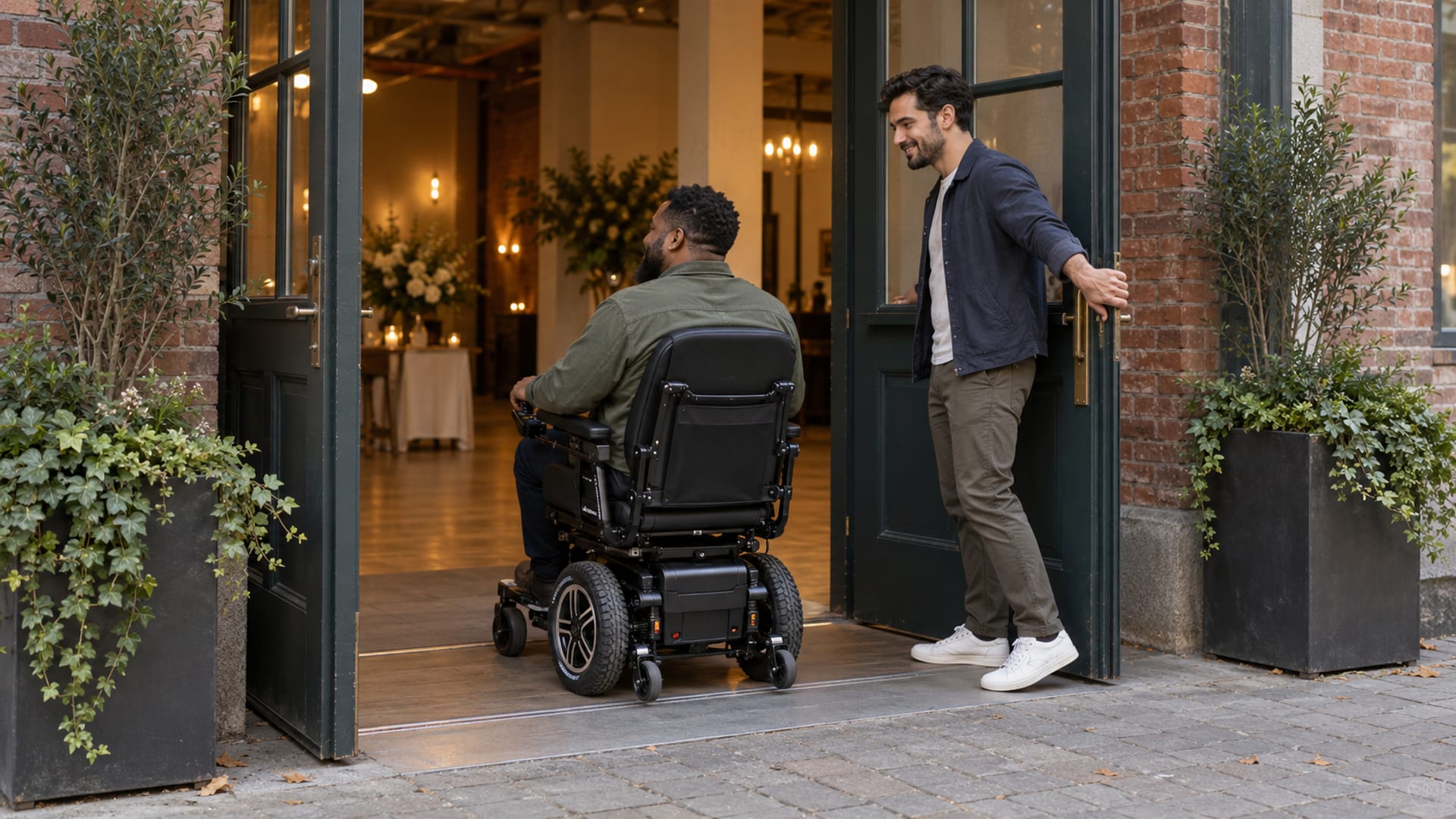
Entrance and route. Is the entrance flush with the sidewalk? If not, is there a ramp or lift, and is it the main entrance? Is the route from the curb or drop-off point continuous, without temporary steps or steep slopes? The ADA checklist looks for a clear entrance width of at least 32 inches and interior accessible routes at least 36 inches wide.
Ramps and lifts. Does the ramp have the right slope, width, landings, handrails and edge protection? Is the lift working, can it carry the guest's chair and the guest, and can the guest use it alone or does staff need to arrange it?
Elevators. Which floors does it serve? Does it reach the rooftop, a mezzanine, the ceremony room, the reception room and the restroom? What are the door width and the inside dimensions, is it a passenger elevator or a freight one, and is it available for the whole booking? If it stops working, what is the backup plan?
Restrooms. Is there an accessible restroom on the same route as your event, open to wedding guests all night? Ask about door clearance, turning space, transfer space, grab bars and sink clearance.
Space for each part of the day. Ask about the ceremony spot, the cocktail hour, the dinner, the dance floor, the photo area, the garden or roof, getting-ready rooms, parking and valet, and curbside drop-off.
If a guest uses a motorized wheelchair or scooter, say so up front. A venue that works for a manual wheelchair may not work for a larger chair, so ask for door, elevator, restroom and turning dimensions and for any weight or equipment limits.
Treat a published statement as a starting point. Elevator operation, construction, furniture layout and restroom availability can change, so confirm them for your date and again shortly before the wedding.
Can every guest reach the ceremony, reception and restroom?
An accessible front door is the first step, not the last. Ask whether every activity on your timeline sits on the same accessible route. The venue pages below show how much detail a venue can publish, and why a floor-by-floor answer matters. LOFT39, for example, says the second through fifth floors are reachable by elevator, the rooftop is not, and the third floor has no ADA-compliant restroom.
Tap or hover a row to highlight it.
| Venue and area | What the venue's page says | Read on |
|---|---|---|
| Venue and areaWarehouse Studios, Industry City, Brooklyn | What the venue's page saysA ramp, an elevator and two ADA-compliant restrooms; capacity of more than 120 seated or 200 cocktail-style | Read onOctober 9, 2026 |
| Venue and areaLOFT39, Midtown Manhattan | What the venue's page saysFloors two to five by elevator; rooftop not reachable by elevator; ADA-compliant restrooms on floors two, four and five, none on three; a 30-inch elevator door; a site visit is recommended | Read onOctober 9, 2026 |
| Venue and areaGH on the Park, Midtown Manhattan | What the venue's page saysA ramp and two sets of double doors at the main entrance; every floor by elevator except the third-floor Club Room; accessible restrooms on floors two, three, eight, nine and ten | Read onOctober 9, 2026 |
| Venue and areaSECOND, Midtown Manhattan | What the venue's page saysElevators, adjustable table heights and an ADA-compliant restroom | Read onOctober 9, 2026 |
| Venue and areaManny Cantor Center, Lower East Side | What the venue's page saysADA elevator access, restroom access and an ADA-accessible second-floor terrace; terrace maximum occupancy of 164 | Read onOctober 9, 2026 |
| Venue and areaCentral Park Conservancy, Conservatory Garden | What the venue's page saysGarden labeled wheelchair accessible, with wheelchair-accessible restrooms; couples request a permit | Read onOctober 9, 2026 |
| Venue and area74Wythe, Williamsburg, Brooklyn | What the venue's page saysAn "ADA Accessibility" section and multiple entrances and passageways; confirm each event area with the venue | Read onOctober 9, 2026 |
Use these as a model for what to ask your own shortlist, and reconfirm anything you plan to rely on for your date and your guest's equipment. For nearby options in Westchester or Connecticut, run the same route screening on each venue's own current page.
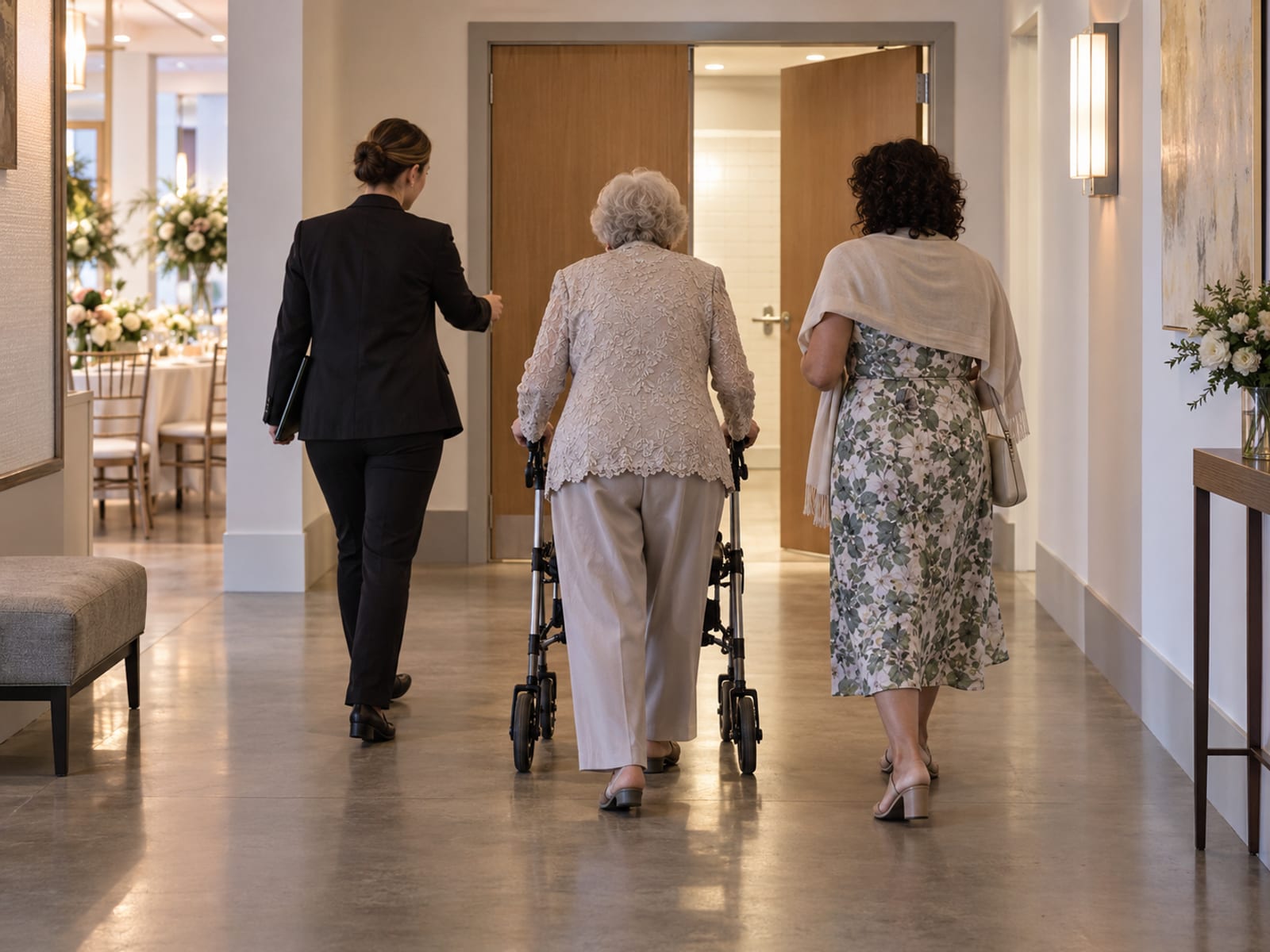
How wheelchair seating and companion seating should work
Wheelchair spaces belong throughout the room, not at the back or in one isolated corner. ADA guidance calls for them to be distributed through assembly areas, so ask for spaces at more than one table or location, with companion seating beside each one. Carrying a guest up steps is not an access plan; the ADA treats steps on an accessible route as a barrier and calls for an accessible entrance, ramp or lift.
A few layout details make the difference on the night:
- A clear route to the ceremony, tables, restroom, bar, dance floor and exit, with tables placed so they do not block turning space.
- Aisles wide enough to reach the ceremony seating and the dance floor.
- Seating for guests who cannot stand for long during cocktail hour or speeches.
- A clear view of interpreters and caption screens from the wheelchair spaces.
- A route that does not send anyone through a separate back entrance.
Ask the venue whether tables can be rearranged without blocking the accessible route, and whether wheelchair seating can sit beside particular guests.
Planning for Deaf, hard-of-hearing, blind, low-vision and sensory needs
Start by asking the guest what works best, since some prefer ASL, some captions and some both. Then book early.
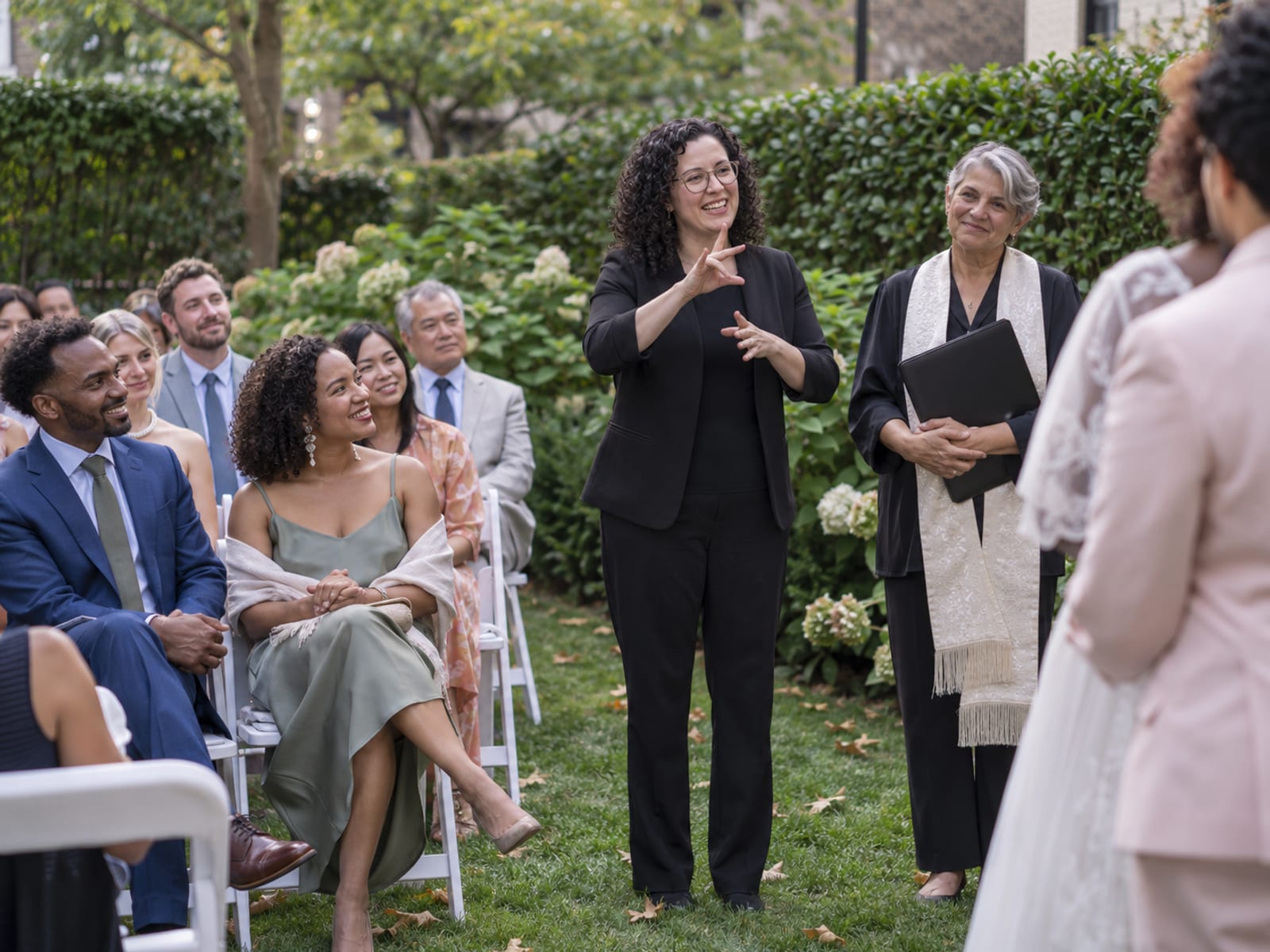
ASL interpreters. NYASL, a New York provider, publishes a request form and offers on-site and virtual interpreting. It recommends asking at least three days ahead and ideally two weeks, because interpreters are in high demand, and says events longer than two hours need two interpreters. It does not post a fixed private-event rate, so request a written quote. Ask about coverage for the ceremony, speeches, announcements and reception, whether the interpreter will voice for Deaf speakers, preparation time, travel, cancellation and minimum hours.
CART (live captioning). The New York State CART resource list shows provider rates and minimums. These are provider-list figures, so confirm current rates, travel, technology and cancellation terms before you rely on them.
Tap or hover a row to highlight it.
| Provider | In person | Remote |
|---|---|---|
| ProviderASLI | In person$190 per hour, one-hour minimum (NYC) | Remote$178 per hour, one-hour minimum |
| ProviderInclusive Communication Services | In person$175 to $195 per hour | Remote$145 to $175 per hour |
| ProviderStenoCaptions | In person$140 per hour, two-hour minimum (NYC) | Remote$140 per hour, two-hour minimum |
| ProviderKarash and Associates | In person$195 per hour, two-hour minimum | Remote$129 per hour, one-hour minimum |
The state's CART best-practices document suggests booking on-site captioning several weeks or months ahead because of provider shortages. Remote captioning can cost less when the sound is clear and the internet connection is strong. Send the captioner the speaker names, the schedule and any names or terms they will hear.
Assistive listening. Ask the venue whether it has a system, which rooms it covers, how many receivers it has and whether it works with the microphones and sound system you will use. MOPD keeps a list of City-owned or City-operated facilities with systems, but it is self-reported and updated yearly, so it does not describe private venues.
Blind and low-vision guests. Offer large-print or digital programs and menus, and ask about high-contrast signage and a clear, uncluttered route.
Sensory needs. A quiet room or low-stimulation space, away from speakers, flashing lights and crowds, helps guests who need a break. Ask about DJ and band volume, strobe or moving lights, fog, haze and smoke effects, a quiet route to the space, seating, water, charging and restroom access, and whether a guest can leave and return without stairs. Confirm the space is actually available for your date.
How guests can travel accessibly
Do not plan around the nearest subway station alone. Identify an accessible station entrance, the route from there to the venue and a backup station or vehicle.
MTA. The MTA publishes an accessibility map of subway stations and current elevator and escalator status, and its trip planner has an accessible-trip option that accounts for current outages. Check MTA alerts shortly before the wedding. Many stations are not accessible, and the list changes over time.
Access-A-Ride. Access-A-Ride is paratransit for eligible customers whose disabilities prevent them from using buses or subways, with an application and an individual assessment, and trips are booked ahead online or by phone. An MTA overview lists a $2.90 base fare and says customers generally reserve one to two days ahead. A visiting guest should confirm eligibility, the current fare and the reservation rules well before the trip.
Accessible taxis and ride-hail. TLC says licensed rideshare, livery, black-car and limousine services must provide a wheelchair-accessible vehicle when requested, by phone or through a licensed NYC car-service app, at the same fare as a non-accessible trip from the same service. Request the vehicle in advance and give the exact curbside entrance, pickup time, wheelchair type and whether the guest will stay in the chair during the ride. TLC also posts wheelchair-accessible vehicle resources, including Spanish materials.
For shuttles, parking and group logistics, see getting wedding guests around New York City. For accessible rooms and hotel-to-venue routes, see where your wedding guests should stay.
The City Clerk ceremony
NYC311 says civil marriage ceremonies are held at all five City Clerk borough offices, by appointment only, for a $25 fee, Monday through Friday, with arrival between 8:30 AM and 3:15 PM. The Marriage Bureau page points couples to Project Cupid for appointments. For the full process, see a City Hall wedding step by step and the Marriage Bureau in all five boroughs.
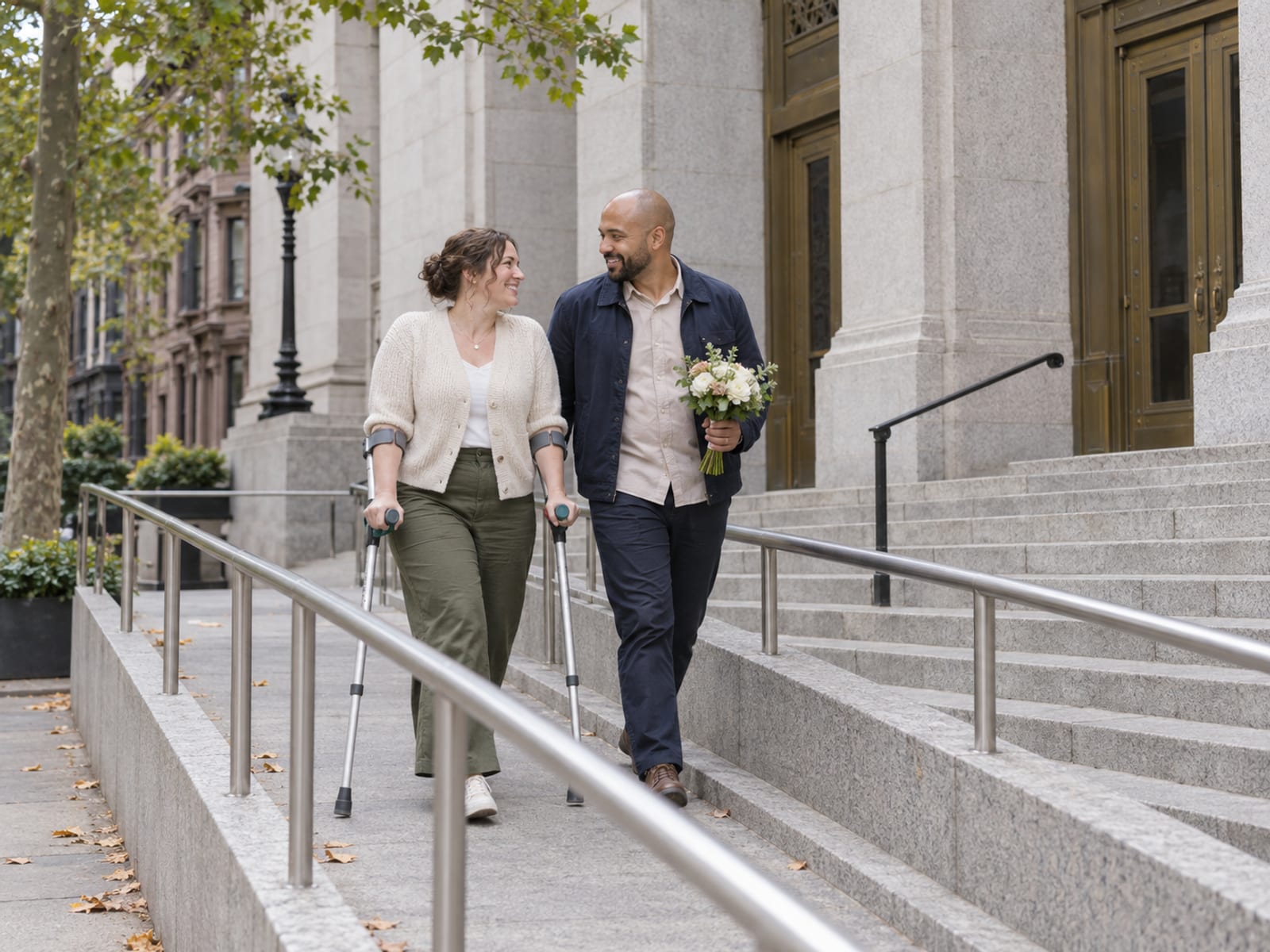
For accommodations, the City Clerk's Accessibility Plan names a Disability Service Facilitator for anyone who needs an auxiliary aid for effective communication or a reasonable modification:
- Email: accessibility@cityclerk.nyc.gov
- Phone: 212-669-8898
- Mail: Disability Service Facilitator, Office of the City Clerk, 141 Worth Street, New York, NY 10013
Requests should come as soon as possible and no later than three business days before your appointment. Confirm the accessible entrance, restroom, seating and communication arrangement for your borough office when you ask, so there are no surprises on the day.
What to put in writing before you sign
A conversation is not a commitment. Ask the venue to list these in the contract or the event plan:
- The exact entrance and the full route to each event space.
- Which rooms the ceremony, cocktail hour, dinner and dancing will use.
- The accessible restroom's location and that it is open to your guests throughout the booking.
- Elevator operation for the whole booking, plus the backup plan if it stops.
- Wheelchair and companion seating locations, and any table layout you agreed on.
- Communication services, who books them and who pays.
- The quiet space and the sound and lighting limits you asked for.
- Drop-off, parking and where an accessible vehicle can stop.
- Whether outside interpreters, captioners and accessible transportation providers are allowed.
- A named person who handles access requests on the wedding day.
Whether a private event owes every accommodation at no cost depends on the venue and the law, so discuss costs with the venue and each provider before you sign. For deposits, payment schedules and cancellation terms, see the general wedding contract advice.
Optional invitation wording for access requests
Ask directly, offer a private way to answer and set a date:

"Do you or anyone in your party need an accessibility accommodation to attend? Please tell us what would help by [date]. You may reply privately to [contact]."
If you want to prompt more specific answers, add: "Examples include step-free access, wheelchair seating with companions, an accessible restroom, ASL interpretation, live captions, large-print materials, a quiet space or accessible transportation information."
Do not promise an accommodation until the venue or provider confirms it. A reply that comes through your wedding website is easier to keep private, and it spares guests from explaining themselves more than once.
Quick check: accessible wedding planning
Answer every question to check.
Questions about accessible NYC weddings
What should an accessible NYC wedding venue provide?
A continuous accessible route to the entrance, event spaces, restrooms and planned activities, plus suitable seating and communication access for guests who need it. Ask for the details in writing.
Does an elevator make a venue accessible?
Not on its own. Confirm which floors and rooms it serves, whether the rooftop is left out, whether it fits the guest's chair or scooter, and whether an accessible restroom is on the same route.
Are NYC City Clerk offices accessible?
The City Clerk states that it does not discriminate based on disability and invites requests for auxiliary aids, effective communication or reasonable modifications. Send requests as soon as possible and no later than three business days before your appointment, and confirm the arrangements at your borough office.
How much does a City Clerk ceremony cost?
NYC311 lists the fee as $25. The marriage license is a separate $35 fee, per NYC311.
What if the elevator stops working?
Ask the venue for a documented alternate route, or a plan to move the affected activity to an accessible area. Get that plan before you book.
Your next step
Pick your top venue and send one email asking for the full route, restroom location, elevator details, seating plan and backup plan, then book a walkthrough. Once you have the answers, ask for them in the contract, and put a reminder on your calendar to reconfirm the route and the elevator the week of the wedding.
Terms in this guide
Tap a term to see what it means.
Accessible route. A continuous route from the sidewalk to the entrance and on to every event activity and facility.