
A venue quote has five lines worth checking: the food and beverage minimum, the package or menu price, the service or administrative charge, sales tax, and gratuity. The all-in total comes from asking the venue to show each line for your guest count, date, menu, bar and hours. In New York, a service charge is not automatically a tip. A mandatory gratuity is treated differently for sales tax only when it is separately stated, identified as a gratuity and paid entirely to employees, according to the New York State Department of Taxation and Finance.
Key takeaways
Tap a card to bring it forward.
- A per-person price is rarely the final number; ask for the total with tax, service charge and gratuity shown on separate lines.
- A service charge is not the same as a tip. New York requires an administrative charge to be labeled as not a gratuity.
- Sales tax generally applies to a service charge. A mandatory gratuity escapes tax only if it is separately stated, called a gratuity and paid entirely to employees.
- New York City's combined sales tax rate is 8.875%, so a $35,000 package adds $3,106.25 in tax.
- No single NYC rule covers a missed minimum; ask the venue to write the remedy into the proposal.
- Compare two quotes only with the same guest count, date, hours, menu and bar.
What are the five lines on a quote, and what does each one mean?
Most quotes fold these five lines into one headline number, so it helps to pull them apart. Each one is below, with the Spanish term beside it in case someone helping you plan reads the quote in Spanish.
- Food and beverage minimum (consumo mínimo, or mínimo de comida y bebidas): the least you must spend on food, drinks, or both.
- Package or menu price (paquete por persona): a per-person price for a meal, a bar, staffing or rentals, multiplied by your guest count.
- Service or administrative charge (cargo por servicio, cargo administrativo): a mandatory fee, often a percentage of food and beverage.
- Sales tax (impuesto sobre las ventas): the state and local tax on taxable items.
- Gratuity (propina): either a voluntary tip or a mandatory charge that is specifically labeled as a gratuity and paid entirely to employees.
Fixed fees can sit beside all five. These include ceremony, room, bartender, maître d', corkage, cake-cutting, security, rental and overtime fees. The useful question is never only "What is the price per person?" It is "What is the taxable subtotal, which fees are mandatory, what does the service charge pay for, and is gratuity included?"
What counts toward a food and beverage minimum?
A minimum is the amount a venue requires you to spend on qualifying food, drinks, or both, and it is a different thing from a room fee. A room fee buys the space. A minimum is a spending floor, and what you order counts toward it. A Salute, a New Jersey venue, says each of its private-event spaces carries a minimum and that you can reach it through the food package, the bar, or both. Its pricing is before tax and 20% gratuity.
So, ask where the minimum is measured. Some venues count it before tax and fees, and others do not, and a quote does not always say. Ask too whether children's meals, vendor meals and the bar count toward it. New York treats minimum charges connected to food and drink as generally taxable, so the tax question comes up here as well. If you are looking at a restaurant, the restaurant wedding reception guide covers minimums and buyouts in more detail.
What does a per-person package include?
A package price is a per-person rate, so the total grows with your guest count. What it covers differs by venue, which is why two $300 quotes can mean two different things.
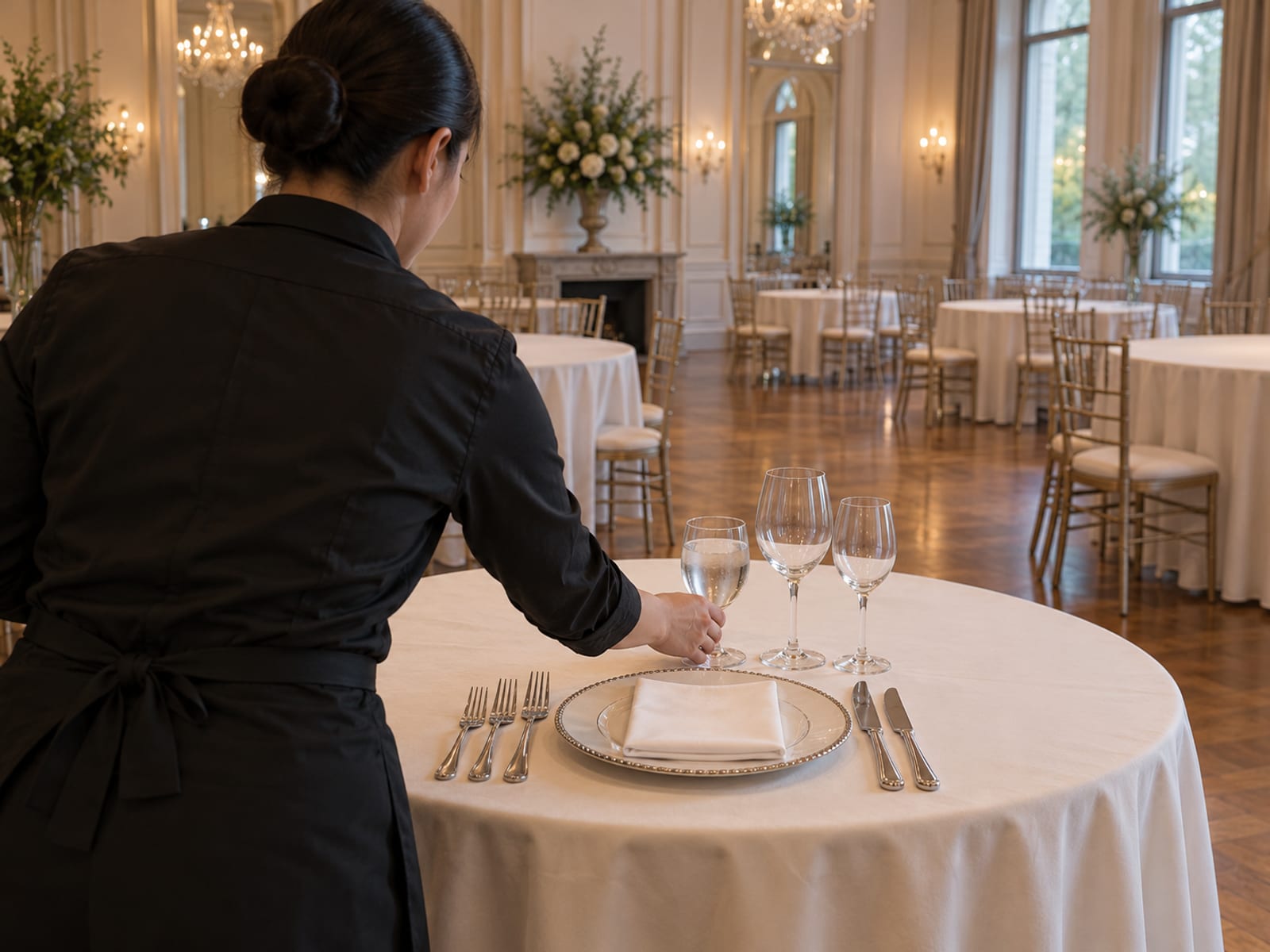
Two Brooklyn examples show the range. Deity NYC lists all-inclusive wedding packages from $275 to $350 per person, depending on season and day, before NYC sales tax. It says it does not charge administration, staff, rental or gratuity fees. From May to October, Friday is $325, Saturday is $350 and Sunday is $300, and each day has a guest minimum of 80 or 100. Brooklyn Event Venues lists a premier wedding package at $235 per person, with service charge, tax and gratuity added, and a price that may rise below 75 guests.
Those two quotes can look close on a first read and land far apart once the added lines go on. Ask what the package includes for food, bar, staffing, rentals, coordination, entertainment and venue time. If you are pricing the meal on its own, wedding catering in New York City shows what catering itself tends to cost.
Is a service charge the same as gratuity?
No. The New York State Department of Labor's hospitality wage order says a charge for administering a banquet, special function or package deal must be clearly identified, and the customer must be told it is not a gratuity or tip. That notice has to appear in your contract and on menus and bills that list prices. It must be in ordinary language, in type no smaller than 12 points. If one charge combines an administrative part and a part paid out as gratuities, the written document must break down the percentages.
What the order does not say is that every service charge reaches the staff who serve your event. That depends on the venue's own wording. For example, the 618 Restaurant and Catering pricing sheet in Freehold, New Jersey, adds a 22% service charge and says it goes toward staff hourly wages and is not gratuity, with gratuity left optional. Read the wording on your own quote, then ask the venue to state in writing who receives the charge and whether any tip is still expected.
Is sales tax charged on the service charge or gratuity?
Usually on the service charge, and sometimes not on gratuity. The New York tax rules for caterers work like this:

- Prepared food and drinks served by a caterer are taxable.
- Charges tied to a catered event are generally taxable, even when listed on their own line.
- A service charge that is not specifically identified as a gratuity is taxable.
- A mandatory gratuity is not taxable only if it is separately stated, specifically identified as a gratuity, and paid entirely to employees.
- A voluntary tip that a customer leaves is not taxable.
- When a hotel, or a caterer hired by the hotel, provides the catering, the room charge is part of the taxable event charge. A separately hired caterer can produce a different result.
- Minimum charges and other charges connected to food and drink are generally taxable.
The combined rates below come from New York's Publication 718 and the New Jersey Division of Taxation, read October 9, 2026.
Tap or hover a row to highlight it.
| Location | Combined sales tax rate |
|---|---|
| LocationNew York City | Combined sales tax rate8.875% |
| LocationNassau County | Combined sales tax rate8.625% |
| LocationSuffolk County | Combined sales tax rate8.75% |
| LocationWestchester County, outside listed cities | Combined sales tax rate8.375% |
| LocationYonkers | Combined sales tax rate8.875% |
| LocationRockland County | Combined sales tax rate8.375% |
| LocationPutnam County | Combined sales tax rate8.375% |
| LocationDutchess County | Combined sales tax rate8.125% |
| LocationOrange County | Combined sales tax rate8.125% |
| LocationNew Jersey | Combined sales tax rate6.625% statewide |
Rates can differ by address, so check the exact venue with the state's rate lookup before you budget to the dollar.
What does a quote add up to? A worked example
Take Deity's Saturday price from May to October: $350 per person with a 100-person minimum, before NYC sales tax.
Tap or hover a row to highlight it.
| Line | Calculation | Amount |
|---|---|---|
| LinePublished package | Calculation100 guests x $350 | Amount$35,000.00 |
| LineNYC sales tax | Calculation$35,000 x 8.875% | Amount$3,106.25 |
| LineTotal with tax | Calculation$35,000 + $3,106.25 | Amount$38,106.25 |
That total leaves out the ceremony-space fee, which can apply if you hold the ceremony at the venue. It adds no gratuity, because Deity says it has no gratuity fee. A venue that adds a service charge would change the arithmetic, so ask it to show the tax base on the proposal. Then divide the final total by your guest count to get an all-in cost per guest.
What happens if you fall below the minimum?
It depends on the contract, so ask for the answer in writing. The venue might charge the gap between your actual qualifying spend and the minimum. It might charge a room or buyout fee instead. It might raise the per-person price under a guest threshold, as Brooklyn Event Venues says it may below 75 guests. It might keep a booking fee that is not applied to your final bill; A Salute's $200 fee is non-refundable and not applied toward the bill. Fixed fees can also apply even when you meet the minimum.

Ask the venue to state the shortfall, room-fee or buyout remedy in the proposal and the contract. Also ask whether a smaller guest count can be offset by a higher menu or bar package, or whether unused minimum can go to a late-night snack or dessert.
How do you compare two quotes fairly?
Put both venues on the same inputs, then line them up side by side. Use the same guest count, date, event hours, menu level and bar plan. The Knot's venue contract advice recommends asking for a complete list of possible fees ahead of time and understanding exactly what the venue provides for its fee. Fill in a row for each of these lines.
Tap or hover a row to highlight it.
| Line to record | Venue A | Venue B |
|---|---|---|
| Line to recordBase price or room fee | Venue A | Venue B |
| Line to recordFood and beverage minimum, and what counts toward it | Venue A | Venue B |
| Line to recordService charge percentage and what it is charged on | Venue A | Venue B |
| Line to recordSales tax rate and taxable base | Venue A | Venue B |
| Line to recordMandatory gratuity and tipping wording | Venue A | Venue B |
| Line to recordFixed fees (ceremony, bartender, maître d', corkage, cake-cutting, security, overtime) | Venue A | Venue B |
| Line to recordDeposits or booking fees not applied to the bill | Venue A | Venue B |
| Line to recordAll-in total and all-in cost per guest | Venue A | Venue B |
Keep venue rental separate from food and beverage so you can see what each part costs. For the larger budget, see what a wedding in New York City costs by borough and a wedding in New York City on a budget. A document folder or expanding organizer with labeled sections helps here; it keeps proposals, signed pages, menus and receipts for both venues together.
What should you ask before you sign?
Ask the questions below, and request a written all-in proposal that answers them for your date and guest count.

- What counts toward the food and beverage minimum, and is it measured before tax and fees?
- Is a service charge included, what percentage, and what is it calculated on?
- Does the service charge go to staff, and is a tip still expected?
- Is gratuity included, and is it mandatory or optional?
- What tax rate and taxable base do you use?
- Which fixed fees apply: room, ceremony, bartender, maître d', corkage, cake-cutting, rentals, security, overtime?
- Are children's and vendor meals charged at the adult rate?
- What is the final guest-count deadline, and what happens if the count drops?
- What happens if we do not reach the minimum?
- Can the menu prices change after we sign?
- Can we bring in outside vendors, and is there a buyout fee?
The signed contract controls the result for your event, so keep the proposal and the contract in step.
Quick check: reading a venue quote
Answer every question to check.
Questions about NYC wedding venue quotes
What is a food and beverage minimum?
It is the least the venue requires you to spend on qualifying food, drinks, or both. Ask whether it is measured before tax and fees, because some venues count it that way and others do not.
Does a service charge go to the staff?
It depends on the venue's written wording. Ask for the policy in writing before you assume the charge is tip money.
Is a mandatory gratuity taxable in New York?
It is not taxable only when it is separately stated, identified as a gratuity and paid entirely to employees. A voluntary tip you leave yourself is not subject to sales tax.
Is a room fee taxable?
When a hotel or a caterer hired by the hotel provides the catering, the room charge is part of the taxable event charge. A caterer you hire separately can produce a different result, so ask the venue how it treats the fee.
What happens if the party misses the minimum?
The contract may require you to pay the shortfall or a room or buyout charge. Ask for the exact remedy before you sign.
What is the next step?
Send each venue the same short request: your guest count, date, event hours, menu level and bar plan, and ask for a written all-in proposal that shows every line above. When both come back, fill in the comparison worksheet and divide each total by your guest count. To see where the venue decision fits among your other bookings, the NYC wedding planning timeline shows what to book and when.
Terms in this guide
Tap a term to see what it means.
Food and beverage minimum. The least you must spend on food, drinks, or both.