Every NYC wedding timeline hangs on a few fixed points: your ceremony time, when you can get into the venue, how long it takes to travel between addresses, when the sun sets, when dinner is served, when the venue needs everyone out, and when you want the send-off. Set those first, then build backward from the venue's end time to the morning.
Building your schedule, in order
Tap or hover a step to follow the order.
Fixed points
Set your ceremony time, venue access, travel between addresses, sunset, dinner, the venue's end time and the send-off.
Work backward
Build backward from the venue's end time to the morning.
Travel buffers
Add a real travel buffer between any two addresses.
Hand-off
Give the finished timeline to a coordinator or a named contact who is not getting married.
Confirm
Confirm venue access and end time with the venue before you lock anything in.
A compact example for a 4 p.m. ceremony looks like this. Hair and makeup start in the morning, getting-ready photos fill the early afternoon, portraits happen before the ceremony, the ceremony runs about 30 minutes, cocktail hour runs an hour, dinner starts around 5:45 or 6 p.m., and the send-off is late in the evening. It is a sample, not a rule.
Add a real travel buffer between any two addresses, and give the finished timeline to a coordinator or a named contact who is not getting married. If your legal ceremony is a City Clerk appointment, that day follows its own appointment and arrival instructions, covered near the end.
Key takeaways
Tap a card to bring it forward.
- Start from your ceremony time and the venue's hard end time, then work backward to hair and makeup.
- A first look moves most portraits before the ceremony; skipping it moves them into cocktail hour.
- Check every trip between addresses for your actual date and time, then add walking, loading, parking and elevator time.
- Day-of coordination often starts weeks before the wedding, and the NYC prices published by coordinators range from $1,200 to $5,950.
- Hand a run of show and contact sheet to someone who is not getting married, so you are not the one answering vendor calls.
- Treat every sample time as a starting point and confirm venue access and end time with the venue.
What does a 4 p.m. ceremony day look like?
For a 4 p.m. ceremony, The Knot's planner-backed example (checked November 5, 2026) is a good place to start. Altar & Agenda publishes a very similar schedule and says it is adapted from The Knot's.
Tap or hover a row to highlight it.
| Time | What happens |
|---|---|
| Time8:30 a.m. | What happensHair and makeup begin |
| TimeNoon | What happensPhotographer arrives for details and getting-ready photos |
| Time12:30 p.m. | What happensHair and makeup wrap |
| TimeAbout 1:15 p.m. | What happensGetting dressed |
| Time2:00 p.m. | What happensFirst look and couple portraits, about 30 minutes |
| Time4:00 p.m. | What happensCeremony |
| Time4:30 p.m. | What happensCocktail hour |
| Time5:30 p.m. | What happensReception entrance |
| Time6:30 p.m. | What happensDinner |
| Time7:30 p.m. | What happensSpeeches |
| Time8:00 p.m. | What happensDancing |
| Time9:00 p.m. | What happensCake |
| Time10:30 p.m. | What happensSend-off |
Treat these times as a starting point. The example assumes five or six people getting both hair and makeup, and your party size, your artists and the distance between addresses will move every line.
What changes for a 6 p.m. ceremony?
A later ceremony gives you a slower morning and a later cocktail hour. The structure below is one way to shape a 6 p.m. day, using anchor times you can adjust to your own venue.
Tap or hover a row to highlight it.
| Time | What happens |
|---|---|
| Time9:00 a.m. | What happensHair and makeup begin |
| TimeLate morning to early afternoon | What happensBeauty services wrap, lunch, getting dressed |
| Time2:30 p.m. | What happensPhotography begins |
| Time5:30 p.m. | What happensGuests arrive |
| Time6:00 p.m. | What happensCeremony |
| Time6:30 p.m. | What happensCocktail hour |
| Time7:45 p.m. | What happensDinner |
| Time11:30 p.m. | What happensEvent ends |
Work from the end: if the venue needs everyone out at 11:30 p.m., dinner, speeches, dances and the send-off all have to fit between 7:45 p.m. and then. In winter, the sun sets early, so if you want outdoor portraits in daylight, move them ahead of the ceremony or shorten the photo block. Confirm venue access and end time with the venue before you lock anything in.
How does a first look change the day?
A first look is optional. According to The Knot's example, it can move couple, wedding-party and family photos before the ceremony, which is why the 4 p.m. sample above puts 30 minutes of couple portraits at 2 p.m.
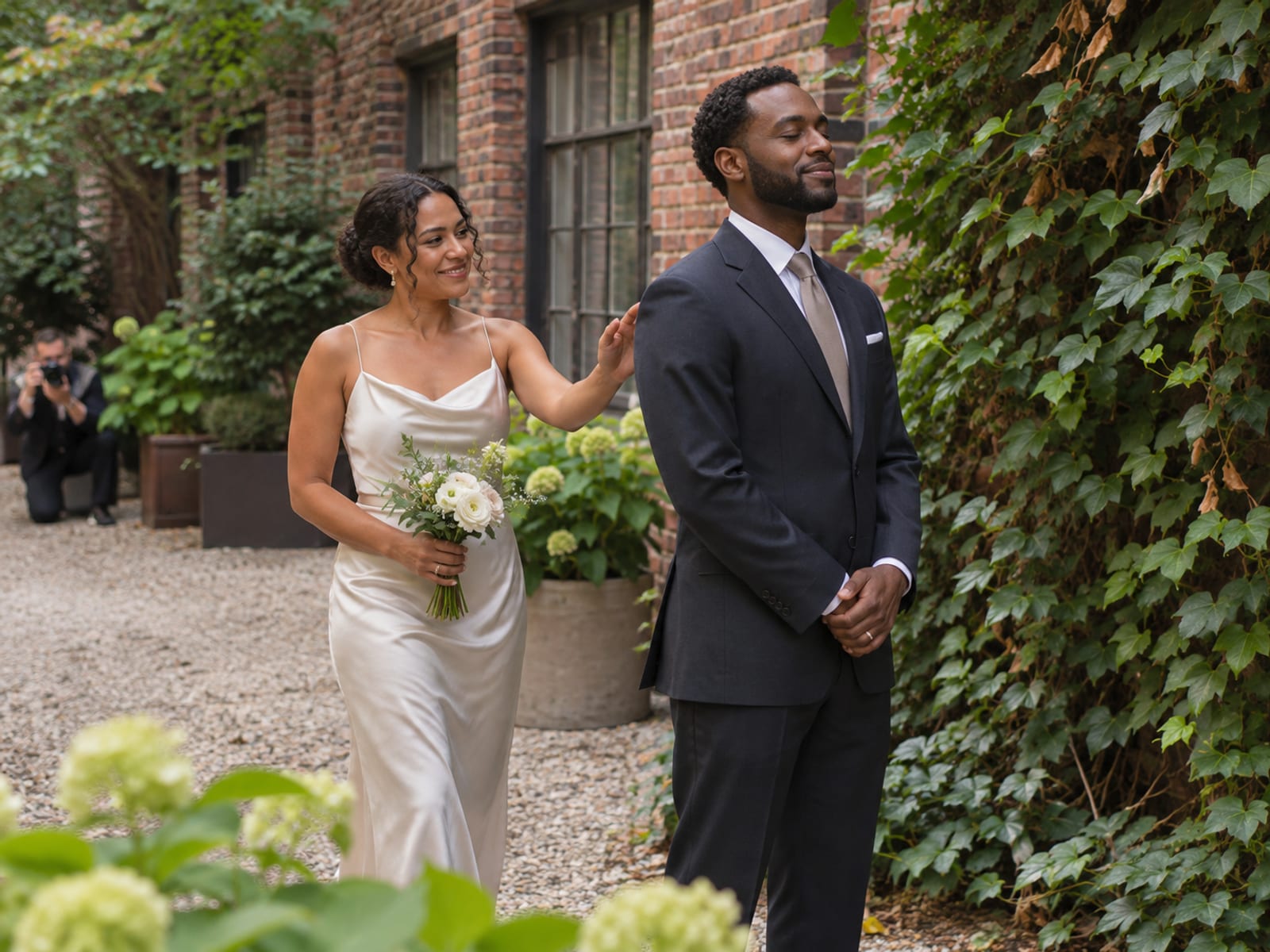
Without a first look, those portraits usually happen during cocktail hour. That works well, but it has a cost: you spend part of cocktail hour with the photographer instead of with your guests. If you skip the first look and want to join your guests for most of the hour, you can extend cocktail hour to 75 or 90 minutes, which is a common adjustment when substantial portraits happen after the ceremony.
The trade, in plain terms: A first look gives you a calmer stretch with your partner, more of cocktail hour with your guests, and a bit more breathing room for photos. No first look keeps the moment at the ceremony entrance a surprise for both of you, and costs you time at the party. Neither one is the better schedule; pick the one that suits you, then tell the photographer and the coordinator.
How much time does each part of the day need?
These durations come from The Knot's hair and makeup guidance, the 4 p.m. example, and The Bridal Link's run of show. They are planning examples, so adjust them to your own vendors and ceremony.
Tap or hover a row to highlight it.
| Part of the day | Time to plan |
|---|---|
| Part of the dayPrincipal hair and makeup | Time to plan2 to 3 hours |
| Part of the dayEach wedding-party member | Time to plan1 to 2 hours; 30 minutes to 1 hour for flower girls and junior attendants |
| Part of the dayWhole group of beauty services | Time to planOften 4 to 6 hours in total, depending on the number of people and artists |
| Part of the dayFirst look and couple portraits | Time to planAbout 30 minutes |
| Part of the dayWedding-party and family photos | Time to planAbout 30 to 45 minutes, before the ceremony or during cocktail hour |
| Part of the dayCeremony | Time to planAbout 30 minutes; religious and cultural ceremonies may need more, so use your officiant's plan |
| Part of the dayCocktail hour | Time to plan1 hour is common; 75 to 90 minutes if portraits follow the ceremony |
| Part of the dayThree-course dinner | Time to planAbout 75 minutes |
| Part of the dayToasts | Time to planAbout 20 minutes |
| Part of the dayFirst and parent dances | Time to planAbout 15 minutes |
| Part of the dayOpen dancing | Time to planMore than 2 hours |
Leave room to eat, use the restroom and sit down for a few minutes. Put those minutes in the schedule on purpose, because they disappear first when something runs late.
How much travel time should you add in NYC?
Use the MTA trip planner for each trip, with your real start address, your destination, and the date and hour you will travel. It shows step-by-step directions and lets you pick a departure or arrival time. One planner result for World Trade Center to 34 St-Herald Sq showed 68 minutes. That is one dated result, not a rule for Manhattan, so run your own.
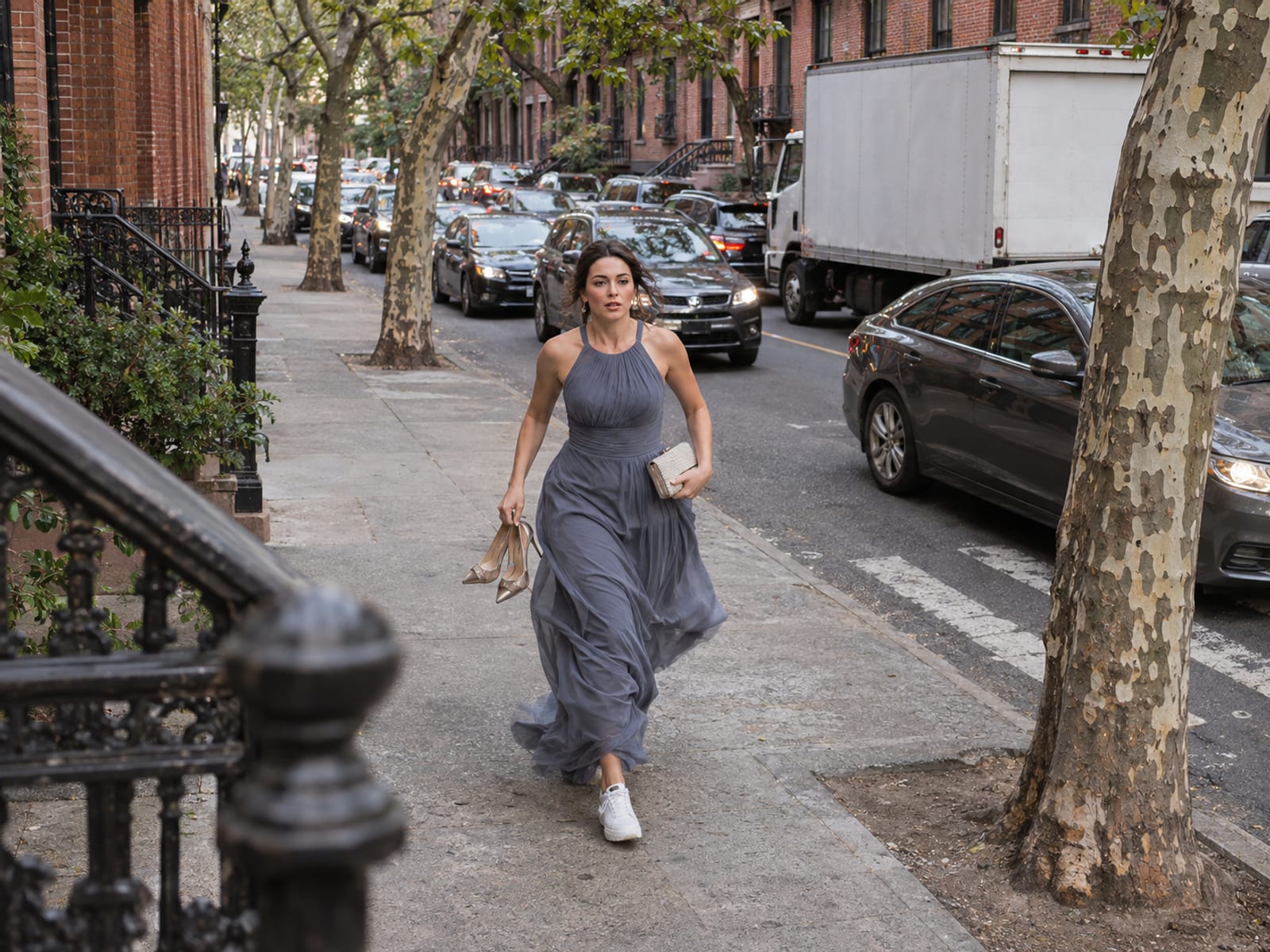
For a car trip, Google Maps can show traffic delays, closures, alternate routes and events such as parades, marathons and sporting events. Check it for your wedding date.
Then add what a route result leaves out:
- Walking from your room or hotel to the car or station.
- Carrying garments and equipment while you are dressed.
- Vehicle pickup and curb access, and rideshare arrival uncertainty.
- Loading and unloading, parking and elevator use.
- Station walking and service changes.
- Guest boarding and headcounts.
- Rain, construction, parades, sports and road closures.
A 15-minute drive does not take 15 minutes in your schedule. Write it as its own line with a start, an end and an owner. For guest shuttles, subways and parking, see getting wedding guests around New York City.
What if the ceremony and reception are in different places?
When the ceremony and reception are at different addresses, give the move between them its own block on the timeline. List who leaves first, how you and your wedding party travel, how guests get there, and where each vehicle stops.
Plan three things in particular:
- Guest transport, with a pickup spot, a departure time and a person counting heads.
- Vendor arrival, so the caterer, DJ and florist reach the second address before you and your guests do.
- Curb access, including where vehicles load and unload and which entrance has the elevator.
Some vendors may need to leave the ceremony early to set up at the reception, and that changes who is available for photos and cues. Put those departures on the contact sheet so nobody has to guess.
Do you need a day-of or month-of coordinator?
A day-of coordinator runs the schedule: vendor calls, setup, rehearsal, cues, family and the final payments. Month-of coordination usually starts earlier and adds meetings, vendor recommendations, contract review and transportation planning. In practice, "day-of" often begins weeks before the wedding. Published NYC packages start two weeks, five weeks, six weeks or two months out.
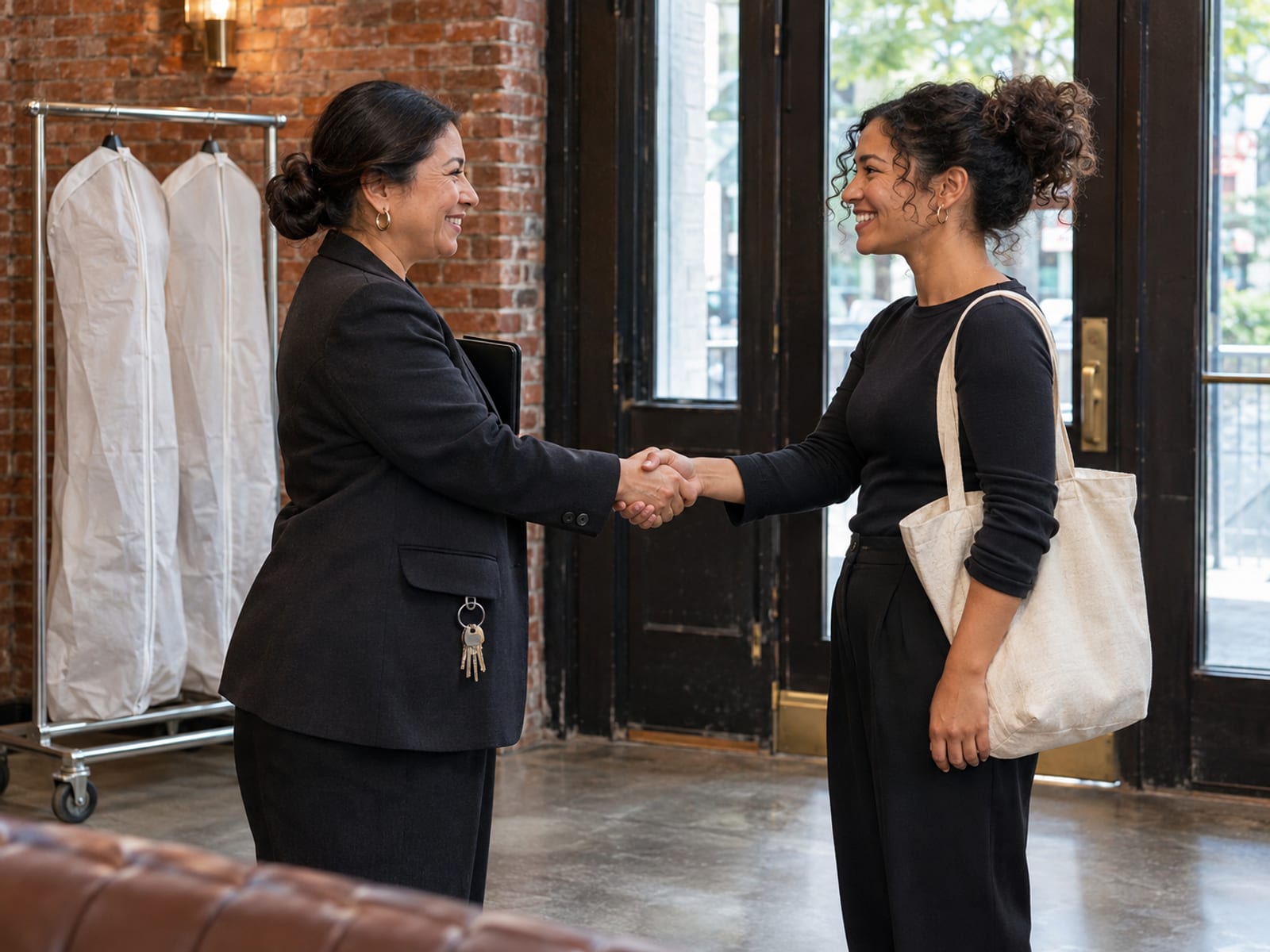
A venue coordinator may not be the same thing. Floraland describes its venue coordinator as responsible for the venue and its staff, and its independent coordinator as the person who handles the couple's timeline, vendors and family. Ask your venue which role it fills, and whether it also manages your vendors, personal items, transportation and family.
Coordination fits especially well if you have many vendors, separate locations, guest transportation, bilingual relatives, a complicated family or a venue with limited staff. If you would rather not make a relative or a friend the person who takes vendor calls and fixes problems, that is a good reason to hire one. For the larger question of full planning help, see do you need a wedding planner in New York City.
NYC coordinators publish the following. These are business-published examples, read in 2026, and not a market average.
Tap or hover a row to highlight it.
| Business | Published price | What the page lists |
|---|---|---|
| BusinessA. Taylor Events | Published priceDay-of from $1,200 | What the page listsThree planning sessions, timeline, seating help, walkthrough, vendor management, rehearsal, setup and breakdown, guest and wedding-party contact |
| BusinessGuō Collective | Published priceDay-of $1,500 | What the page listsTwo months of support, three meetings, full day-of management, vendor coordination, one coordinator and one assistant, light setup |
| BusinessFloraland | Published priceWinter and spring day-of $1,800 promotional, $2,400 regular; one-month $2,800 promotional, $3,800 regular; two-month $3,800 promotional, $4,800 regular | What the page listsDay-of begins two weeks before; month-of begins one or two months before and may include recommendations, contract review, meetings, transportation and guest movement |
| BusinessStephanie Gatton Events | Published priceShort-notice package $2,250; month-of from $3,500, most couples $3,500 to $4,500 | What the page listsMonth-of begins five weeks before; the short-notice package begins three weeks before and can be booked only six weeks out; travel outside NYC and additional assistants are excluded |
| BusinessOne 15 Events | Published priceDay-of $3,500 | What the page listsFour weeks of planning help, run of show, logistics, venue and decor coordination, vendor and family contact, setup and tear down, two planners for 12 hours |
| BusinessThirty4thStreet Productions | Published priceDay-of or month-of $5,450 | What the page listsSix weeks of help, calls, recommendations, checklist, venue walkthrough, timeline and floor-plan finalization, vendor coordination, rehearsal, up to eight hours |
| BusinessA Central Park Wedding | Published price$5,950 | What the page listsUp to 100 people, services begin two months before, rehearsal, contracts and vendor confirmations, timeline, up to 10 hours onsite, setup, cues, family photos, payments and packing |
Confirm current prices, taxes, assistants, overtime, travel fees and availability in writing. Ask the coordinator for a written scope and price, and ask what is left out.
What should you hand your coordinator?
Give your coordinator, or the friend or relative you name as your contact, a package they can use without calling you. A document folder or an accordion organizer keeps the paper in one place, and a power bank with the right cables keeps phones alive all day. Put these in the package:
- A contact sheet with each vendor's business name, role, main contact, phone, email, arrival and departure times, and responsibility. Include the venue contact, officiant, transportation lead, photographer, caterer, DJ or band, florist, rental company and beauty team.
- A run of show with the time and length of each moment, its location, who owns it, and who else is involved. The Bridal Link stresses durations, owners, deliberate overlaps and travel lines.
- A floor plan and the venue's access and hard-out times.
- A family and wedding-party photo list, with a named person who calls the groups.
- Vendor arrival times, meals, and the payment and tip envelopes.
- A transport plan, the ceremony cues, and the processional order.
- A plan for personal items, cards, gifts and attire, and who carries the rings.
- A rain plan with the trigger time and the backup location.
- An emergency decision-maker, and the date of the current version.
Name the person who holds your phone, too. Then send the final schedule to the vendors, the venue, your wedding party and your family contacts. If you have relatives or vendors who read Spanish, a Spanish copy of the schedule saves calls on the day. For the order in which to book vendors, see the NYC wedding planning timeline.
What does a City Clerk ceremony day look like?
A City Clerk ceremony runs on an appointment, so it is not a walk-in. NYC311 says you and your witness should arrive between 8:30 a.m. and 3:15 p.m., Monday through Friday. The ceremony costs $25, and you bring a valid New York State marriage license, at least one witness over 18, an acceptable form of payment and the same type of photo ID you used for the license. Attendance is limited to six people, including you, your partner and the witness. You receive the marriage certificate the same day.
How long you wait after you arrive is not fixed, so arrive well before the window closes. Do not tie a photographer, a car or a restaurant reservation to the minute the ceremony ends. For the full walk-through, see a City Hall wedding in NYC, step by step.
Quick check: your wedding day schedule
Answer every question to check.
Questions about NYC wedding day schedules
What time should hair and makeup start for a 4 p.m. ceremony?
One planner-backed example starts beauty services at 8:30 a.m. for five or six people who are getting both hair and makeup. Your own start time depends on the size of your group, the number of artists, your style and your travel time to the venue.
How long does wedding hair and makeup take?
The Knot suggests two to three hours for the principal person and one to two hours per member of the wedding party. Total group services often run four to six hours, so ask your artist for a schedule that names each person.
Should you do a first look?
It is your call. A first look moves couple, wedding-party and family photos ahead of the ceremony, while skipping it usually places them during cocktail hour. Decide how much of cocktail hour you want to spend with your guests, then choose.
How much does NYC wedding coordination cost?
The coordinators in the table above publish prices from $1,200 for a day-of package up to $5,950 for a package for up to 100 people, and the packages differ a lot in hours, assistants and start date. Ask for a written scope and price before you compare.
Does a venue coordinator replace an independent coordinator?
Not necessarily. Ask your venue whether its coordinator handles only the venue, or also your vendors, family, transportation and the full-day timeline.
What should you do next?
Write down your fixed points: ceremony time, venue access, hard end time, sunset, dinner and send-off. Build the hour-by-hour schedule from them with a travel buffer added to every move, then send the run of show and contact sheet to your coordinator or a named contact who is not getting married.
Terms in this guide
Tap a term to see what it means.
First look. An optional moment that can move couple, wedding-party and family photos before the ceremony.