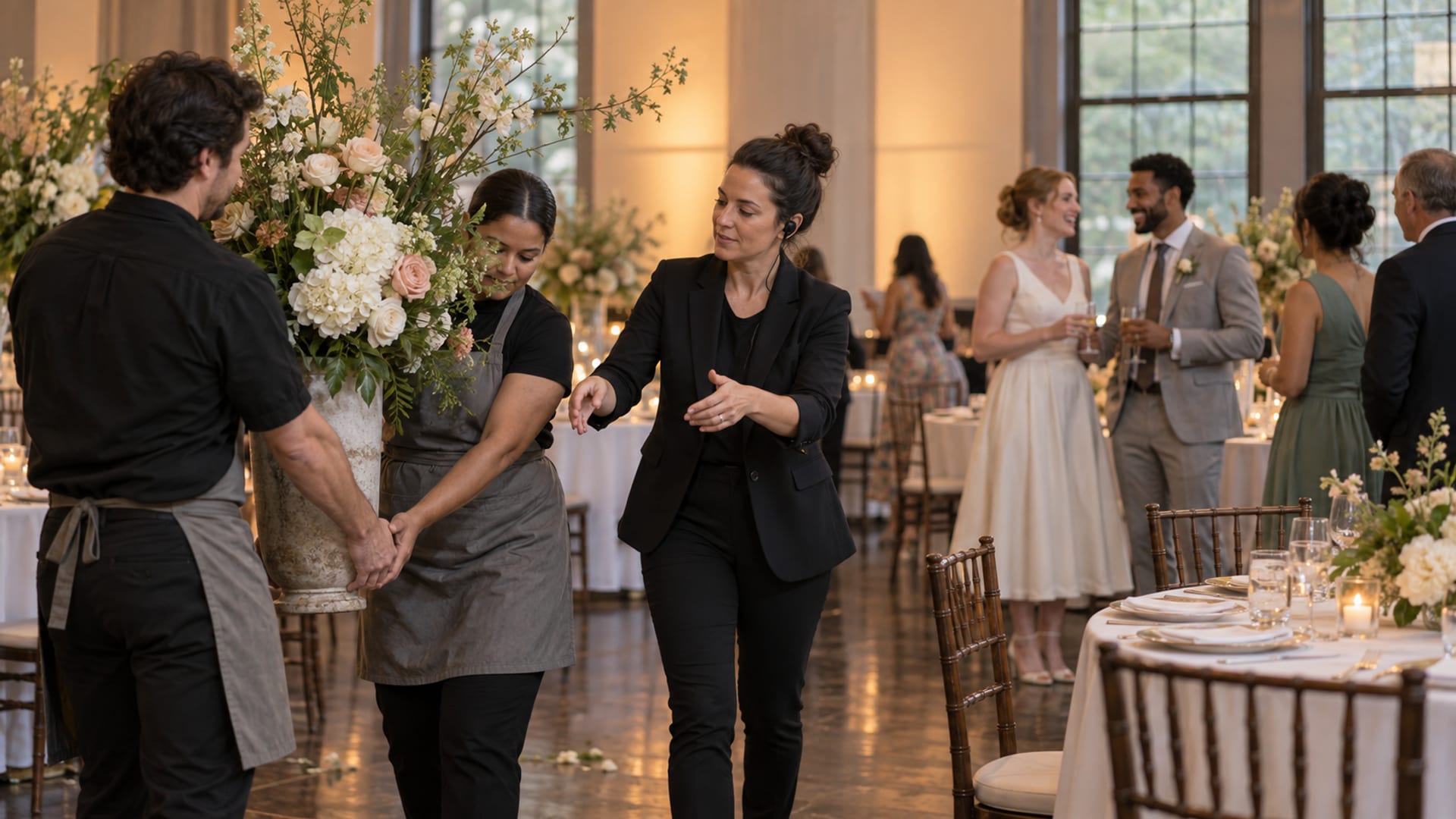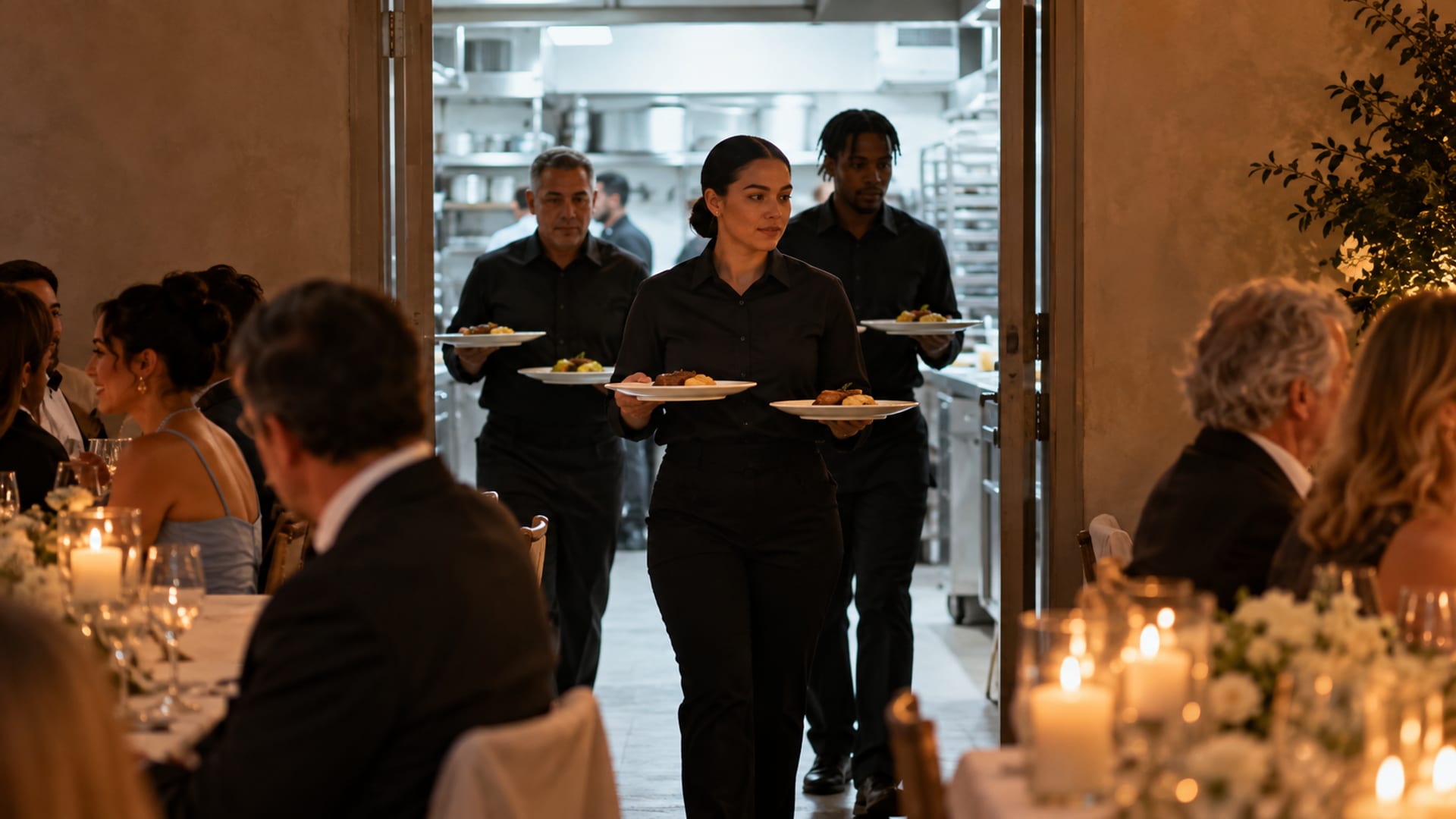
There is no single price for wedding catering in New York City. The most quoted benchmark is national: The Knot's 2025 Real Weddings Study put average catering at $80 per person across the weddings it surveyed. Published NYC-area prices, read in September 2026, run from restaurant catering packages in the $30s per person at Omar's to venue wedding packages at $135 to $175 per person at the New York Botanical Garden and The Skillman in Sunnyside. Those numbers cover very different things. To compare any two, ask each caterer for an itemized quote, add everything up and divide by your guest count. Before that, check whether your venue requires its own caterer or an approved list.
Key takeaways
Tap a card to bring it forward.
- The Knot's $80 per person is a 2025 national figure; NYC quotes can land well below or well above it.
- "Per person" can mean food only, or food plus bar, staff, rentals and the room. Ask which.
- Service charges, gratuity and New York sales tax usually sit on top of the headline price.
- Many venues control the caterer or the bar, so read the venue's policy before you sign with anyone.
- A caterer serving alcohol off its own premises needs a State Liquor Authority permit filed at least 15 business days ahead.
- Work every quote down to one all-in number per guest before you compare.
What does wedding catering cost per guest in NYC?
The Knot's $80 per person is an average across weddings nationwide, not a New York City rate. Zola, in an article updated February 19, 2026, reported a national average catering cost of $6,927 and a Manhattan figure of $13,100 for 150 guests. Zola's numbers come from its own cost index, so treat them as a rough reference point rather than a quote.
What you will actually pay depends on your borough, venue, date, guest count and service style. The useful calculation is simple once every line is on paper:
`food + drinks + staff + rentals + service charge + gratuity + tax + required extras, divided by guests`
That result, the all-in cost per guest, is the number to budget around and compare. For the wider wedding budget, the guide to what a wedding in NYC costs by borough puts catering alongside everything else.
What "per person" includes, and what gets added
A per-person price can be almost anything. A restaurant's package might mean the food, setup and utensils. A venue package might mean cocktail hour, dinner, an open bar, servers, tables, chairs, linens and the room itself. The Knot suggests checking the cost of each entrée, appetizer, dessert and drink, plus rentals, labor, travel, setup, breakdown, cake cutting and tax.

Lines that often come as extras include:
- Rentals: plates, glassware, flatware, tables, chairs, linens and napkins, and upgrades to any of them.
- Staff: servers, bartenders, chefs, a captain or event manager, and cleanup crew, plus extra service hours.
- Setup, breakdown, travel and kitchen use.
- Cake cutting, coffee and tea, late-night food and meals for your vendors.
- Venue charges such as an outside-caterer fee, corkage, security or insurance.
- The service charge, the gratuity and sales tax.
Two of those need a closer look. A service charge is not automatically the tip. Ask the caterer or venue to say in writing what the service charge pays for and whether gratuity is included, optional or added separately. Tax is the other. New York State's Tax Bulletin ST-110 says a caterer's charges related to an event are generally taxable, including food, alcoholic and nonalcoholic drinks and services, and that expenses built into the event charge stay taxable even when listed separately. When a hotel, or a caterer hired by the hotel, sells the catering, the room charge is part of the taxable total; when you rent a room and hire a separate caterer, that bulletin treats the room rental differently. The rate depends on where the event takes place, so look for sales tax as its own line on the caterer's invoice and ask what it is applied to.
Service styles and how each changes the cost
The way food reaches your guests changes the labor, the amount of food, the equipment and the space you need. Venues such as City View publish buffet, plated, family-style, station and custom bar options, so you will often be choosing among these:
- Plated. Each guest gets a served course. Portions are precise, but it takes more servers and tighter kitchen timing.
- Buffet. Guests serve themselves. You may need fewer servers, but usually more food, buffet equipment, staff to refill it and room for the lines.
- Family style. Shared platters go to each table. It needs table space for the platters and enough staff to keep them moving.
- Stations. Chefs or attendants serve at themed stations. Guests move around, and each station adds equipment and often an attendant.
- Cocktail reception. Passed and stationary hors d'oeuvres instead of a seated meal. It can suit a shorter or smaller reception.
- Drop-off. Food arrives ready to serve, with little or no staff. It suits restaurants and simple setups, and it leaves serving, clearing and cleanup to someone else.
A buffet is not always cheaper than a plated dinner. The only fair test is two complete proposals for the same menu scope, staffing, rentals, bar and tax treatment.
Published NYC-area prices, by type
These examples come from each business's own published page, read September 28, 2026. They belong to that one caterer or venue, they change, and they are three different products, so confirm the current price and inclusions before you plan around any of them.
Restaurant catering. Omar's lists build-your-own packages at $29.95 and $32.95 per person with proteins, sides, rice, sauces, pita and utensils, and feast packages from $34.95 (chicken) to $45.95 (lamb), with setup included. There is no staff, bar or rentals in that price.
Event catering. Golden Plate Events lists buffet dinner collections at $58 to $75 per person and plated options from $95 for three courses and $125 for four courses up to $175 for its chef's-table option. Its published three-hour bar examples are separate: $35 per person for a classic bar, $50 for premium and $65 for a craft cocktail bar. The Hudson lists a $55 dinner package with three entrées and one side and an $80 formal package with passed hors d'oeuvres, three entrées and two sides, each plus tax and a 20% service fee.
Venue wedding packages. The Skillman in Sunnyside, Queens, lists $145 per person for three hours of passed hors d'oeuvres, boards, a four-hour open bar, tea, coffee and dessert, and $175 per person for either a buffet dinner with an hour of passed hors d'oeuvres or a three-course plated meal, each with a four-hour open bar. Tax and a 20% gratuity are extra. The NYBG kosher wedding package lists $135 per person for five hours of service, staff, kosher caterer kitchen use, equipment, tables, chairs, linens, napkins, glassware and a dance floor, with sales tax not included and facility and ceremony fees listed separately.
Can your venue require a caterer?
Often, yes, and this is the first thing to settle, because it decides who you can even ask for a quote. Venues tend to fall into three groups: an in-house caterer only, a list of approved caterers, or outside caterers allowed with conditions.
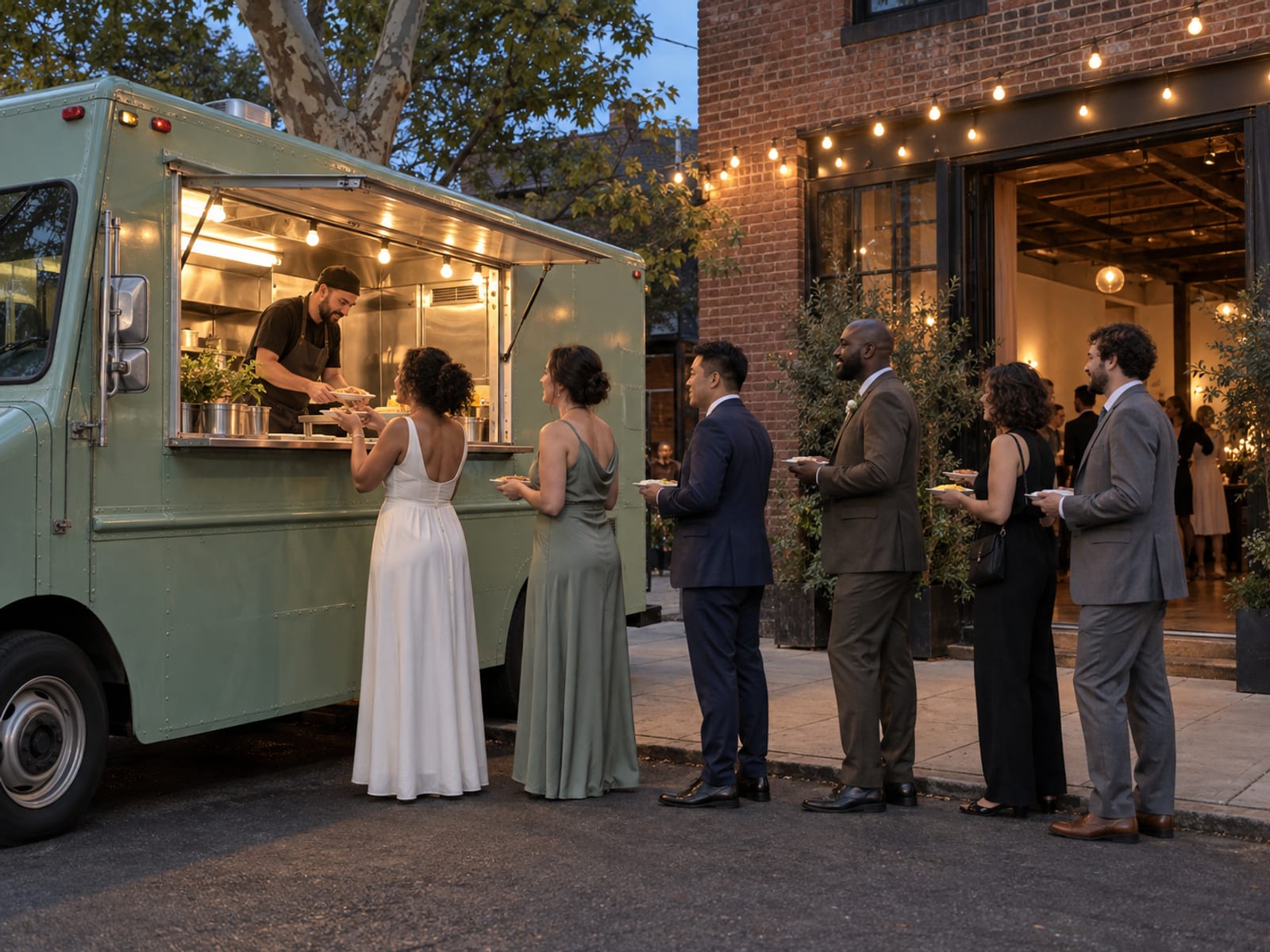
At the Picnic House in Prospect Park, the Prospect Park Alliance vendor list says only the listed catering companies may work there, with general and kosher caterers on the list. Ask the venue whether the current list is still the one in force. 501 Union in Gowanus, Brooklyn, allows outside caterers, including restaurants, food trucks and drop-off services, as long as the caterer supplies a certificate of insurance naming the venue's specified entity as additionally insured. It suggests a preferred list but does not require it. Its drinks are another matter: all beverage service there runs through its in-house bar program. The NYBG kosher package also names the kosher caterers you choose from, a rule tied to that package rather than to every event at the garden.
So, treat food and drink as two separate questions. Before signing the venue contract, ask:
- Is outside catering allowed, and is there an approved list? Can a new caterer be approved?
- Is there an outside-caterer fee, and what insurance certificate does the venue need?
- Is there a kitchen, and who supplies tables, chairs, kitchen equipment and trash removal?
- Can an outside bar serve, and who gets the alcohol permit?
- Are there load-in, elevator or parking limits, or required kosher supervision?
Raw and loft spaces raise most of these at once, since the caterer and the rentals become separate costs. The guide to loft and raw space weddings in New York City covers that setup.
How bar service works, and who holds the permit
Bar options range from beer and wine only to a full open bar, a premium or top-shelf bar, a signature cocktail or craft cocktail bar, a consumption bar billed on what is poured, a limited-time bar, a cash bar and nonalcoholic service. Zola's national guidance says beer and wine adds $12 to $18 per person and a full premium bar adds $25 to $35 per person. NYC packages can differ a lot from that, as Golden Plate's $35 to $65 three-hour examples show. When you compare bar quotes, check whether each is priced per guest, per drink, per hour or by consumption, and whether guests who are not drinking, including children, are charged the same.
Alcohol served away from a licensed bar or restaurant needs a permit from the New York State Liquor Authority. As of September 28, 2026, the SLA lists:
| Permit | Who applies | When to file | Fee |
|---|---|---|---|
| Catering Permit | An active on-premises retail licensee, for a specific private event away from its premises; food must be provided | At least 15 business days before the event | $48 per point of sale per day |
| One-Day Alcohol Event Permit | Allows sale or service of beer, wine, cider and liquor for 24 hours, subject to location limits | At least 15 business days before the event | $36 per point of sale per day |
Ask your caterer or venue which path applies, who files it and who supplies the alcohol: the venue, the caterer, a licensed retailer or the two of you. Check the SLA's current timing and fees before your date.
Quick check: catering quotes and bar permits
Answer every question to check.
Kosher, halal, vegetarian, allergy and cultural menus
Silverline publishes glatt kosher meat, dairy and pareve menus and says it coordinates hashgacha (kosher supervision) requirements with the venue or community. Baba Döner says its catering is 100% halal, with doner, kebab platters, falafel, salads, rice and mezze for vegetarian guests. Omar's publishes Mediterranean and Middle Eastern packages with chicken, lamb, falafel, hummus, tabouli, eggplant and yogurt-based dishes, and Golden Plate publishes a Latin station and a Latin buffet collection and says it accommodates dietary restrictions.
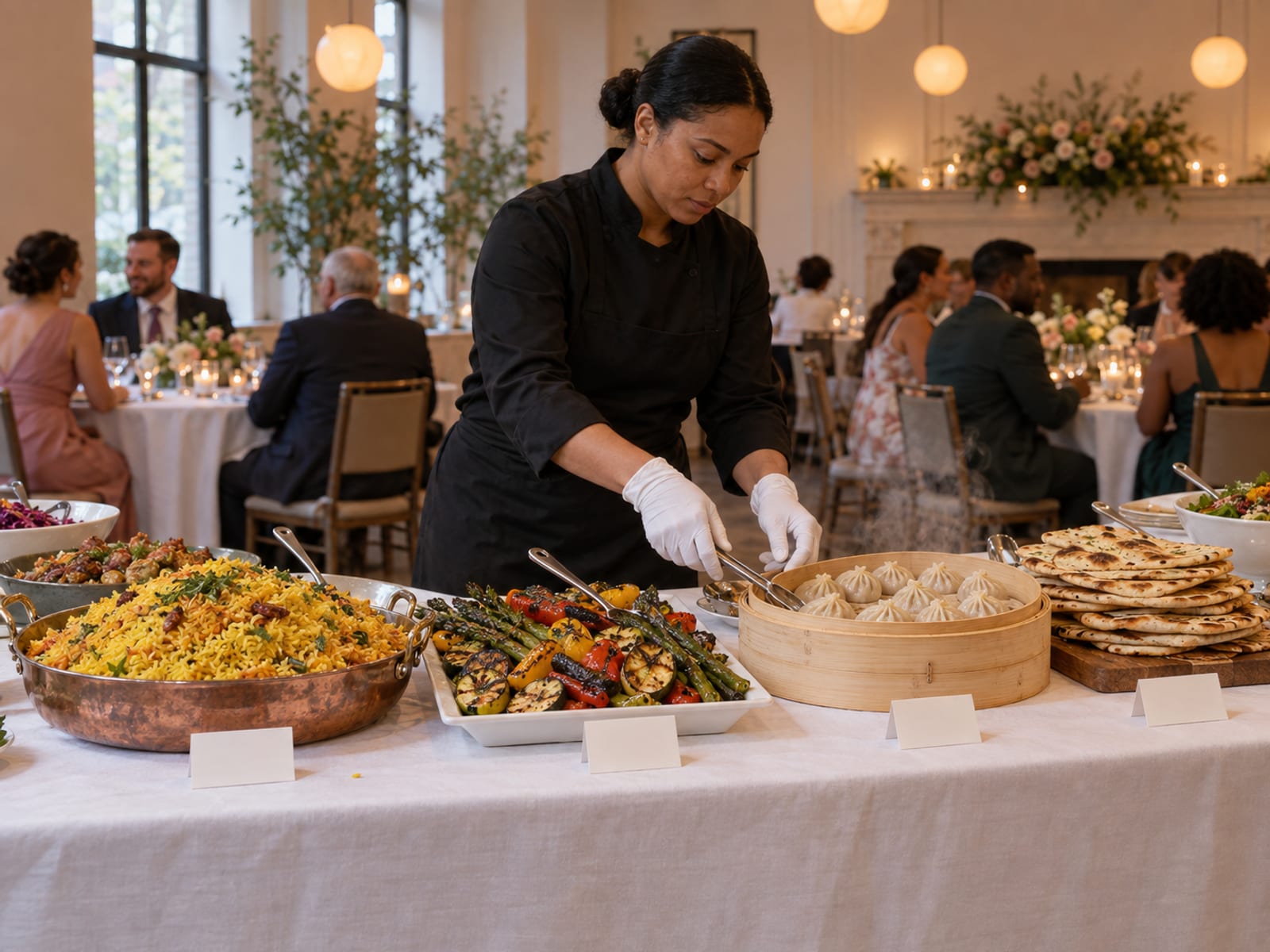
Before relying on a menu description, confirm these with the caterer, and with the venue where it has its own rules:
- Is the whole menu certified, or only some dishes? Who provides the kosher supervision or halal certification?
- Are meat, dairy and pareve prepared separately? Who certifies the halal meat?
- Is there separate preparation for vegetarian or vegan meals, and how is gluten cross-contact handled?
- Can the caterer cook a family recipe or add dishes from your tradition?
- Are dietary meals part of the package or priced as upgrades?
A simple guest dietary tracker, paper or spreadsheet, with fields for allergies, kosher, halal, vegetarian, vegan, gluten-free, children's meals and vendor meals makes the final count much easier to hand over.
When to book and hold a tasting
Book in this order, because each step depends on the one before it:
- Confirm the venue's policy: in-house only, an approved list or outside caterers allowed.
- Settle the date, the venue address, a guest estimate and the service style you want.
- Ask two or three caterers for itemized proposals built on the same details.
- Confirm insurance, kitchen access, rentals, staffing and who handles the bar and its permit.
- Hold a tasting where it is offered, and ask whether it is free, charged or credited toward the contract.
- Sign the contract and pay the deposit.
- Finalize the menu, dietary notes, bar and rentals.
- Send the final guest count by the deadline in your contract.
Lead times are each caterer's own advice. Golden Plate's published FAQ suggests 4 to 8 weeks for large events and earlier for May through October, and a wedding usually needs more room than that. Start earlier if you want a peak Saturday, your venue works from an approved list, your menu needs kosher or halal coordination, or you are in a raw space that needs rentals and load-in planning. A notebook or menu comparison pad with room for flavor, portions, presentation and dietary notes keeps tastings straight when you see more than one.
How to compare two quotes
Put both proposals into the same rows and fill in every line; any blank cell is a question to ask.

| Line | Quote A | Quote B |
|---|---|---|
| Food: cocktail hour, main meal, dessert | ||
| Bar: type, hours, pricing method | ||
| Staff: servers, bartenders, chefs, captain | ||
| Rentals: tables, chairs, linens, china, glassware | ||
| Setup, breakdown and cleanup | ||
| Travel or delivery | ||
| Cake cutting and vendor meals | ||
| Venue charges: kitchen, outside caterer, corkage | ||
| Service charge (and what it covers) | ||
| Gratuity (included, optional or separate) | ||
| Sales tax (and what it applies to) | ||
| Minimum guest count or minimum spend | ||
| Deposit, final count deadline, cancellation terms | ||
| Total | ||
| Total divided by guests |
Minimums matter more for small weddings. If a caterer or venue has a minimum spend, cutting guests may not bring the total down in step, so your cost per guest can rise. The guide to small and micro wedding venues in New York City goes further into scale and minimums.
Questions couples ask about NYC wedding catering
A few points that come up once the first quotes arrive.
Is The Knot's $80 per person a good budget for NYC?
It is a national average from The Knot's 2025 study, so use it as a broad marker only. Published NYC-area examples run from the $30s for restaurant catering to $175 per person for venue packages, and each covers different things. Current quotes for your borough, date and guest count are the only reliable figure.
Does the caterer's price include tables, chairs and plates?
Sometimes. Venue packages such as NYBG's kosher package list tables, chairs, linens and glassware, while restaurant packages usually do not. Ask for rentals as a separate line so you can see them.
Can we bring our own alcohol?
That depends on the venue and on who holds the permit. Some venues, such as 501 Union, run all drinks through their own bar even when outside food is allowed. Ask the venue first, then ask who files with the State Liquor Authority.
What happens if our guest count changes?
Check the contract for the final count deadline, any minimum guest count or minimum spend, and the cancellation and postponement terms. Ask whether you pay for the guaranteed number or the final number.
Next step: find caterers and build your quotes
With your venue's policy settled and a guest estimate in hand, you are ready to ask for proposals. The caterers category of the directory lists NYC and nearby caterers to start your short list; send each one the same date, address, guest count and service style so the quotes come back comparable. For the rest of the budget, see what a wedding in NYC costs by borough, and if you are working with an empty loft or warehouse, the raw space guide covers rentals and logistics.
Terms in this guide
Tap a term to see what it means.
All-in cost per guest. Food, drinks, staff, rentals, service charge, gratuity, tax and required extras, divided by your guest count. It is the number to compare.