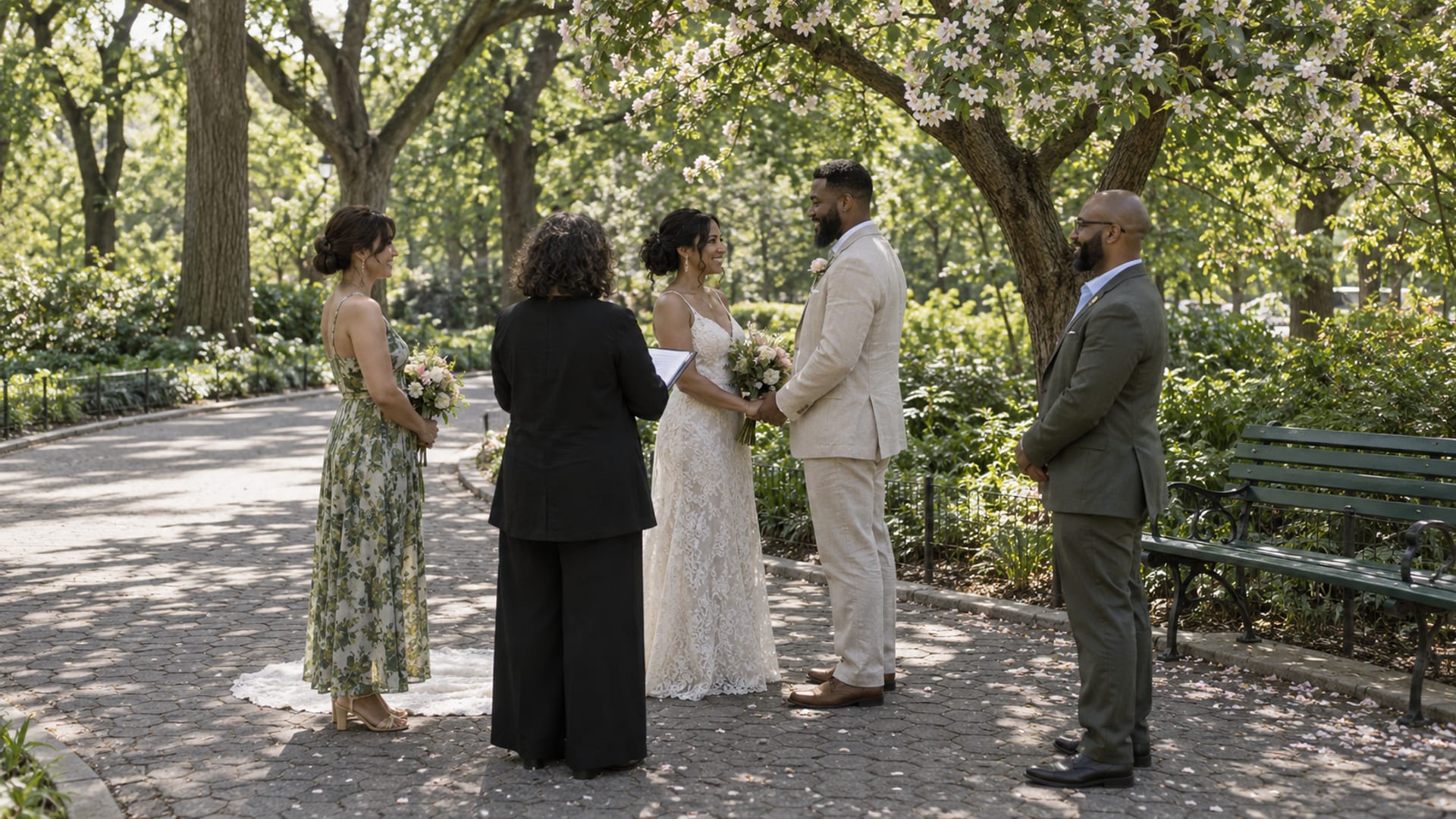
Wedding insurance usually means two separate products. Event liability cover may protect you against covered bodily injury or property damage that you are legally responsible for. Cancellation or postponement cover may reimburse covered non-refundable costs when an unforeseen covered event forces you to cancel or move the date.
If your venue asked for a certificate of insurance, it wants proof of a liability policy, often with the venue named as an additional insured. That request is a normal part of booking a space, and it is easy to complete once you know what to send.
Requirements differ by venue and by permit, so the first step is to get the venue's requirements in writing. The sections below cover what to ask for, which cover answers which question, who else may need paperwork, and how to send proof on time.
Key takeaways
Tap a card to bring it forward.
- Liability cover and cancellation cover are different products that answer different questions.
- A venue's insurance requirement comes from its contract or permit, not from a single NYC rule, so ask for it in writing.
- A certificate of insurance is proof of coverage; the policy and its endorsements control what is actually covered.
- Liability cover can usually be bought within days of the event, but cancellation cover needs at least 14 days, and your venue's deadline may be earlier than both.
- Ask each vendor whether it has its own policy and certificate, and check the insurer through NYS DFS before you pay.
What to ask your venue for first
Before you price a single policy, ask the venue or permit office to send its insurance requirements in writing. A short email gets you the answers that decide what you buy.
Ask for these items:
- The required liability limits, per occurrence and in total (the aggregate).
- The exact name the venue wants listed as an additional insured.
- The certificate holder name and mailing address.
- Any special wording, such as primary and non-contributory wording or a waiver of subrogation.
- Whether alcohol triggers an extra requirement.
- The event dates the policy must cover, including setup and any rehearsal.
- The deadline for receiving the certificate.
Keep the reply. If a certificate is rejected later, you will want the original wording in hand.
Event liability and cancellation cover: what each does and does not do
Event liability cover is about claims. WedSafe describes it as covering bodily injury, property damage and personal injury for which you are legally liable, and Markel lists host liquor liability as an available option. This is the cover venues usually ask to see.

Cancellation or postponement cover is about money. Travelers says its plan may cover non-recoverable deposits, vendor failures, attire, gifts, photographs, illness, military deployment, severe weather and certain honeymoon expenses. Markel lists deposits, attire, gifts, photographs and no-show vendors. You buy it by choice, not because a venue asks.
Every policy has exclusions, so read them before you pay. The ones that come up most often:
- A change of heart is excluded by both Travelers and WedSafe.
- Minor weather, such as ordinary rain, is not automatically covered. Travelers applies a 15-day exclusion after the policy starts for extreme weather.
- Travelers states that COVID-related cancellation is excluded.
- Problems you already know about are generally outside cover, because the event must be unforeseen.
- Commercial liquor liability is excluded when the insured is in the business of selling or serving alcohol.
Cancellation cover does not replace your venue contract's own deposit and cancellation terms, which are covered in our guide to wedding contracts. Exact terms, deductibles and state availability depend on the policy you are quoted.
What a certificate of insurance and an additional insured mean
A certificate of insurance, often shortened to COI, is a one-page summary of a policy. It shows the named insured (that is you), the insurer, the policy dates, the limits and the certificate holder. It does not change the policy.
The certificate holder is the party the certificate is sent to. An additional insured is a different thing: another person or organization, such as your venue, that receives specified protection under the policy or an endorsement. A venue can be a certificate holder without being an additional insured, so ask which role it wants, or both. Riskado explains what being an additional insured means and what to check on the endorsement.
An endorsement is a written addition to the policy. Some venues want one attached to the certificate. Because the certificate is only proof, the policy wording and any endorsement are what control coverage, and you can ask the insurer for them.
Markel states that a venue can be named as an additional insured at no extra cost. Travelers notes that vendors such as DJs, bands, caterers and photographers cannot be added as additional insureds on its plan.
How much liability cover NYC venues and public properties have asked for
There is no single NYC limit for weddings. These are dated examples of what some places have asked for, all checked November 5, 2026, so use them to see the range and then ask your own venue.

- NYCEDC lists $1 million per occurrence and $2 million aggregate for Brooklyn Army Terminal events, with the City of New York and NYCEDC as additional insureds. It asks for at least four weeks' notice for an event permit.
- DCAS asks for $2 million and a $4 million aggregate for its event spaces, with specified additional insured wording for the City of New York.
- The NYC event permitting guide (2021) sets a $1 million per-occurrence minimum for certain required permits and allows a higher limit depending on the activity.
- NYC Parks lists $2 million per occurrence for its large-event program. That is not the requirement for every ordinary wedding ceremony in every park, so confirm the current figure with NYC Parks or your permit office.
- Loft39 asks vendors for $1 million per occurrence and $2 million aggregate, and Dobbin St asks for $1 million per occurrence and $1 million aggregate, including property damage.
For park ceremony permit rules, see our park permit guide.
Which vendors may need their own certificates
Some venues ask you to cover your vendors under your policy. Others ask every vendor to send a certificate of its own. Loft39 requires every vendor to provide a COI naming Loft39 LLC as an additional insured, at $1 million per occurrence and $2 million aggregate. Dobbin St asks for a certificate covering you and your vendors and says a caterer may be able to add other vendors as additional insureds.
The vendors most often affected are caterers, bartenders, rental companies, photographers, videographers, planners, DJs and bands, florists, and hair and makeup artists. Security, transportation and special-effects providers can be asked too.
Your venue contract controls here, so ask for a vendor-by-vendor list rather than assuming your event policy covers every contractor. The venue's rules on who can work there are covered in our outside vendor guide.
Alcohol: host liquor liability and commercial liquor liability
Host liquor liability is aimed at a non-commercial host, such as a couple. WedSafe describes it as protection against bodily injury or property damage claims from people hurt because of an intoxicated guest who was served alcohol at your event. Travelers recommends considering its liquor liability option when alcohol is served.

Commercial liquor liability is different. A policy may exclude it when the insured is in the business of manufacturing, selling, distributing or furnishing alcohol, so a caterer, bartender or venue is checked separately from you.
Ask three questions: who is buying the alcohol, who is serving it, and who is selling it. The answers tell you whether you need host liquor liability or whether the venue and caterer cover the bar under their own policies. NYCEDC notes that alcohol and catering can add insurance requirements at its venue. Riskado defines liquor liability insurance in plain terms. Licensing and bar rules are in our bar and alcohol guide.
When to buy, and how quickly the documents arrive
Insurers allow more time than most venues do, so work backward from your venue's deadline.
- Liability: Markel says at least one day before the event. WedSafe says up to 24 hours before.
- Cancellation: Markel and WedSafe both say at least 14 days before. Buy it before you pay deposits if you can.
- Travelers says you can buy from two years to 24 hours before the wedding.
- Venues: Loft39 wants liability proof no later than seven days before the event. Another venue's contract may say 30 days or something else.
Documents can come quickly. WedSafe says you can buy online in minutes and have the certificate emailed or mailed straight to the venue, and Travelers emails the policy documents after purchase. Still, buy early enough to fix a mistake, since a rejected certificate sent the week of the wedding leaves little room.
What to gather, how to send the certificate and how to check the insurer
Have these ready before you ask for a quote:

- Both your legal names and your mailing address.
- The wedding date, plus any rehearsal dinner, setup and breakdown dates.
- The address of the ceremony, reception and rehearsal locations.
- Your guest count.
- Whether alcohol will be served, and by whom.
- The limits and exact wording the venue asked for.
- A list of your vendors.
Rehearsal dinners and setup are not always included. WedSafe describes a rehearsal dinner window of 48 hours around the wedding and a setup and breakdown window of 24 hours, so list every activity and confirm each one.
To send the certificate, give the insurer the venue's certificate holder name and address and ask it to email the certificate to the venue, or forward it yourself. Then confirm in writing that the venue received it and ask whether an endorsement is also required. If it is rejected, ask the insurer for a corrected certificate and whether there is a charge.
Keep your contract, receipts, policy, endorsements and the certificate you sent in one place. A document folder or a scanning app on your phone, with a backup in secure cloud storage, covers most of it.
Finally, check who is selling the policy. NYS DFS advises confirming that the insurer, agent or broker is licensed in New York, using its Insurance Company Search for insurers and its Licensee Search for agents and brokers. It also advises answering quote questions accurately, comparing more than the premium, and reading the policy for deductibles and exclusions. A company in the directory does not necessarily write every type of cover, so confirm the product is available for your event and state.
Quick check: wedding insurance
Answer every question to check.
Questions couples ask about wedding insurance
These are the questions that come up most once a venue mentions a certificate.
Do I need wedding insurance in NYC?
Only if your venue, permit, property owner or contract requires it, though you can buy it voluntarily. Ask for the requirement in writing, and ask whether existing coverage such as a homeowners or renters policy is accepted, since you should not assume it is.
What does it cost?
Prices depend on your limits, state and event details. Published starting prices include Markel liability from $75 and cancellation from $130, and Travelers liability from $165 in most states, but none of these is an NYC quote. Request a quote using your actual venue, dates, limits and alcohol plans.
Can I be covered if I pay my deposits first?
Ask before you buy. Cancellation cover is easiest to arrange before deposits are paid, and Markel and WedSafe both require it at least 14 days before the event. Keep every contract and receipt so a claim is straightforward.
Does the venue's insurance cover my vendors?
Not necessarily. Venue requirements may call for you and each vendor to show separate proof, so ask each vendor whether it has its own liability policy and certificate.
Your next step
Email your venue or permit office today and ask for its insurance requirements in writing: the limits, the additional insured name, the certificate holder address, any special wording, the alcohol requirement, the dates and the deadline. Once you have that reply, you can request a quote that matches it, buy early, and send the certificate with time to spare.
Terms in this guide
Tap a term to see what it means.
Certificate of insurance (COI). A one-page summary of a policy that shows the named insured, the insurer, the policy dates, the limits and the certificate holder. It does not change the policy.