NYC wedding venue hours are not standardized. Each venue's contract sets them, and two quotes that both say "eight hours" can leave the two of you with very different amounts of time with your guests. One venue may sell five guest-facing event hours with setup and cleanup on top, while another sells an all-day access block that covers everything.
Your contract should state the access start, the guest event time, the music and bar end times, the vendor departure time, the overtime rate and who may approve an extension. If any of those is missing, ask for it in writing before you sign.
Published examples show how wide the range is. Loft39 books eight hours, four of them event hours and four for setup and breakdown. The Elliott Room in Brooklyn Heights sells a 14-hour exclusive-access block. The Foundry in Long Island City sets a 12:30 a.m. guest and music curfew, with vendors allowed until 2 a.m.
Key takeaways
Tap a card to bring it forward.
- Ask what the hours include: guest time, setup, room flip, cleanup and vendor departure can all sit inside one number.
- Get four end times in writing: guests, music, bar and vendors. They are often different.
- Venue overtime and vendor overtime are billed separately, so one extra hour can mean several charges.
- An NYPD sound permit costs $45 and must be filed five days ahead, but it does not override the Noise Code or your venue's rules.
- Plan the last hour backward from the contract end time, with one person authorized to approve overtime.
How many hours do you really have?
A single number in a quote can mean four different things, so start by finding out which model your venue uses. The examples below are what each venue publishes as of November 5, 2026. Venue pages and rates change, so confirm the current version with the venue.
Tap or hover a row to highlight it.
| Access model | Venue | What it publishes |
|---|---|---|
| Access modelFive-hour event | VenueVenue 92 | What it publishesFive event hours, with two hours of vendor setup and one hour of breakdown; ceremony clients may have access three hours before |
| Access modelEight-hour combined | VenueLoft39, Manhattan | What it publishesEight total hours: four event hours plus four setup and breakdown hours |
| Access modelEight-hour combined | VenueChizzy Event Venue, Jamaica, Queens | What it publishesEight-hour rental that includes setup and breakdown |
| Access model12-hour rental | VenueThe Foundry, Long Island City | What it publishes12 rental hours covering setup, event and breakdown |
| Access model14-hour exclusive access | VenueThe Elliott Room, Brooklyn Heights | What it publishes14 hours of exclusive access for setup, event and breakdown |
The headline number is not your party length. At Loft39, an eight-hour booking gives you four event hours. At a 14-hour block, the same math applies: subtract setup, the room flip and breakdown before you decide how long dinner and dancing can run.
What counts as venue time?
Venue time is the clock your contract runs on, and it may start well before your first guest arrives. Ask your venue to define each of these terms in the contract: event time, total access, setup, room flip, cleanup and vendor departure.
Event time is usually the part your guests see. Total access is the whole block, including florists, rentals, the DJ's load-in and the caterer's setup. Loft39's FAQ says the contract controls the setup and breakdown hours, and that vendor setup, event time and final cleanup all have to fit inside them (Loft39 FAQ).
If your ceremony and reception share the room, the room flip eats into the same clock. Ask how long the venue needs to turn the space and whether that time comes out of your event hours or your setup hours.
Early delivery and storage can carry separate terms. Loft39 coordinates early deliveries one week in advance, subject to the event schedule, storage space and staff. Atmosfera lists overnight storage at $150 per night. The Foundry says day-before setup is not free. Ask for the earliest vendor arrival, the delivery appointment, the storage location, the pickup deadline and the exact charge.
How late can a wedding run?
The answer is four separate times, not one: when guests must leave, when the music stops, when the bar closes and when vendors must be out. Ask for each of them by name.
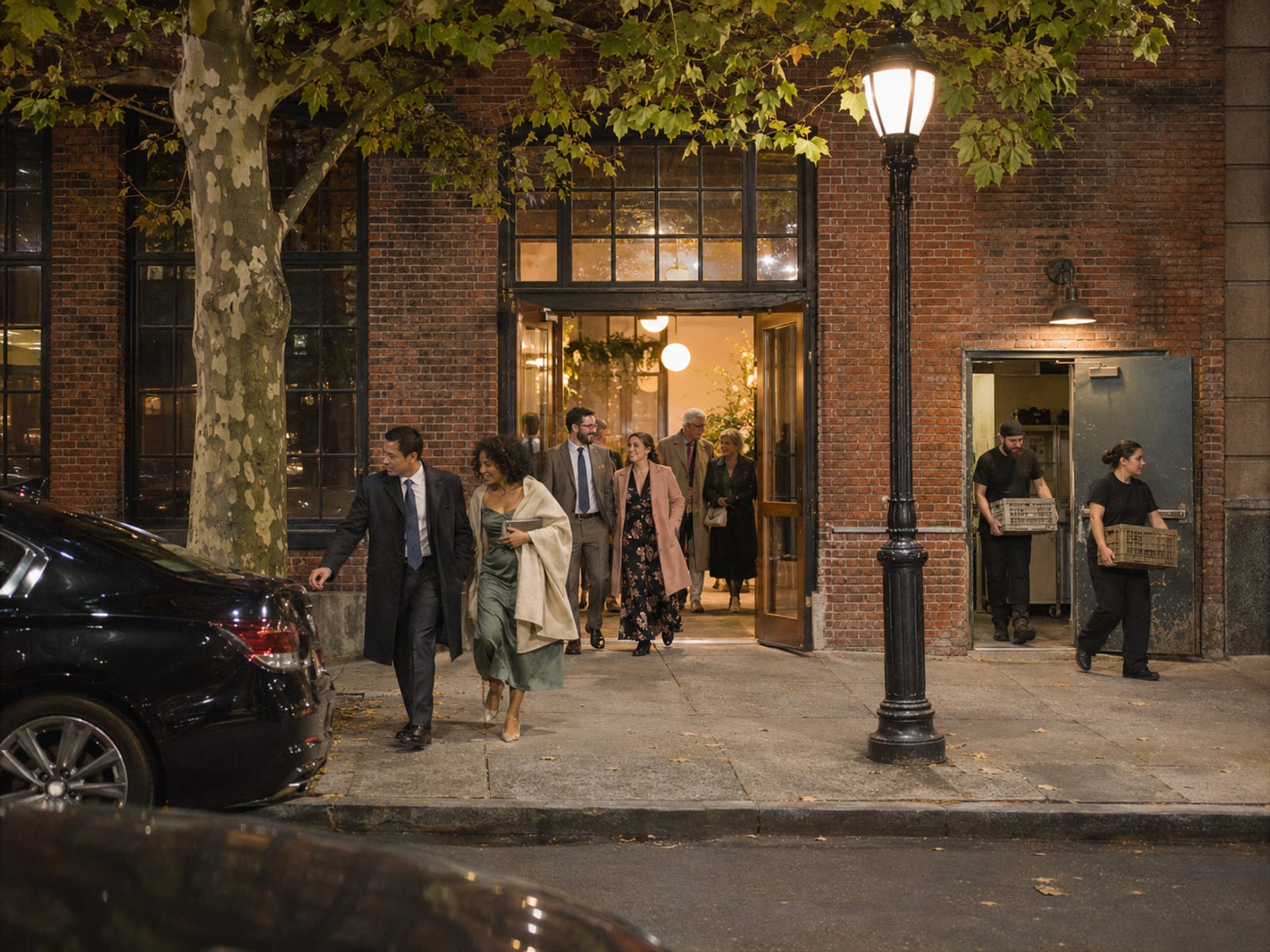
The Foundry shows why they differ. Its guest and music curfew is 12:30 a.m., and vendors may keep cleaning until 2 a.m. That gap gives your caterer, DJ and rental company time to strike the room after guests are gone. It also means your last dance has to land before 12:30 a.m., not at the moment the vendors are supposed to be loading out.
A bar last-call time is something to ask the venue directly, because it may differ from the music and guest curfew. Building rules, neighbors, staffing and noise limits can all shape the practical end time. Some venues allow the night to continue under their own terms, but that is a venue decision, not a citywide right.
What does venue overtime cost?
Venue overtime is set by each venue, so a rate you see on one site tells you nothing about the next one. These are published figures as of November 5, 2026, each tied to its venue.
- The Foundry: $1,000 per hour to extend the guest curfew.
- Atmosfera: $250 per hour after midnight, in addition to the hourly rate.
- Atmosfera: additional setup time at $125 per hour on weekdays and $150 per hour on weekends.
- Chizzy Event Venue: additional setup time at $100 per hour. Its weekday rental is $225 per hour with a four-hour minimum, and the eight-hour packages start at $1,550 on Friday, $1,750 on Saturday and $1,450 on Sunday.
Beyond the rate, ask how overtime is billed: in 30-minute increments or in full hours. Ask who is allowed to approve it, and whether the venue can refuse an extension if the next morning's booking or the building's rules get in the way. A venue's extension fee covers the venue only. Your vendors have their own contracts.
For the contract's other terms, such as deposits and cancellation, see wedding contracts in NYC.
What does vendor overtime cost?
Every hourly vendor can bill separately, so one extra hour can mean a venue charge plus a charge from each vendor who stays. DJs are the category with the clearest published numbers.
- NT Wedding DJs includes up to seven hours of event time, then charges $500 per hour.
- Celebration Entertainment gives $295 as an extra-hour example and describes a range of $250 to $500 per hour.
- DJ Romantics lists $400 per hour in its rate sheet.
As an illustration only, one more hour at a venue like The Foundry plus a DJ at $500 would be $1,500 before any other vendor. For your photographer, videographer, band, planner, bartenders and transportation, overtime depends on the contract. Ask each one for the overtime rate, the billing increment, the approval rule and a maximum charge in writing, and make sure every vendor is booked to the same end time as the venue.
How do NYC sound rules affect the last dance?
If you play amplified music, you need to know how the NYPD permit and the Noise Code fit together. The NYPD says amplified sound requires a sound permit, filed with your local precinct at least five days before the event, and the fee is $45 (NYPD permits page).
A permit is not a guarantee of late, loud music. The city's Noise Code still applies, and for non-impulsive sound it generally prohibits levels seven dB(A) or more above ambient at or after 10 p.m. and before 7 a.m. (NYC Administrative Code §24-218). Your venue's own music cutoff can be earlier still. If you plan to hold any part of the day in a park, confirm the current amplified-sound limits with NYC Parks.
For the filing steps, see sound permits for amplified music at an NYC wedding. In practice, treat the earlier of the venue's music cutoff and the Noise Code as your real last song.
How should you plan the last hour?
Work backward from the contract end time, and give guests and vendors separate exit windows. This sequence is planning guidance, not an official rule, so adjust it to your venue's times.

- Finish formal dances, speeches and other planned moments before the final 30 minutes.
- Call last call early enough that guests can finish their drinks before the bar's contractual end.
- Give the DJ or band the exact final-song time and the venue's music cutoff.
- Hold the final toast, then the last dance, before the guest curfew, not when vendors must already be leaving.
- Run the send-off after the last dance, leaving time for coats, cards and personal items. Confirm whether it happens inside, on private property or on a public sidewalk, since that can affect venue rules and permits.
- Let guests depart while vendors strike the room, rental returns and pickups, all inside the contracted access period unless an extension is written.
- Tell transportation providers the departure window and where guests should wait.
Choose one coordinator or trusted point person who can approve or decline overtime on the night. A document folder with your contracts, rate sheets and permit, and a power bank for that person's phone, are the two practical things worth carrying.
The last hour, in order
Tap or hover a step to follow the order.
Before the final 30 minutes
Finish formal dances, speeches and other planned moments.
Last call
Call it early enough that guests can finish their drinks before the bar's contractual end.
Final song
Give the DJ or band the exact final-song time and the venue's music cutoff.
Last dance
Hold the final toast, then the last dance, before the guest curfew, not when vendors must already be leaving.
Send-off
Run it after the last dance, leaving time for coats, cards and personal items.
Guests leave, vendors strike
Let guests depart while vendors strike the room, rental returns and pickups, all inside the contracted access period unless an extension is written.
Transportation
Tell providers the departure window and where guests should wait.
Extend the venue or move to an after-party?
Both options cost money, so compare them on the same terms. Extending the venue keeps everyone in one place and avoids a second move, but you pay the venue's overtime, and your DJ, bartenders and other vendors may bill theirs as well.
An after-party at a separate location adds a second space, its own staffing and transportation between the two, and not every guest will want to continue. It can still make sense if your venue has a hard curfew or a high hourly extension rate, such as The Foundry's $1,000.
Ask the venue whether it will extend at all, and for how long. Then price the after-party with real quotes, not guesses. For ideas on late-night options, see wedding after-parties in New York City, and for moving guests between locations, see getting wedding guests around New York City.
What should you ask before signing?
Put these questions to your venue, and get the answers in the contract.
- When does our access start, and what is the earliest a vendor can arrive?
- When do guests have to leave?
- When does the music stop?
- When is last call, and when does the bar close?
- When do vendors have to be out?
- What is the overtime rate, and is it billed in 30-minute increments or full hours?
- Who is authorized to approve overtime, and can the venue refuse it?
- Can early deliveries be accepted, and where are they stored?
- Is day-before access available, and what does it cost?
- Who is responsible for the sound permit, and what are the venue's own sound rules?
- Do we have to use preferred vendors, and if so, what hours do their contracts cover?
Confirm that your photographer, DJ or band, planner, caterer and rental company are all booked through the same end time, and ask where gifts, cards and rentals go at the end of the night.
Quick check: venue hours and overtime
Answer every question to check.
Questions about venue hours and overtime
These are the questions couples ask most once they understand the basics.
How many hours does an NYC wedding venue usually include?
There is no single standard. Published examples include five event hours, eight total hours, 12 rental hours and 14 exclusive-access hours. Ask whether setup and breakdown are inside that number.
Do setup and breakdown count in the venue hours?
Sometimes. Loft39 counts four setup and breakdown hours inside its eight-hour booking, while other venues list separate access windows. Check how your contract defines rental hours.
Does a sound permit guarantee late music?
No. The permit is required for amplified sound and costs $45, but the Noise Code and your venue's terms still apply. Your venue's music cutoff may be earlier than anything the city requires.
Who pays overtime when a wedding runs late?
You may owe separate charges to the venue and to each vendor whose contracted time you exceed. Put every overtime rate and approval rule in writing, and name the person who can say yes on the night.
Your next step
Pull out your venue quote and mark four times: when access starts, when guests leave, when the music stops and when vendors must be out. Anything that is blank or vague is a question for the venue before you sign, along with the overtime rate and who can approve it.
Then check that each hourly vendor's contract ends when the venue's does. If you are still comparing venues, the contract guide is a good place to read next.
Terms in this guide
Tap a term to see what it means.
Event time. Usually the part your guests see.