LGBTQ+ couples marry in New York City through the same marriage license and City Clerk process as every other couple, and have since New York's Marriage Equality Act took effect on July 24, 2011, according to the New York State Department of Health. You apply for the license, show identification, wait 24 hours, and marry at the City Clerk's office or with a private officiant at a place you choose. City and state human rights laws also protect you from discrimination by covered businesses, so the planning that matters most happens before you sign a contract: finding a venue and vendors who will get your names, pronouns and paperwork right, and checking any permit a meaningful location still requires.
Key takeaways
Tap a card to bring it forward.
- Same-sex marriage is valid in New York under Domestic Relations Law §10-a and recognized federally.
- The City Clerk license and ceremony process is the same for every couple, with a 24-hour wait after the license is issued.
- Current City Clerk application fields use "Spouse A" and "Spouse B", and gender information is optional.
- Ask every venue and vendor how their contract names you, and whether they will use your names and pronouns, before you pay a deposit.
- Stonewall National Monument is federal parkland: some ceremonies and photo sessions need a permit, with a $50 application fee.
- Recognition abroad depends on the country, so order the right certificate and check with your consulate early.
Same-sex marriage is legal in New York and across the country
New York settled the question in state law. Domestic Relations Law §10-a says an otherwise valid marriage "shall be valid regardless of whether the parties to the marriage are of the same or different sex." The same section says the rights, benefits, protections and responsibilities that come with marriage can't differ because the two of you are the same sex. The Marriage Equality Act was signed June 24, 2011, and took effect a month later, a date the New York State Department of Taxation and Finance also uses for how married couples file.
Federal law backs this up in two places. In *Obergefell v. Hodges*, decided June 26, 2015, the U.S. Supreme Court held that the Fourteenth Amendment protects the right of same-sex couples to marry and requires every state to license and recognize those marriages. The Respect for Marriage Act, signed December 13, 2022, requires the federal government to recognize valid marriages and requires states to recognize valid marriages performed in another state, regardless of sex, as the Congressional Record sets out. A marriage from New York travels with you inside the United States.
Marriage equality in New York and nationally
Tap or hover a step to follow the order.
June 24, 2011
New York's Marriage Equality Act is signed.
July 24, 2011
The act takes effect, and the NYC City Clerk begins issuing licenses and performing civil ceremonies for same-sex couples.
June 26, 2015
In Obergefell v. Hodges, the U.S. Supreme Court requires every state to license and recognize same-sex marriages.
December 13, 2022
The Respect for Marriage Act is signed, requiring federal recognition and recognition between states, regardless of sex.
How the license and City Clerk process works for you
The NYC City Clerk states that it has issued marriage licenses and performed civil ceremonies for same-sex couples since July 24, 2011, and the steps are the ones every couple follows. You complete the application, book an appointment through Project Cupid or the Clerk's current system, bring valid identification and any documents about a prior marriage, pay the fee, and receive the license. Then you wait 24 hours before the ceremony, unless a valid legal waiver applies, and marry.

The license fee changes from time to time, so check the amount on the City Clerk's site when you book rather than relying on an older figure. The Marriage License, Step by Step guide covers the application screens, the identification the Clerk accepts and the appointment in more detail, and Getting Married in NYC as a Visitor or From Abroad covers the extra planning if one or both of you are traveling in. Visitors use the same process, as long as you meet New York's requirements.
If a friend or family member will officiate, they can apply for a One-Day Marriage Officiant License. The applicant must be 18 or older, the license names your specific couple, and the City Clerk lists the fee as $25.
Names, pronouns and gender fields on the forms
This is where many couples hesitate, and the current forms are simpler than older ones. The City Clerk's online application, shown in its Spanish translation, labels the two of you "Spouse A" and "Spouse B" and treats gender information as optional. Neither of you is sorted into bride or groom.
Older PDFs and forms you find online can still carry legacy labels, so work from the current City Clerk instructions, and if a field on the day looks unclear, ask the clerk how the application records your names and any gender information before you sign. Use the legal name on your identification for the license; if your ID shows a former name, bring what you need to connect the two and confirm with the Clerk ahead of your appointment.
Marrying doesn't change anyone's name automatically. If either of you wants a new last name, or both of you do, you follow the name-change process tied to the marriage record and then update each agency in turn. Changing Your Name After Marrying in NYC walks through that order.
City Clerk, a private officiant or a venue ceremony
The City Clerk ceremony is the quickest and simplest route: a short civil ceremony in the Clerk's office, booked for any time after the 24-hour wait. Many couples pair it with a larger celebration later, at a restaurant, a rooftop or a friend's apartment. A City Hall Wedding in NYC, Step by Step covers the day itself.
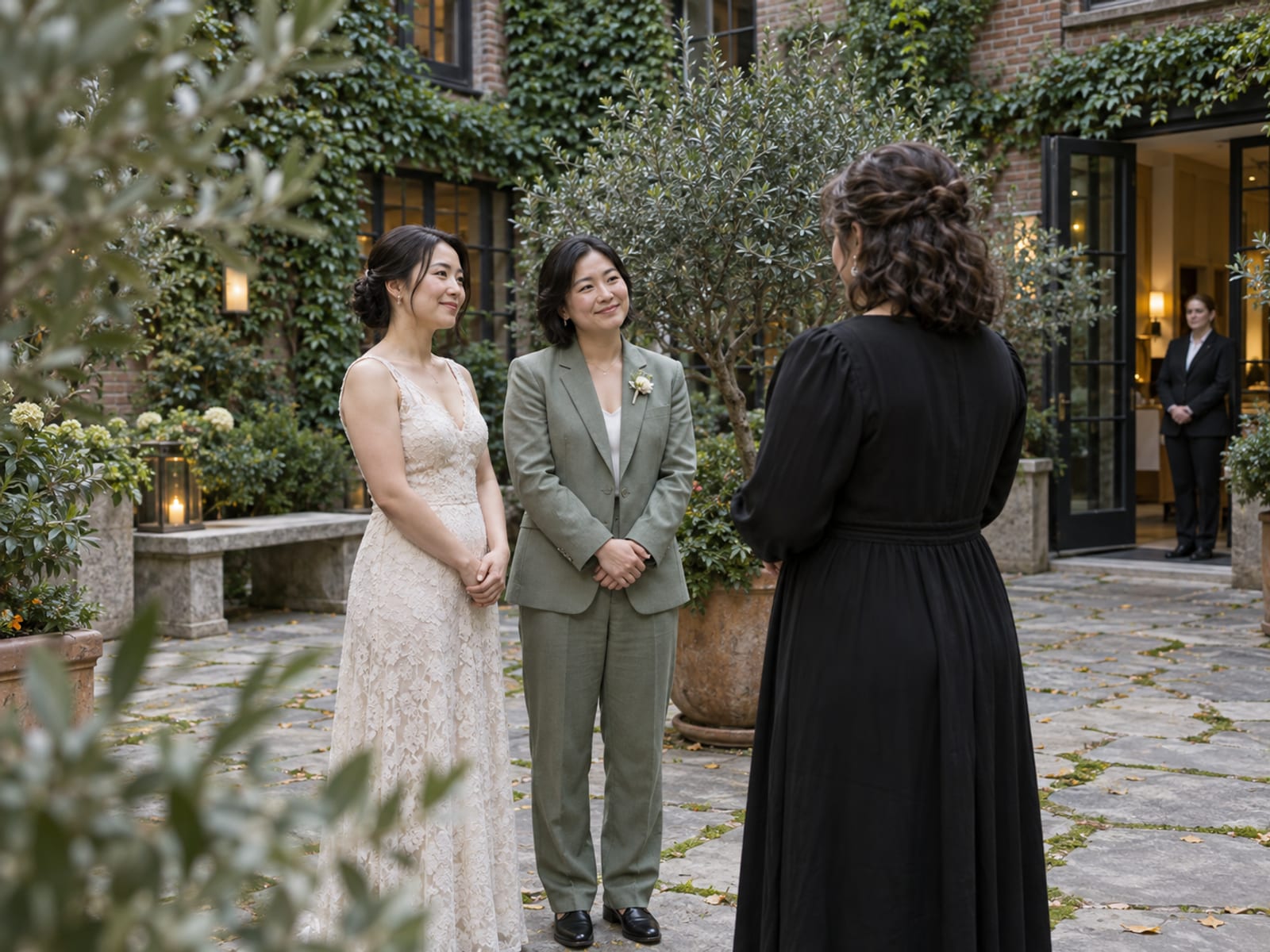
A private officiant gives you the words you want in the place you want. You can write a ceremony with gender-neutral titles such as partners or spouses, include both families' languages, and choose who stands beside each of you. Who Can Officiate a Wedding in NYC explains who is authorized, and the one-day license lets someone close to you do it.
A venue ceremony puts everything in one place and suits a larger guest list, but it also brings contracts, minimums and more vendors, each of which is worth checking the same way. If the ceremony is outdoors in a city park, NYC Parks asks for applications at least 21 days ahead, with a $25 non-refundable processing fee. Getting a Park Ceremony Permit in NYC has the full steps.
How to tell whether a venue or vendor is welcoming
A welcome statement on a website is a start, and the useful answer comes from the contract and the conversation. Begin with several kinds of sources. Equally Wed is an LGBTQ+-focused wedding directory whose listed vendors sign a pledge of fairness and respect. IGLTA connects LGBTQ+-welcoming travel and hospitality businesses. The NYC Comptroller's LGBTQIA+ guide lists city resources, and The Center in the West Village rents its own space for events. Some venues publish a dedicated LGBTQ+ weddings page, such as Deity NYC in Downtown Brooklyn, Terrace on the Park in Queens and The Briarcliff Manor in Westchester. A planner, photographer or officiant who has already treated you well is often the best referral for the next vendor.
Then ask each one the same questions, in writing where you can:
- How do your forms and contracts address both of us?
- Will you and your staff use our names and pronouns?
- Have you worked with same-sex, trans and non-binary couples?
- Can you show relevant work you have permission to share?
- Who will actually be there on the day?
- Does the contract say "couple" or "partners," or does it use gendered terms?
- Are every package, service and benefit available to us on the same terms?
- What happens if the person we booked cancels, and who replaces them?
- Can you work with our ceremony language, our attire and our family?
- Do you have bilingual staff or written information in Spanish?
Ask a venue about restrooms and accessibility, too, and about how staff will introduce the two of you. Get the answers you care about written into the contract. A listing tells you where to start; a signed contract tells you what you're getting.
Stonewall, Greenwich Village and the rules that still apply
For many couples, a photo in Greenwich Village or at Stonewall is part of the day. Stonewall National Monument includes the Stonewall Inn and Christopher Park, and it is federal parkland run by the National Park Service with its own rules. The park's compendium sets its hours at 7:00 a.m. to 8:00 p.m. in peak season and 7:00 a.m. to 5:00 p.m. otherwise, weather permitting, and the Christopher Park grounds close on the last Sunday of June, during NYC Pride weekend.
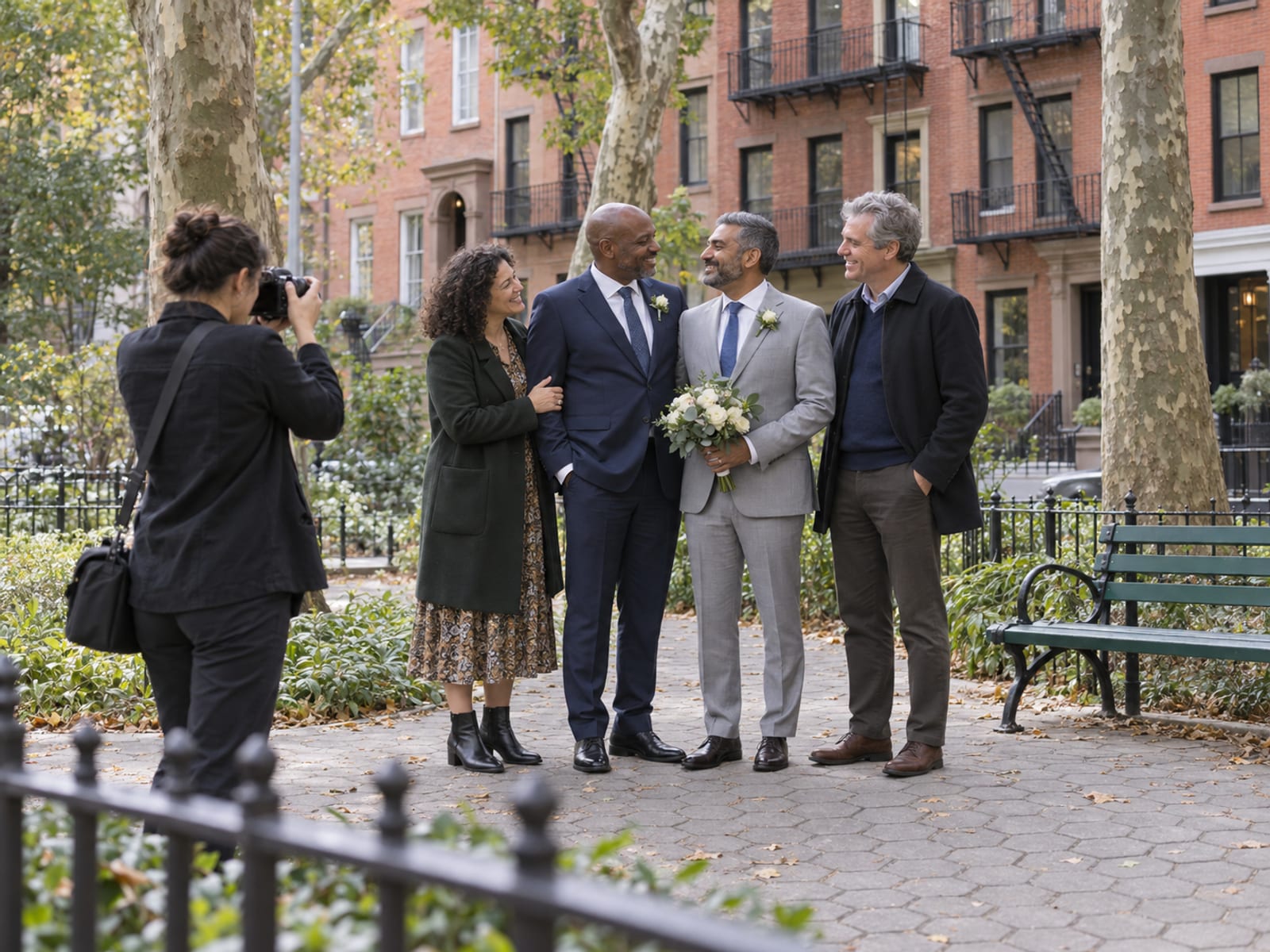
A ceremony or similar event there needs a permit when the NPS rules cover it, and so does any activity that benefits an individual or a business. A special-use permit application carries a $50 non-refundable fee, with possible added costs. For photos, a small, low-impact shoot with five people or fewer and equipment you carry generally doesn't need a permit. Still photography does need one in specific cases, such as using closed areas, models, sets or props. Anything beyond low-impact filming needs at least 10 days' written notice. Contact the park with the exact plan, your headcount and your photographer, and allow time before the date.
The Center and other community spaces in the Village each set their own reservation, photography and event rules, so ask each owner directly. The Best City Hall Wedding Photo Spots in NYC and A Rain Plan for an Outdoor NYC Wedding or Photo Session can help you fit the Village into a wider photo route.
If a vendor refuses you
The NYC Human Rights Law prohibits discrimination in public accommodations based on sexual orientation and gender. The NYC Commission on Human Rights says discrimination based on actual or perceived sexual orientation or gender identity is illegal in public spaces, and its gender identity guidance says covered businesses can't deny services, facilities or privileges because someone is transgender, non-binary or gender-nonconforming. The Commission also says no one has to prove their gender identity to be addressed by their name and pronouns. At the state level, the New York State Division of Human Rights lists sexual orientation and gender identity or expression as protected in places of public accommodation.
If something goes wrong, keep a record: emails, texts, the contract, invoices and the refusal itself, with dates. Then contact the Commission or the Division, which can tell you whether your situation falls under the law and what the next step is. For your own case, a lawyer can advise you. Meanwhile, book a replacement from your shortlist so the date stays on track.
Recognition abroad for international couples
A New York marriage is not automatically registered in every other country, and each one sets its own rules. Start by ordering the right record from the City Clerk. Many countries ask for the extended certificate plus authentication and an apostille.
Tap or hover a row to highlight it.
| Item | Fee | Source |
|---|---|---|
| ItemMarriage record, first copy | Fee$15 | SourceNYC City Clerk |
| ItemMarriage record, each additional copy | Fee$10 | SourceNYC City Clerk |
| ItemExtended certificate, first copy | Fee$35 | SourceNYC City Clerk |
| ItemExtended certificate, each additional copy | Fee$30 | SourceNYC City Clerk |
| ItemCounty Clerk authentication | Fee$3 | SourceNYC City Clerk |
| ItemNew York State apostille | Fee$10 | SourceNYC City Clerk |
Spain shows how the next step works. Spain has recognized same-sex marriage since July 3, 2005, according to the U.S. Department of State. When one of you is a Spanish citizen, the Spanish consular service says a marriage celebrated abroad must be entered in the Spanish Civil Registry to have full civil effect in Spain. Either spouse, whatever their nationality, can request registration, usually with the foreign marriage certificate and proof of identity and U.S. status, and the consulate may ask for more. Other countries differ, so contact your own country's consulate before the wedding to learn which certificate, translation and registration steps it expects. Getting Your NYC Marriage Certificate, the Extended Copy and the Apostille covers the New York side in full.
A water-resistant document folder with sections for your IDs, appointment confirmations, license and certificate orders keeps the paperwork together while you travel, and a protective sleeve keeps certificates flat on the way to the apostille office.
Quick check: licenses, forms and Stonewall
Answer every question to check.
Questions couples ask about LGBTQ+ weddings in NYC
Can non-binary partners get married at the City Clerk's office?
Yes. New York law makes a marriage valid regardless of the sex of the parties, and the current application lists you as Spouse A and Spouse B with gender information optional. Bring the identification the Clerk asks for, in the name on your ID.
Is there a waiting period after we get the license?
New York generally requires 24 hours between the license being issued and the ceremony. A valid legal waiver is the exception, so plan your ceremony for at least the next day.
Can a friend officiate our wedding?
Yes, if they get a One-Day Marriage Officiant License from the City Clerk. They must be 18 or older, the license is specific to your couple, and the fee is $25.
Do we need a permit for wedding photos at Stonewall?
A small, low-impact session with five people or fewer and hand-carried equipment generally doesn't. Using closed areas, models, sets or props, or holding a ceremony, can require a special-use permit with a $50 application fee, so contact the National Park Service with your plan first.
Will our New York marriage be recognized in our home country?
It depends on the country. Some require an extended certificate, an apostille, a translation and registration with their civil registry before the marriage has full effect there, so check with your consulate before you order certificates.
Your next step
Book your license appointment with the City Clerk first, since the 24-hour wait and the appointment calendar set your earliest date. Then start your venue and vendor shortlist in the directory, from venues and officiants to photographers, planners, florists, hair and makeup, and suit and tuxedo shops, and put the ten questions above to each one before you sign.
Terms in this guide
Tap a term to see what it means.
Marriage Equality Act. The New York law signed June 24, 2011, that took effect July 24, 2011.