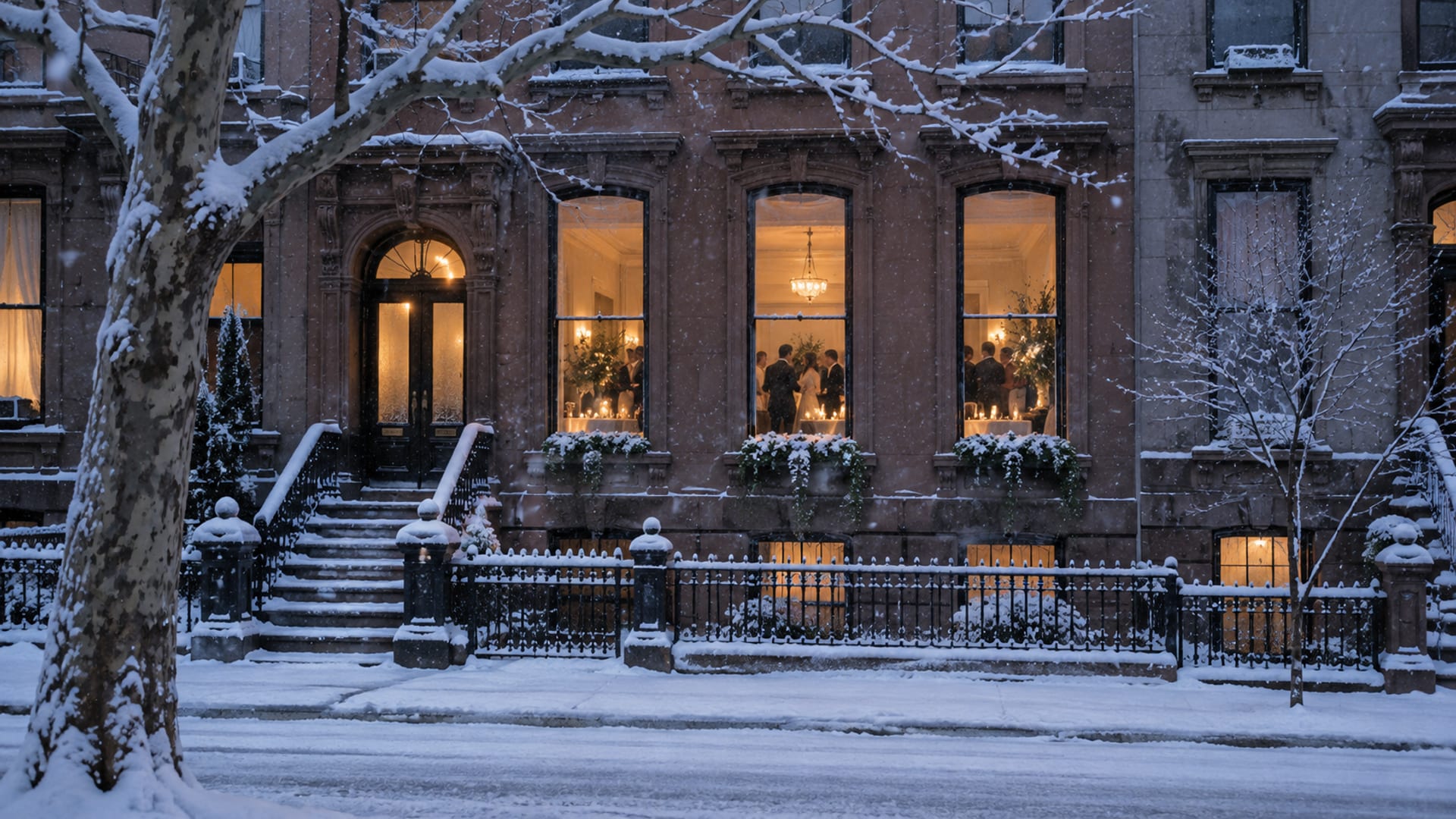
A winter wedding in New York City means planning for December through March: short days, cold air, and the chance of snow, ice or freezing rain. The National Weather Service's Central Park 1991-2020 normals put the average high at 44.3°F in December, 39.5°F in January, 42.2°F in February and 49.9°F in March. Winter pricing is not automatic. Some venues publish lower January and February rates or a winter package, and others publish no prices at all. The plan that works is simple to state: choose an indoor or indoor-first venue, schedule outdoor photos around daylight, get weather and postponement terms in writing, and confirm holiday travel and hotel conditions before you pay a deposit.
Key takeaways
Tap a card to bring it forward.
- January is the coldest month in Central Park, with an average low of 27.9°F; March is the mildest.
- Daylight runs about 9 hours 19 minutes on January 1, so outdoor portraits need an early slot.
- Christmas week, New Year's Eve and Valentine's Day are the hardest winter dates.
- Some venues publish lower winter prices; compare full contract totals for your date.
- Book indoor ceremony space, a coat plan and written snow and ice terms.
Is a winter wedding in NYC practical?
Yes, if you build the day around indoor space and a flexible schedule. Winter in the city is cold rather than extreme. The same NWS normals give a winter seasonal average high of 42.0°F and an average low of 30.4°F, which is coat weather for guests walking between a car and a door, and genuinely cold for portraits that run longer than a few minutes outside.
The bigger planning factor is light. On January 1 New York gets roughly 9 hours 19 minutes of daylight, and by mid-February about 10 hours 36 minutes. An afternoon ceremony can end in darkness, so settle the order of your day before you sign with a photographer, using the sunset time for your exact date.
The good part is real too: warm rooms against a cold street, holiday lights in December and, at some venues, rates that drop after the holidays.
What NYC weather is really like from December through March
The four winter months compare this way in Central Park, from the National Weather Service's 1991-2020 normals.
Tap or hover a row to highlight it.
| Month | Average high | Average low | Monthly mean |
|---|---|---|---|
| MonthDecember | Average high44.3°F | Average low33.8°F | Monthly mean39.1°F |
| MonthJanuary | Average high39.5°F | Average low27.9°F | Monthly mean33.7°F |
| MonthFebruary | Average high42.2°F | Average low29.5°F | Monthly mean35.9°F |
| MonthMarch | Average high49.9°F | Average low35.8°F | Monthly mean42.8°F |
These figures are 30-year averages. NOAA describes normals as a baseline, not a prediction for one date, so a January Saturday can be mild and sunny or well below average. Snow is possible in every one of these months, and so are rain, freezing rain and bare, gray sidewalks. The NWS keeps Central Park historical records if you want to see how past winters went on your stretch of the calendar.
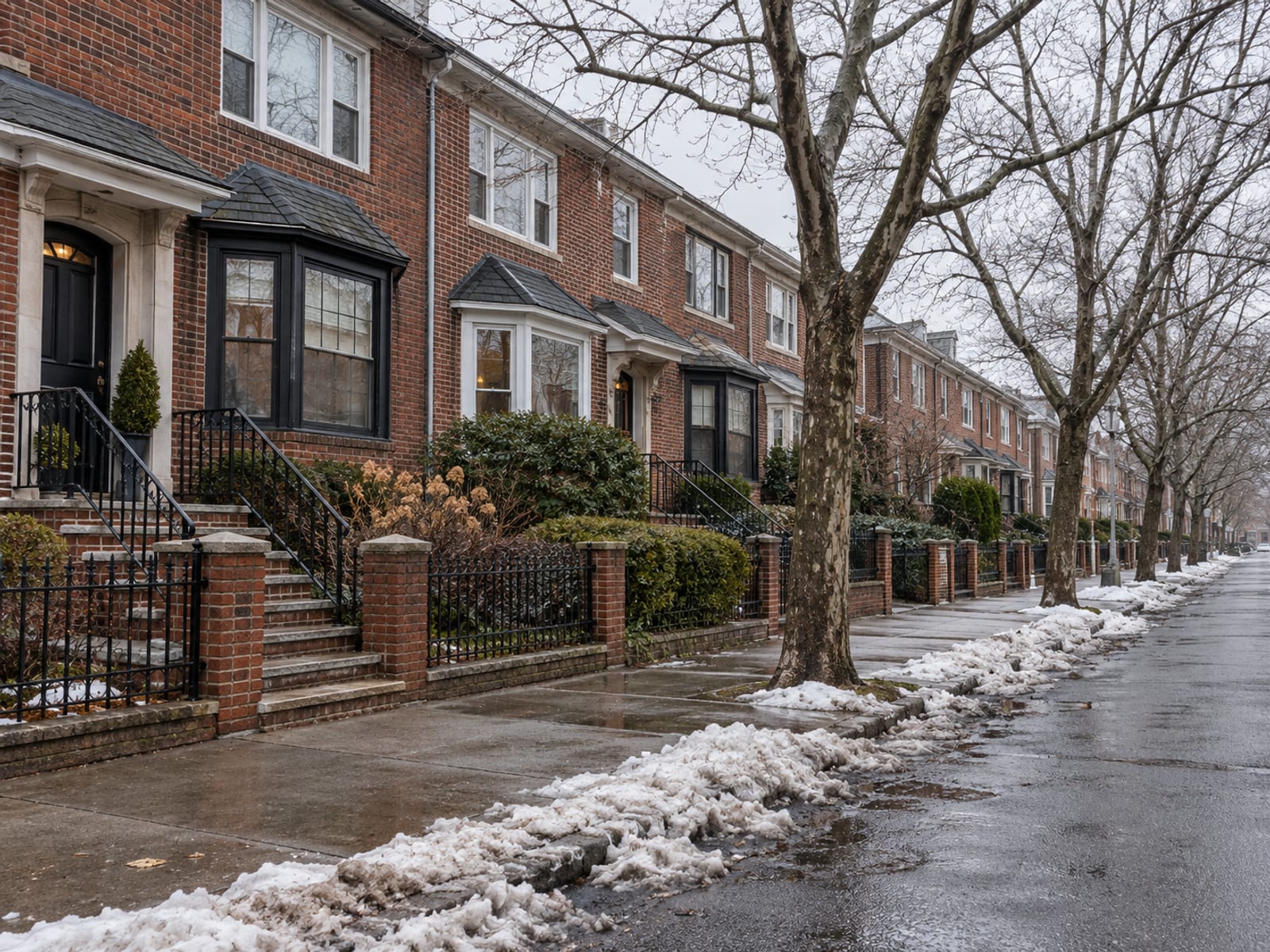
Treat snow as one outcome among several. A plan that works on a dry 38°F day, a wet 45°F day and a snowy 30°F day is the plan to book.
The winter dates that are hardest for venues and guests
Not every winter weekend is equal. A few dates carry extra pressure on venues, hotels, transport and your guests' own calendars.
Christmas week. Families have their own plans, some businesses run shorter hours, holiday travel is heavy and lodging demand rises. Ask the venue about availability, minimums and holiday pricing, in writing.
New Year's Eve. Midtown is hard to move through that night. The Times Square FAQ explains that the outdoor event is free and first-come, first-served while nearby restaurant and hotel parties require tickets, and the city publishes street and pedestrian closures around it. A venue near Times Square needs a guest route mapped against that year's closures.
Valentine's Day. An appealing date that competes with restaurant bookings and romantic travel. Ask for the actual rate for your nights rather than assuming a surcharge or a deal.
Holiday displays. If you are counting on the Rockefeller Center tree for photos, check the dates for your year. The official tree page shows the 2025 tree came down January 10, so a mid-January wedding may miss it entirely.
For any of these dates, request a group hotel rate for the exact nights and compare the written rate, cancellation terms, taxes and minimum stay before you send the room block link to guests.
Do NYC venues really lower their winter prices?
Some do, and they say so in writing. There is no citywide cheapest month, so the useful move is to ask every venue on your list for a proposal for your specific date and guest count, then compare totals after service charges, taxes and gratuities.
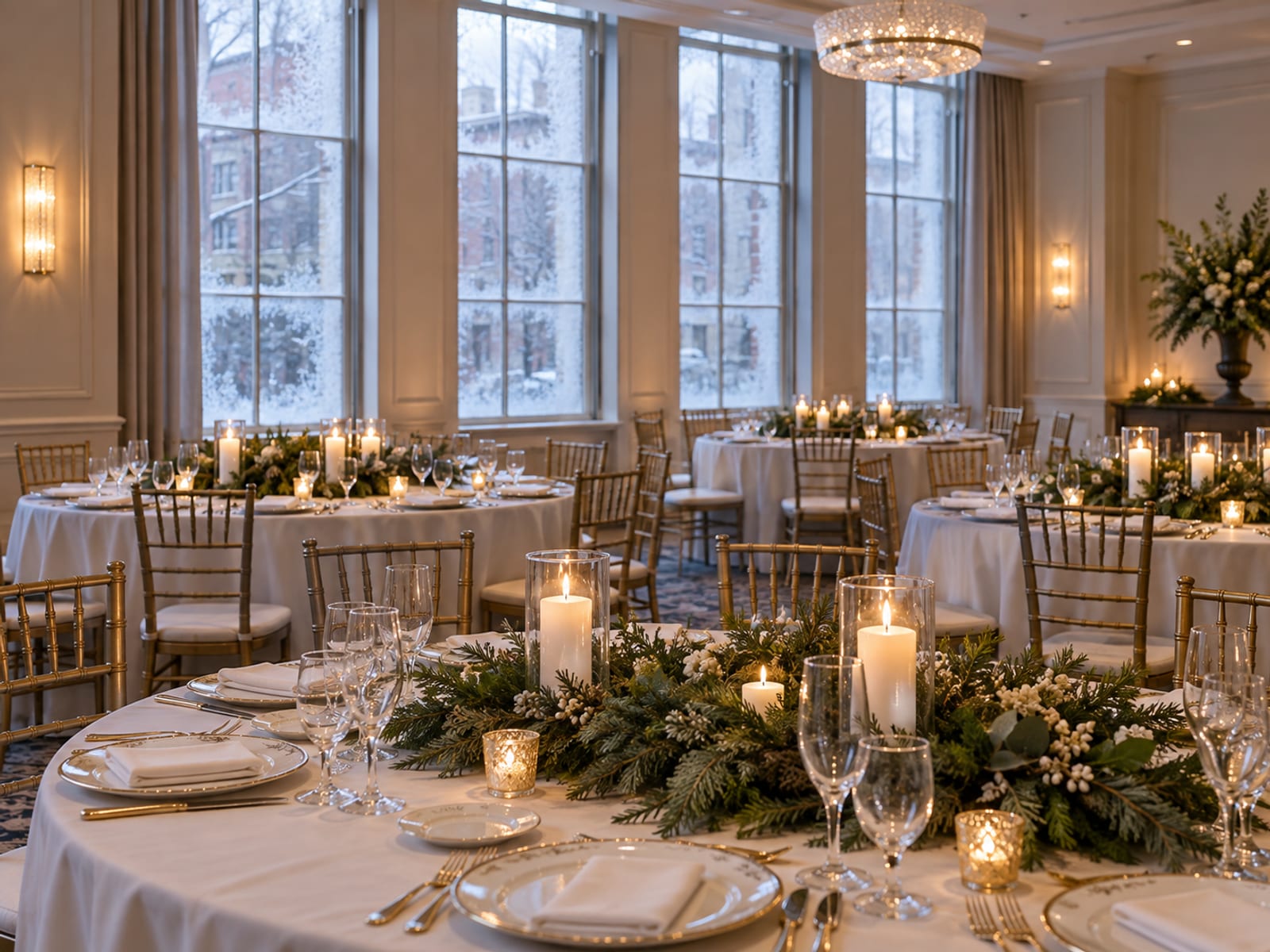
Three venues publish winter terms you can compare against the quotes you receive:
- Astoria. Its 2026 Signature Wedding brochure lists per-person prices by season: January-February at $54 on Saturdays and $48 on Fridays and Sundays, March-April at $60 and $52, late November-December at $62 and $56, and May through mid-November at $68 and $62. Monday through Thursday is $48. An on-site ceremony is priced separately.
- Four Seasons New York. Its winter package runs January, February and March and includes a five-hour event, cocktail reception, dinner, open bar, linens, a tasting, menu cards, a complimentary suite night and preferred guest-room rates. The package page does not list a price, so you will need a quote.
- Watermill. Its winter special for January and February 2027 is $13,000 for 100 guests, with additional guests at $130 each plus applicable charges. A 22% facility fee and New York State tax apply, and gratuities are not included.
At Astoria, the lowest rate falls in January and February, while December sits closer to fall pricing. Published prices change by year, so confirm the current figure with the venue before you budget around it. For costs by borough, see What a NYC Wedding Costs, From Manhattan to the Outer Boroughs.
Tap or hover a row to highlight it.
| Season | Saturday | Friday or Sunday |
|---|---|---|
| SeasonMay through mid-November | Saturday$68 | Friday or Sunday$62 |
| SeasonLate November and December | Saturday$62 | Friday or Sunday$56 |
| SeasonMarch and April | Saturday$60 | Friday or Sunday$52 |
| SeasonJanuary and February | Saturday$54 | Friday or Sunday$48 |
Venue types that work best in the cold
In winter, the best venue lets the ceremony, cocktails, dinner and a few portraits happen without guests going back outside. Hotels are strong here: guests can stay in the building, and your getting-ready suite is an elevator ride from the ceremony. Restaurants and private dining rooms suit smaller guest counts and already have heat, coat handling and staff. Lofts give you more control over the layout, but check how the space stays warm with the doors open for load-in. Museums and landmark interiors each set their own rules on access, photography and guest counts. Venues within two hours of Manhattan, in the Hudson Valley, North Jersey or on Long Island, add a travel leg to plan around the forecast.
Ask every venue these questions before you sign:
- Where does the ceremony happen if it is too cold, wet or icy to be outside, and is that space included in the price?
- How is the room heated, and does it stay comfortable when doors open for arrivals?
- Where do all the coats go, and who staffs the coat check?
- Is there a warm, private room where the two of you can wait, and an indoor spot with good light for portraits?
- Who clears and salts the entrance? The Department of Sanitation makes property owners responsible for their sidewalks after snow.
If you have your heart set on an open-air setting, Rooftop Weddings in NYC: Permits, Cost and the Weather Plan covers what a rooftop needs, and Small and micro wedding venues in New York City lists options for a short guest list.
Planning winter wedding photos around early sunset and snow
Start with your date's sunset and work backward, allowing for the drive to the photo location, coats off and on, and a weather buffer. Moving portraits before the ceremony keeps the outdoor part in daylight.
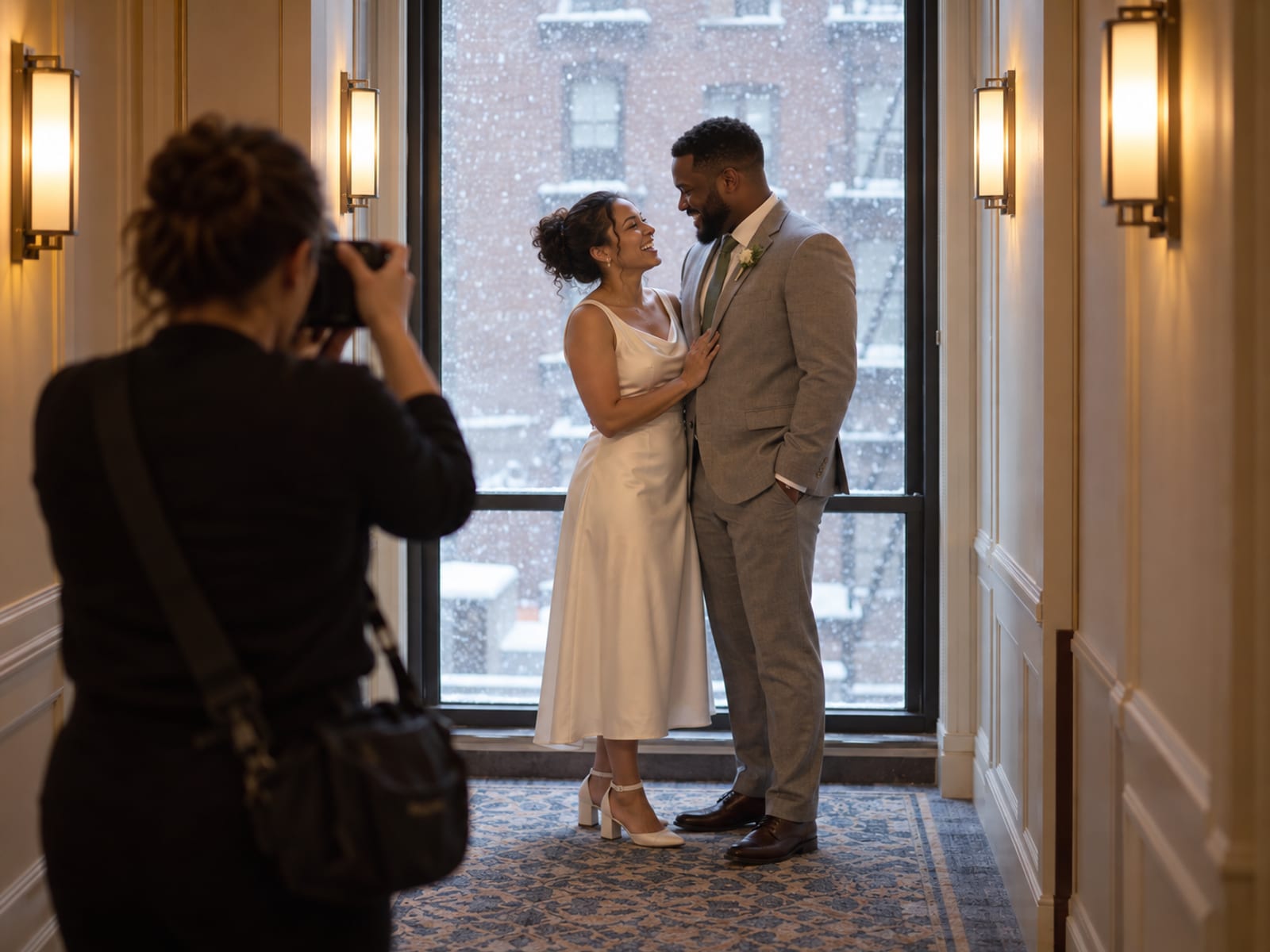
Treat indoor photos as the plan you can count on and outdoor photos as the bonus. Hotels, restaurants, libraries, conservatories and private venues give you warmth and controlled light, but each property decides whether tripods or flash are allowed and whether a fee applies, so get written permission first.
Parks need their own check. NYC Parks requires a special event permit for events with more than 20 attendees, with a $25 nonrefundable processing fee. Its photography guidance says a handheld camera or a tripod, without exclusive use, props, vehicles or restricted access, may not need a permit from the Mayor's Office of Media and Entertainment or Parks authorization, while a more involved shoot can need both. Describe exactly what your photographer plans to bring when you ask. Places such as Brooklyn Bridge Park and Hudson River Park run their own processes, listed on the city's permitting agencies page. Getting a Park Ceremony Permit in NYC covers the full permit steps.
If you do get snow, enjoy it from solid ground. NYC Emergency Management warns that ice on park ponds and lakes can be dangerously thin, so keep the party off frozen water. For wet days, see A rain plan for an outdoor NYC wedding or photo session.
How guests should plan travel around winter weather
Winter travel is where a small delay turns into a missed ceremony, so give guests a plan that has slack built in. Encourage everyone flying in to arrive at least a day before the wedding, and do not schedule a legal ceremony right after an international arrival.
The U.S. Department of Transportation explains that airlines do not guarantee their schedules. After a cancellation they generally rebook passengers on their next available flight, but meals, hotels and reimbursement depend on the airline's policy and the cause, and airlines are generally not required to compensate domestic passengers for weather delays. Tell guests this when they book, and suggest they read their airline's policy and consider travel insurance.
Inside the city, choose hotels close to the venue or near reliable subway and rail lines, and give guests more than one way to arrive: subway, train, taxi and, for short distances, walking. Cars and rideshares slow down in snow, and the city can issue travel advisories that limit driving during a storm. Where Your Wedding Guests Should Stay in NYC, by Borough and Getting wedding guests around New York City cover both in more detail.
In the days before, follow National Weather Service forecasts and NYC Emergency Management alerts, and share the Notify NYC sign-up with guests. A welcome card with the venue address, transit directions, a backup route and one day-of phone number saves a lot of texting when the weather turns. Pack a portable power bank too, since alerts, maps and vendor calls all run through your phone.
What to wear, and what the contract should say about snow or ice
Dress for the walk between the door and the car, not only for the room. NYC Emergency Management advises layers, a wind-resistant outer layer, gloves and a hat when winter conditions change quickly, and that advice works under formal clothes too.
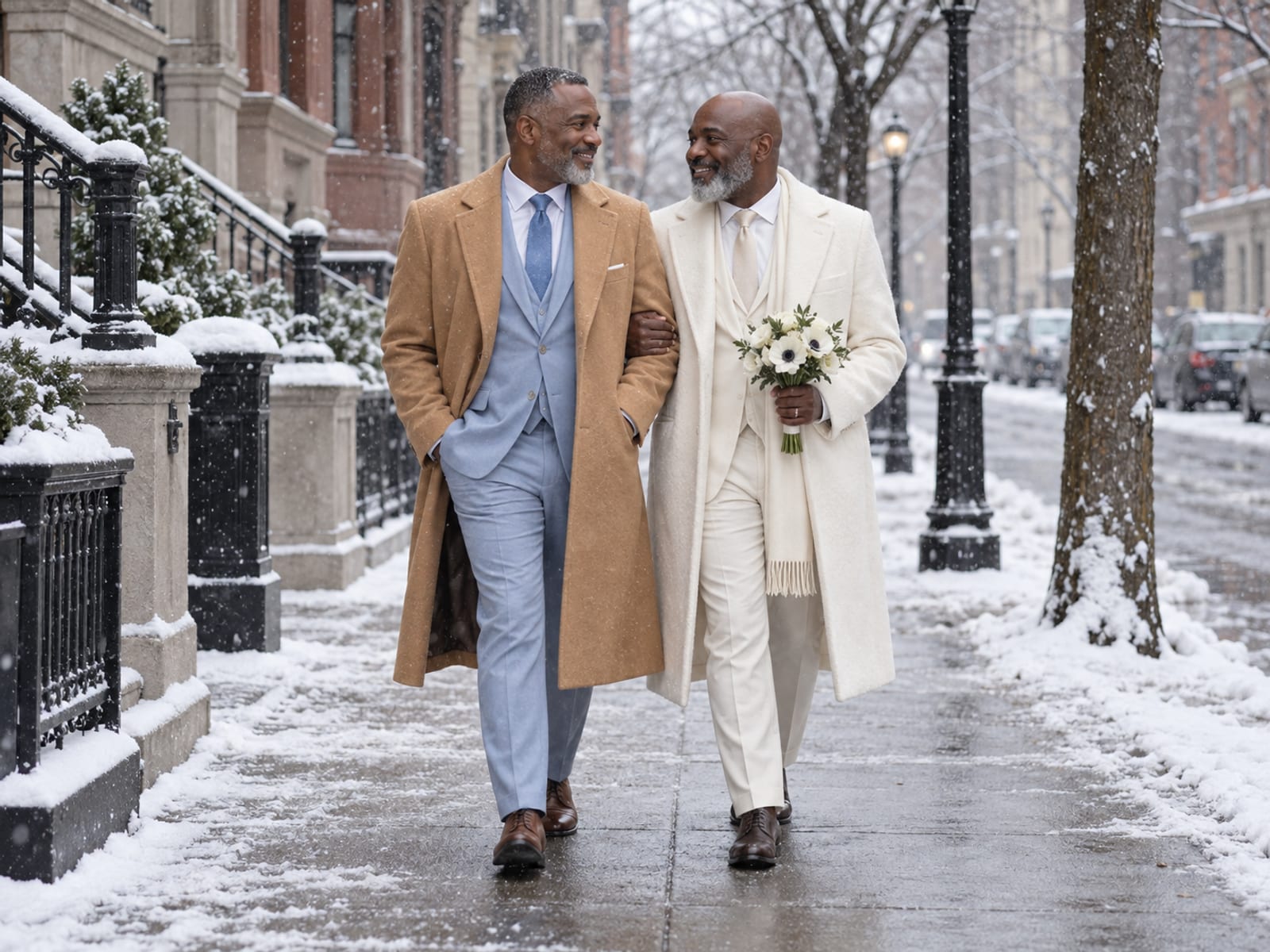
- Outerwear. A formal coat, cape, wrap, shawl or overcoat that works in photos, long enough to cover the outfit and roomy enough to go on without crushing it.
- Layers. Warm layers underneath where they do not change the fit; bring them to your final fitting.
- Shoes. Closed-toe shoes or boots with non-slip soles for travel, then formal shoes indoors, with foldable shoe bags to keep wet pairs away from the outfit.
- Small comforts. Gloves, a scarf and hand warmers for portraits; lip balm and touch-up makeup for wind.
- Storage. A garment bag with a wide gusset and a strong hanger, and a clean place to hang outerwear at the venue.
The contract matters as much as the coat. Before you pay a deposit to a venue or vendor, ask for written answers to these questions:
- What happens if snow or ice keeps the venue closed, or if a city travel advisory or emergency order is in effect on the date?
- Can the ceremony, cocktail hour, portraits or reception times shift on the day, and at what cost?
- What are the postponement and cancellation terms, and does a postponement turn your deposit into a credit? By what date must it be used?
- What does the force majeure clause cover, in plain words?
- If the photographer, florist, band or officiant cannot travel, who replaces them, and do you approve the substitute?
- Does a minimum guest count still apply if guests cannot reach the city?
Wedding insurance can cover some of this; check whether the policy you are considering covers weather disruption before you buy it.
Quick check: planning a winter date
Answer every question to check.
Questions couples ask about a winter wedding in NYC
These short answers cover the details people most often look up after they settle on a winter date.
Can we get married at the City Clerk in winter?
Yes. NYC311 says City Clerk ceremonies take place Monday through Friday by appointment, with arrivals between 8:30 a.m. and 3:15 p.m. There is no walk-in service, the ceremony fee is $25, and no more than six people can attend, including the two of you.
Will it snow on our wedding day?
No one can tell you that months ahead. Climate normals describe averages, not a forecast for a date, so plan a day that works with snow, rain, ice or dry, cold streets.
How long is the marriage license good for?
A New York marriage license is valid for 60 days, or 180 days for qualifying active-duty military, according to the City Clerk's application page. That window lets you get the license on one trip in early winter and hold the ceremony weeks later.
Is the license application available in Spanish?
Yes. The City Clerk publishes a Spanish translation of the marriage license request, which also notes that an online application expires after 21 days if you do not complete it.
Your next step
With a month and a venue short list in hand, fit the legal steps around your date. The NYC Mayor's Office sets the marriage license fee at $35 and generally requires a 24-hour wait between getting the license and holding the ceremony, so plan the license appointment at least a day before, and earlier if guests or officiants are coming in from out of town during storm season. If you marry at the City Clerk, bring at least one witness age 18 or older and the same type of identification you used for the license, per NYC311.
The NYC Marriage License, Step by Step and A City Hall Wedding in NYC, Step by Step walk through each appointment in order, and Getting Married in NYC as a Visitor or From Abroad covers what changes if you are flying in. Still choosing a season? The Best Time of Year to Get Married in NYC compares winter with the rest of the year. When you are ready for quotes, the vendor directory lists venues, photographers, planners and transportation, so you can ask each about winter dates, weather terms and an indoor plan before you commit.