New York does not hand you a script. Under New York Domestic Relations Law § 12, no particular form of ceremony is required; the one thing the law needs is for the two of you to solemnly declare, in front of an authorized officiant and at least one witness, that you take each other as spouses. Everything else, from the welcome and readings to your vows, the rings and the pronouncement, is yours to shape. A typical running order goes processional, welcome, readings or remarks, declaration, vows, rings, pronouncement, recessional, then signing the license. If a friend is officiating in New York City, they register with the City Clerk or get a one-day officiant license first.
Key takeaways
Tap a card to bring it forward.
- The only words New York requires are a solemn declaration that you take each other as spouses, made before an authorized officiant and at least one witness.
- There is no required "I do," no required vows and no required religious language.
- Personal vows commonly run about 200 to 300 words, or two to three minutes, for each of you.
- A friend officiating in NYC registers with the City Clerk ($15) or gets a one-day officiant license ($25) before the ceremony.
- A City Clerk civil ceremony costs $25 and needs a witness 18 or older; ask the Clerk before planning personal vows or readings there.
- A vow renewal uses a renewal statement instead of the legal declaration and needs no new license.
The one part of the ceremony New York requires
Before you write a single line, it helps to know which part is the law and which part is yours. Section 12 asks for three things together: the two of you, an officiant with authority to marry you, and at least one witness besides the officiant. In front of them, you each declare that you take the other as your spouse. That declaration is the legal heart of the ceremony.
What the statute does not ask for is just as useful to know. It does not require the words "I do," and it does not require "husband and wife"; it speaks of spouses. It does not require personal vows, readings, a ring exchange or a kiss. Your vows can be the most moving part of the day, but they are not the part that makes you married. So, when you draft, mark the declaration clearly in the script, and build everything else around it.
Who counts as an authorized officiant is set out in Domestic Relations Law § 11, and in New York City the officiant also has to meet the City Clerk's registration or one-day licensing rules. More on that below.
The usual order of a ceremony, as an outline to fill in
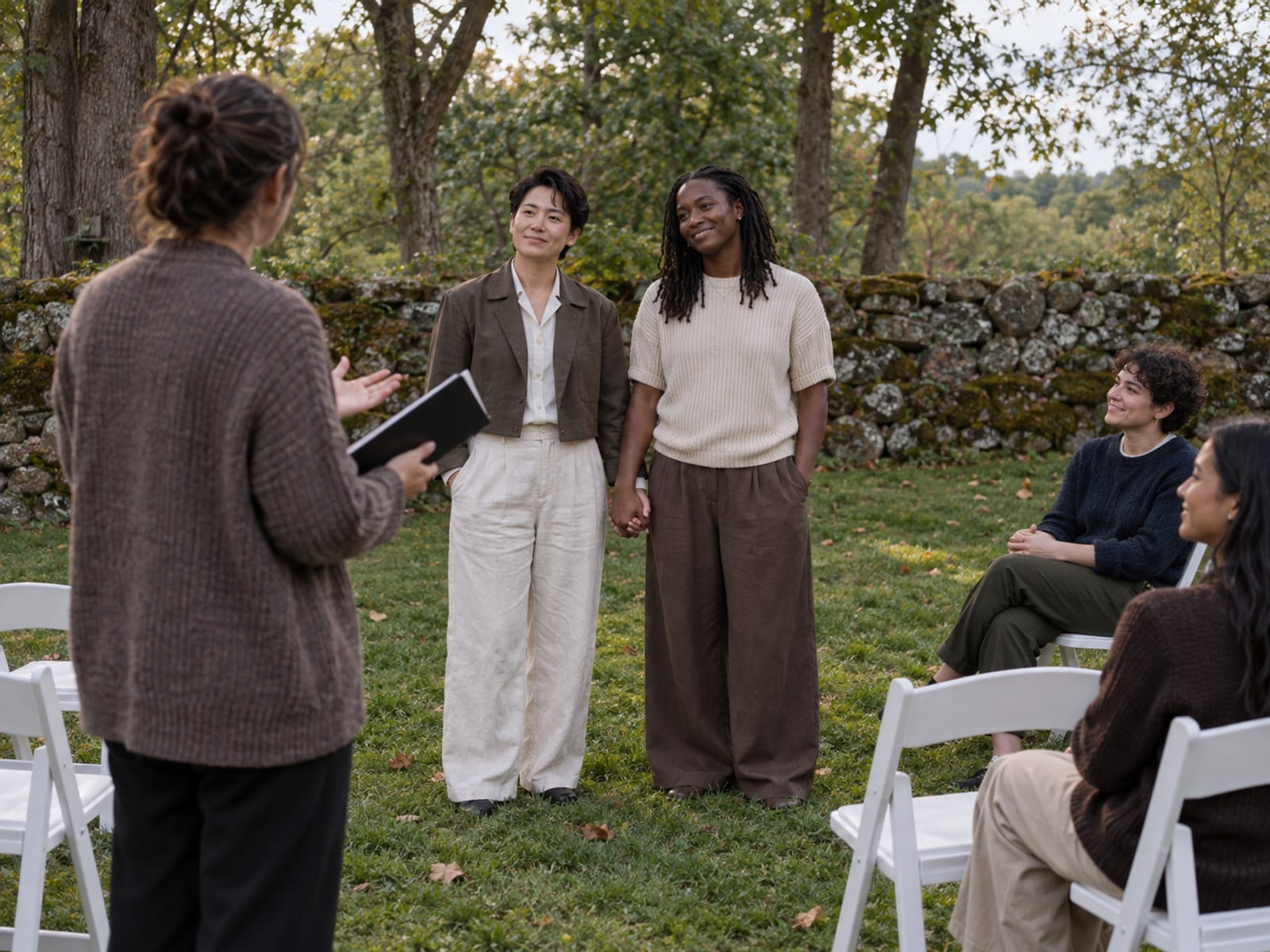
Most ceremonies follow a customary sequence, and The Knot's ceremony order lays out the familiar version. Treat the list below as a template: keep what fits, cut what doesn't, and write a line or two under each heading.
- Guests arrive, music plays. Seating, a quiet moment, any request to put phones away.
- Processional. Who walks in, in what order, and to what music.
- Welcome. The officiant greets everyone and says why you're gathered.
- Family and community. A word for the people who raised you, chosen family, or loved ones who can't be there.
- Reading, prayer or poem. One or two, read by someone you choose.
- Your story or the officiant's remarks. A few minutes about the two of you.
- The declaration. The legal moment, marked in bold in your script.
- Vows. Personal, traditional, or both.
- Ring exchange. A short line from each of you as the rings go on.
- Pronouncement. The officiant declares you married.
- Kiss. Optional, like everything here except the declaration.
- Recessional. You walk out together.
- Signing the license. You, your officiant and your witness sign where the license asks, and the officiant returns it as the Clerk instructs.
The last step is easy to forget in the excitement. Give it a place in the script, with a note on who holds the license and the pen.
How long each part runs, and the whole ceremony
The law sets no minimum or maximum length. Your venue booking and your officiant's format set the real limit, and the elements you choose fill the time. These are planning ranges for a private ceremony, not rules:
Tap or hover a row to highlight it.
| Part | Planning range |
|---|---|
| PartProcessional | Planning range2 to 5 minutes |
| PartWelcome and opening | Planning range1 to 3 minutes |
| PartFamily, guests or absent loved ones | Planning range1 to 3 minutes |
| PartOfficiant's remarks or your story | Planning range3 to 8 minutes |
| PartEach reading, prayer or poem | Planning range2 to 5 minutes |
| PartDeclaration | Planning rangeunder 2 minutes |
| PartPersonal vows | Planning rangeabout 2 to 3 minutes each |
| PartRing exchange | Planning range2 to 4 minutes |
| PartFamily or unity ritual | Planning range2 to 5 minutes |
| PartPronouncement and kiss | Planning rangeunder 2 minutes |
| PartRecessional | Planning range2 to 5 minutes |
Add up only the parts you keep. A ceremony with one reading, short remarks and personal vows lands comfortably in the middle of these ranges; a short civil ceremony can be far shorter. If your venue gives you a tight window, the remarks and readings are the easiest places to trim, and the declaration, vows and rings are the parts guests remember. Share your final timing with the officiant, the venue and any photographer or musician, since their cues depend on it.
How to write your vows
Vows feel like the hardest part, and a simple structure makes them much easier. This six-step pattern works whether you write a few lines or a full page:

- Address your partner by name or by the term you use for each other.
- Name one or two specific things: a quality, a memory, a moment you knew.
- Say what marriage means to you, in a sentence or two.
- Make concrete promises, things you'll actually do.
- Speak to ordinary days and hard ones, how you'll show up in both.
- End with a clear statement of commitment.
For length, a February 2026 article on writing and speaking your vows suggests roughly 200 to 300 words, or two to three minutes, for each of you. You can both follow the same structure without using the same words.
Decide a few things together before either of you starts writing. Will your vows match, with parallel promises, or will each of you write in your own voice? Matching vows suit couples who want an equal shape; different vows suit two people with different styles or traditions. Will they be a surprise, or will you read each other's drafts first? Either works, as long as you agree on tone, length and any subjects to keep out. Many couples let the officiant see both drafts so the lengths stay close.
Then practice out loud, more than once. The same article recommends using notes if you need them, looking up at your partner, and leaving out jokes at anyone's expense, very private details and long wandering stories. Large-print vow cards or a small vow book are easier to read than a phone screen when your hands are a little unsteady.
Sample wording to adapt with your officiant
These samples are starting points written for this page, not official text. Swap in your names, change any word that doesn't sound like you, and confirm the final declaration wording with your officiant.
Sample declaration
> Officiant: [Name], do you solemnly declare that you take [Name] as your spouse? > [Name]: I do. > Officiant: [Name], do you solemnly declare that you take [Name] as your spouse? > [Name]: I do.
Any clear answer works here; "I do" is familiar, but "I will" or "I take you" carries the same meaning.
Sample welcome
> Today, [Name] and [Name] gather with the people who have helped them become who they are. They enter this marriage as equal partners, and they have chosen words that reflect their own family, their values and the life ahead of them. Thank you for being here to witness it.
Sample short vows
> [Name], I choose you as my spouse. I promise to meet our life with honesty, patience and care. I will celebrate your joy, stand beside you in difficulty, and keep making room for who we become.
That vow runs well under a minute. If you want more, add a specific memory after the first sentence and one or two concrete promises before the last.
Wording that fits the two of you
The simplest way to get the language right is to start neutral and then add. Draft the ceremony using your names and "spouse," "partner" or "the couple," and then add the titles and pronouns each of you chooses. A 2026 officiant guide to inclusive ceremonies recommends asking each person which names, pronouns and titles to use before any drafting, and using names wherever a pronoun might be unclear. "I now pronounce you spouses" is a complete pronouncement, and it matches the word the statute uses.
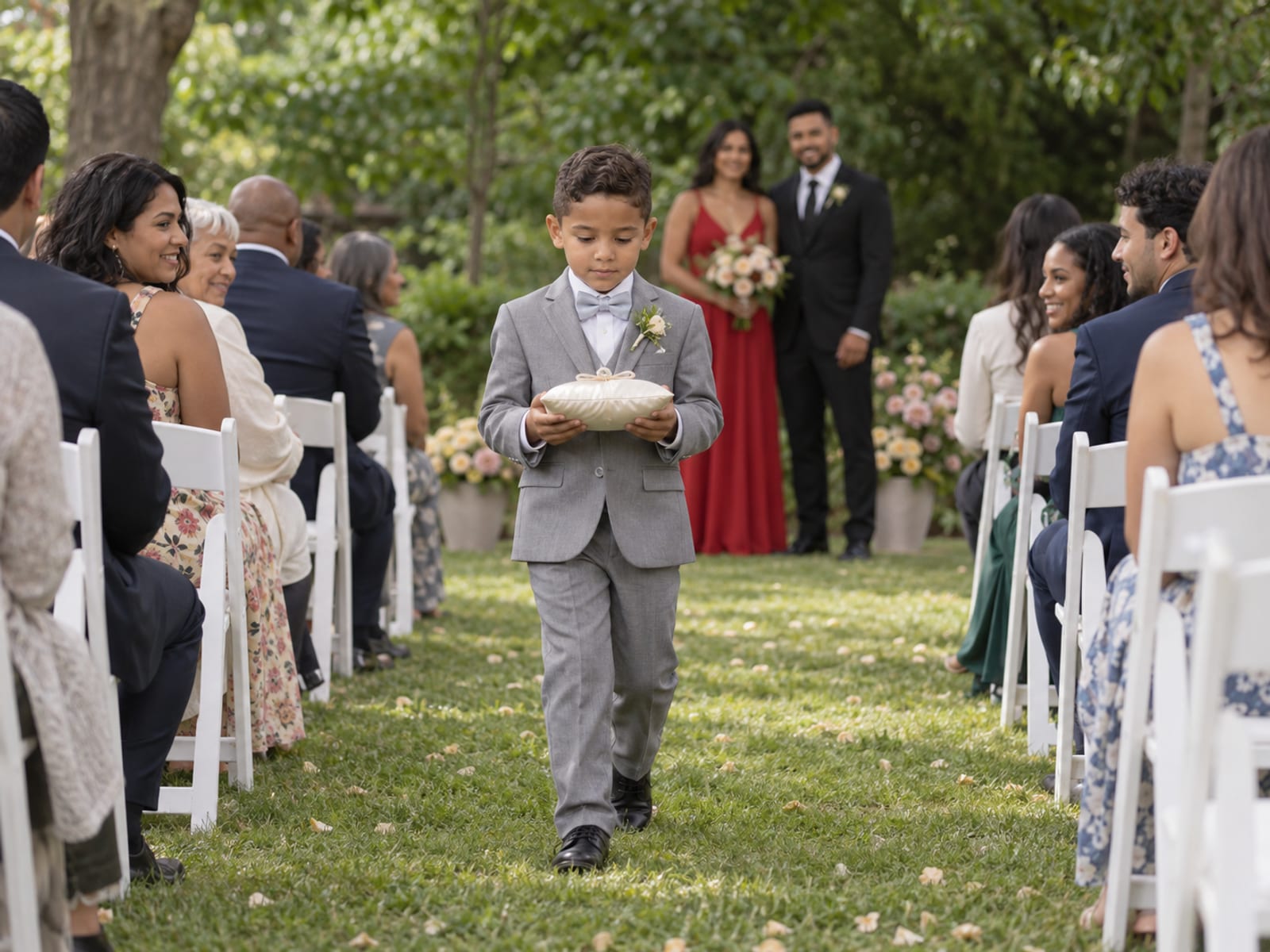
The same approach helps with family. "Those who raised and supported you" includes more people than "your mother and father," and you can drop the giving-away question entirely or replace it with a community vow in which all your guests promise their support. If children are part of your new family, ask them whether they want a role, such as walking in, reading or holding the rings, and keep any promise you ask of them to one they understand.
For a nonreligious ceremony, build around values, promises, community and your shared life instead of prayers. For an interfaith ceremony, sort out which traditions matter to each family and which, if any, a religious institution requires; none of them is required by New York law, so the choice is yours. For a bilingual English and Spanish ceremony, decide early who translates and where: some couples alternate languages line by line, others say their vows in each person's first language and print a translation in the program. For more on planning an inclusive wedding in the city, see the LGBTQ+ weddings guide.
When a friend officiates in NYC
A friend can marry you in New York City, but they need to sort out the paperwork before the day, not after. Your friend first needs authority to solemnize a marriage under § 11, and then has two routes with the City Clerk.
Registration. Per NYC311, your friend submits a Marriage Officiant Registration Application through City Clerk Online, prints it, has the signature notarized, gathers the confirmation number, identification and other required documents, and mails the package with the $15 fee to the Manhattan Office of the City Clerk, 141 Worth Street, New York, NY 10013. Processing by mail takes time and the Clerk does not publish a current estimate, so register well ahead and check timing with the Clerk.
The one-day officiant license. The City Clerk's one-day license (from a Clerk document dated October 9, 2024) is open to anyone 18 or older, including people who don't live in New York. You need your marriage license first. It costs $25, covers only your ceremony, and ends once you're married or your marriage license expires. Afterward, the officiant makes sure the license is completed and returned to the Clerk office that issued it within five days.
The officiant guide on this site covers eligibility and both routes in more detail.
If you marry at the City Clerk
A City Clerk ceremony is a civil ceremony performed by the Office of the City Clerk, by appointment, and NYC311 lists the fee at $25. You bring a valid New York marriage license, identification and at least one witness who is 18 or older, and you arrive between 8:30 AM and 3:15 PM, Monday through Friday. Ceremonies happen at the Clerk's borough offices; the Manhattan office is at 141 Worth Street, not the historic City Hall building.
The Clerk does not publish a script you can rewrite. If personal vows or a reading matter to you, ask the Clerk in advance whether they can be included, and don't plan around it until you have an answer. Many couples split the day instead: the Clerk appointment handles the legal ceremony, and a longer personal ceremony follows separately with a private officiant, at a park, a restaurant or home, where every word is yours.
Quick check: what New York requires
Answer every question to check.
Writing for a vow renewal
A vow renewal is a celebration of a marriage you already have, not a new legal marriage, so there's no new license and no legal declaration. In its place, write a renewal statement, something like "[Name] and [Name], you stand here to reaffirm the promises you made on [date]," followed by reflection on the years behind you and promises for the years ahead. Readings, children, family acknowledgements and rituals all fit well. If your officiant offers a keepsake certificate, keep in mind that it is not a government marriage certificate. The vow renewal guide covers where to hold one, who can lead it and what it costs.
Questions couples ask about ceremony wording
A few questions come up again and again once the draft is underway.
Do the two of us have to say "I do" in New York?
No. The law requires a solemn declaration that you take each other as spouses, not any particular words. "I do," "I will" or a full sentence all work, as long as your officiant and witness hear a clear declaration.
Can we use traditional vows instead of writing our own?
Yes. Section 12 does not require personal vows at all, so traditional vows, a religious text or a mix of old and new words are all fine. Some couples say traditional vows aloud and exchange written ones privately before the ceremony.
Does our witness have to be 18?
For a City Clerk ceremony, yes, the witness must be at least 18. For any ceremony, state law needs at least one witness present besides the officiant, so choose someone reliable who will be there on time with you.
Can we write the ceremony in both English and Spanish?
Yes. Nothing in New York law limits the language of your ceremony. Make sure your officiant can lead the declaration in a language both of you and your witness understand, and give guests a printed translation if many of them speak only one of the languages.
Your next step
With a running order and a first draft of your vows, the next move is getting the legal pieces lined up. Book your marriage license appointment, since both a City Clerk ceremony and a one-day officiant license depend on it; the NYC marriage license guide walks through it. If a friend is officiating, send them to the officiant guide this week so registration isn't a last-minute rush. If you'd rather work with a professional, browse the officiant directory for someone who writes custom ceremonies, and share your draft and timing with them early.
Terms in this guide
Tap a term to see what it means.
Solemn declaration. The statement, made before an authorized officiant and at least one witness, that you take each other as spouses. It is the one part of the ceremony New York requires.