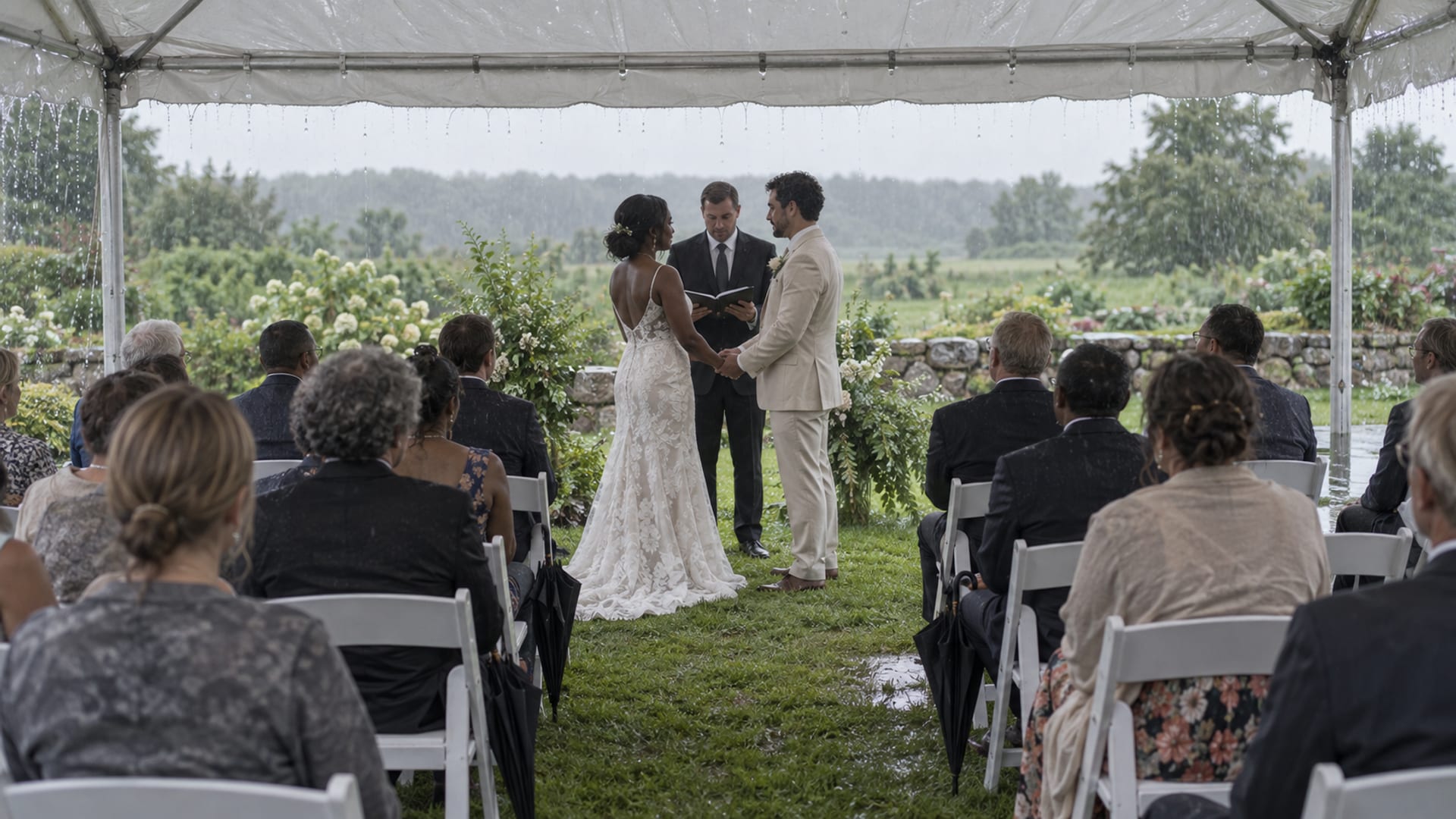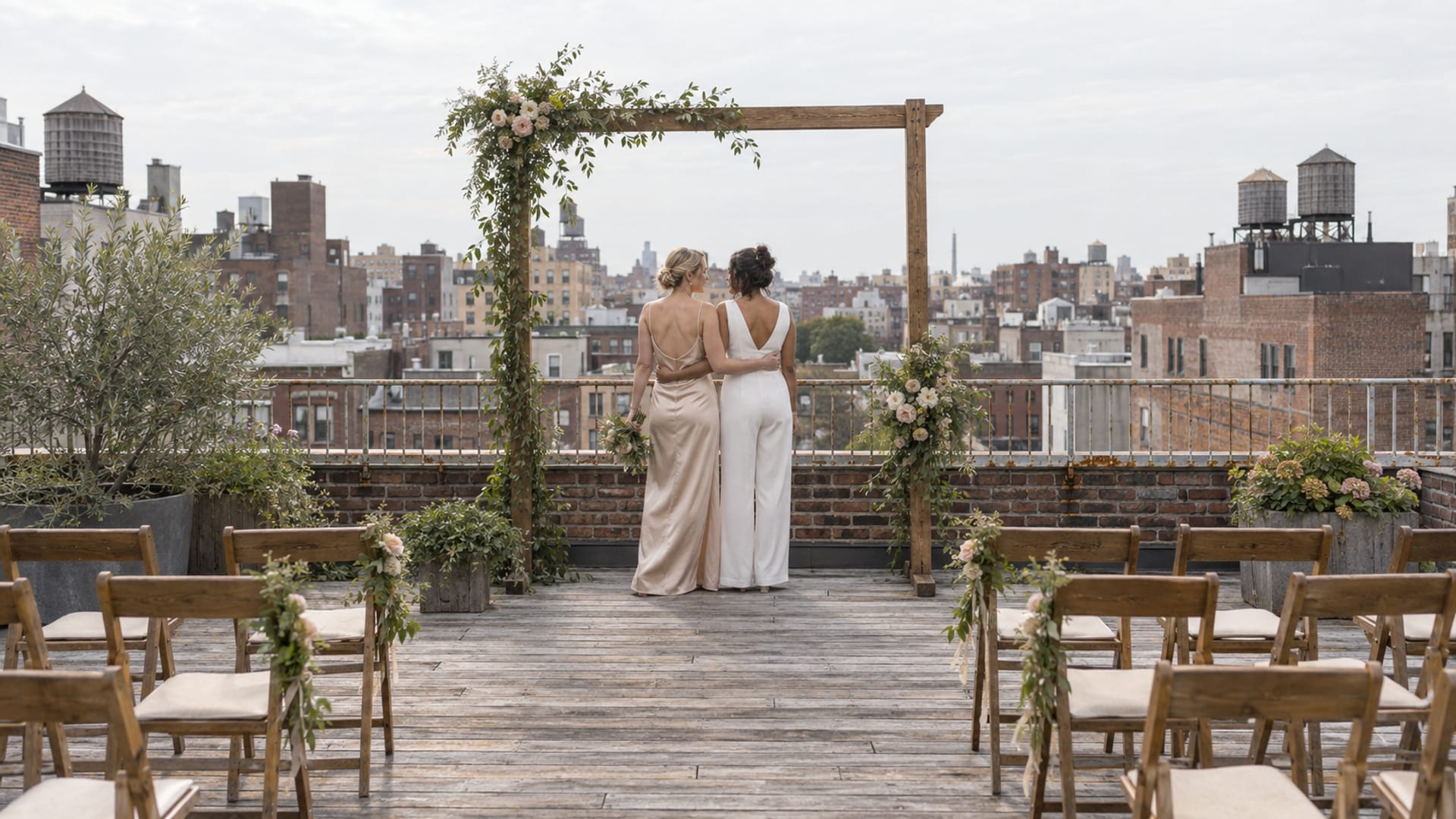
A rooftop wedding in New York City can be a ceremony, a reception, a cocktail hour or a full buyout on a hotel roof, a rooftop restaurant, a terrace, a rooftop ballroom or a private event space. The legal marriage sits alongside it. You can bring your New York marriage license and an authorized officiant up to the roof, or marry first at the City Clerk, where the ceremony costs $25 according to NYC311, and celebrate upstairs afterward. Before you book, get four things from the venue in writing: the legal capacity for your layout, the food and beverage minimum, the season the roof is open, and the plan for rain and wind.
Key takeaways
Tap a card to bring it forward.
- A rooftop wedding is a venue choice; the marriage itself still needs a New York license and an authorized officiant, on the roof or at the City Clerk.
- Published prices vary widely: one Park Avenue venue lists a $2,500 daytime rental and a $10,000 full buyout.
- A roof terrace where 75 or more people gather needs a Place of Assembly Certificate of Operation, and the posted capacity sign sets the legal number.
- Seated and standing counts differ: Rory's Rooftop publishes up to 80 seated or 200 standing.
- Ask who calls the weather decision, by what time, and whether the indoor backup room is yours alone.
The short answer: what a rooftop wedding can be, and where the marriage fits
A rooftop day can mean vows on an open terrace and dinner inside, a standing cocktail reception after a morning at City Hall, or an entire roof for the evening.
Whatever the format, the roof is the setting and the license is the marriage. In New York City the license costs $35 and there is a 24-hour wait before the ceremony unless a judge grants a waiver, according to the NYC Mayor's Office marriage page. An eligible officiant can perform the ceremony outside the City Clerk's office, as the city's Spanish-language marriage page states, so a legal ceremony on the roof itself is possible when the venue allows it.
The kinds of rooftop venues you can book
Rooftop spaces in the city fall into a few groups, and each handles cost and weather a little differently.
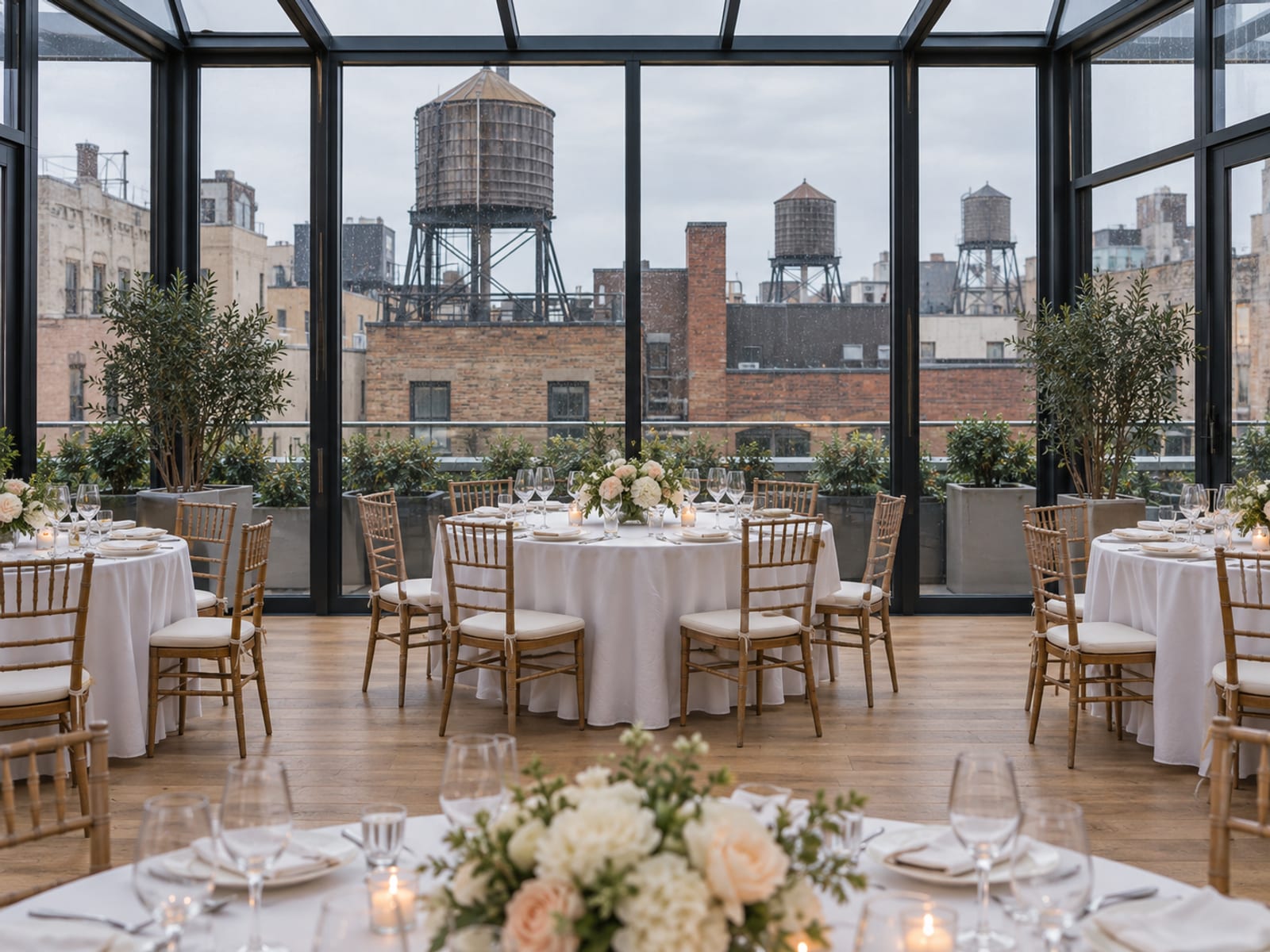
Hotel rooftops and rooftop ballrooms. A hotel brings catering, staff and indoor rooms on the same property, which helps when the weather turns. Some are open terraces used in the warm months; others are enclosed ballrooms at the top of the building.
Rooftop restaurants and hotel bars. These often offer a semi-private section or a full buyout, with an indoor lounge beside an open-air terrace, and suit standing receptions.
Dedicated rooftop event venues. These are built for private events, and some have glass-covered areas so a ceremony can go on in the rain.
Private rentals. Rentable decks and event spaces often price by the hour and leave more of the vendor planning to you.
NYC rooftop venues that publish wedding or event details
Four rooftops publish enough detail on their own pages to give you a starting point. Figures below were read on their pages on September 27, 2026, and each venue will confirm what applies to your date.
The Manner, SoHo. The hotel's wedding page describes a seasonal outdoor rooftop for weddings and receptions, accommodating up to 80 guests in its description, while a capacity field on the same page shows 60. Ask which number applies to your layout.
The St. Regis New York, Midtown. The hotel's events page lists a rooftop ballroom for weddings with capacity up to 220 guests. Its wedding document says that in case of inclement weather the ceremony moves to the Carlton Ballroom, and that for events in the Astor Ballroom the adjoining terrace may be tented for an additional fee.
Bar Cima, near Bryant Park. The Grayson Hotel's rooftop has an indoor lounge and an open-air terrace. Its private events page lists 15 to 75 standing guests for a semi-private event and 15 to 175 standing for a buyout that includes the indoor lounge and the terrace. The location page describes the outdoor patio as weather permitting.
Rory's Rooftop, Meatpacking District. The wedding page lists up to 80 seated or 200 standing guests, an open-air rooftop for ceremonies and an all-glass covered atrium for dinner and dancing. Food and drink packages are custom, so request a quote for your guest count.
| Venue | Area | Published capacity | Weather detail |
|---|---|---|---|
| The Manner | SoHo | Up to 80 (field shows 60) | Seasonal outdoor rooftop |
| The St. Regis New York | Midtown | Up to 220 | Ceremony moves to the Carlton Ballroom |
| Bar Cima | Bryant Park | 15 to 175 standing | Terrace weather permitting |
| Rory's Rooftop | Meatpacking | 80 seated, 200 standing | Glass atrium, tents, indoor floors |
What a rooftop wedding costs
Rooftop pricing comes in layers, and the headline number rarely covers the whole bill. Expect some mix of a site fee or hourly rate, a food and beverage minimum, staffing charges, a deposit, tax and a service charge, with prices shifting by season and by weekday or weekend.
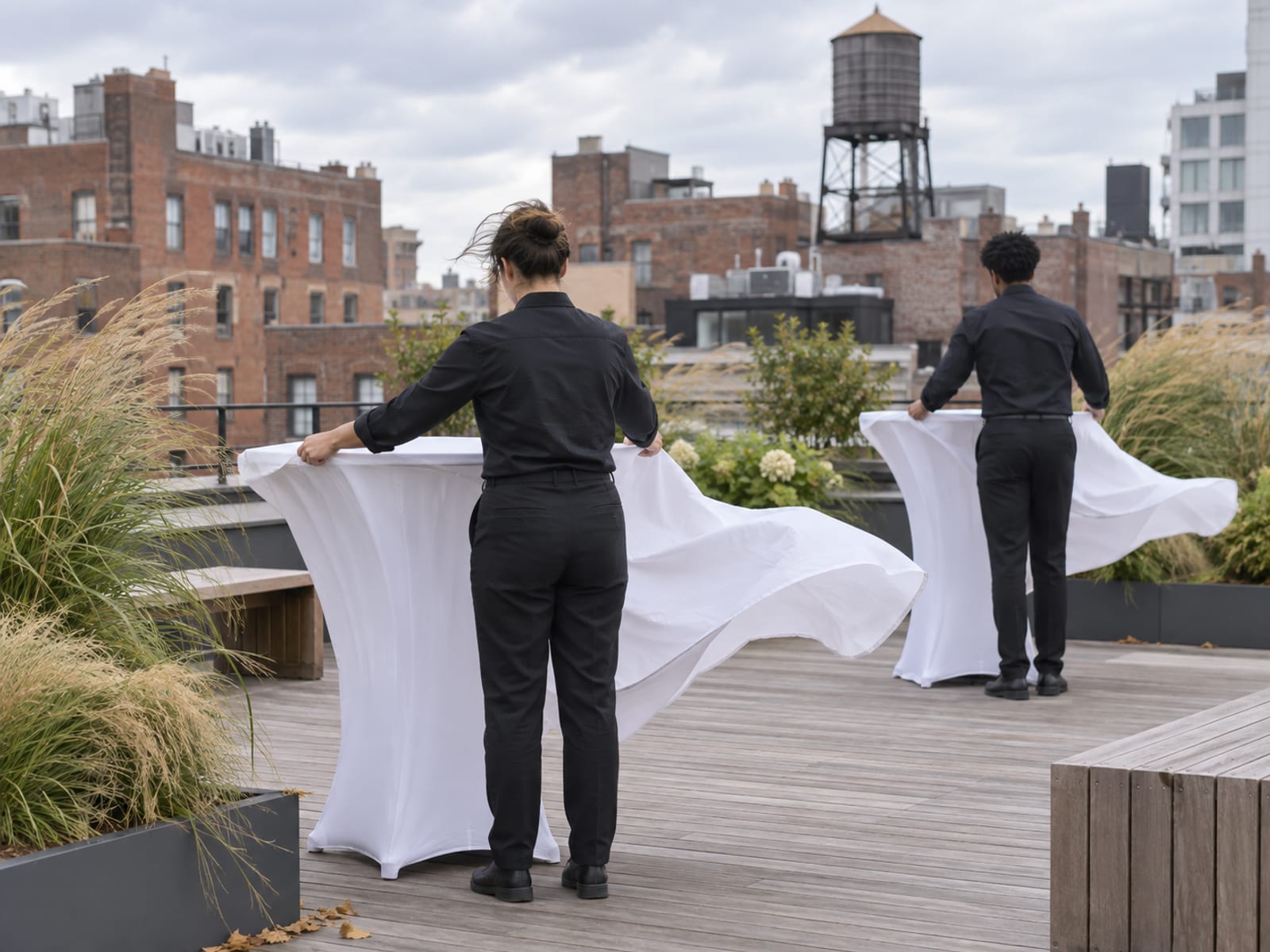
A few venues publish real figures. The Ivory On Park lists a $2,500 daytime rental for four hours, a $6,500 evening rental for six hours and a $10,000 full buyout for 12 hours that includes exclusive rooftop access. 13th Storey in Midtown starts at $500 per hour with a four-hour minimum for all events, plus $250 to $500 per event for cleaning and reset and a $250 setup fee for additional tables and seating. The Delancey notes that the prices in its 2026 event deck exclude tax and service, so ask every venue the same question.
Prices change by space and season. When you request quotes, give each venue the same date, guest count and hours, and ask for a total with tax, service charge, gratuity, staffing and rentals included.
How many guests a roof can hold
The guest count on a venue's website is a marketing figure. The legal number comes from the building's paperwork, and it can change with your layout: a seated dinner holds fewer people than a standing reception, and a dance floor takes space from both.
NYC Buildings sets the key threshold on its Place of Assembly page. A Place of Assembly Certificate of Operation, called a PACO, is required where 75 or more people gather indoors or on roof terraces, and where 200 or more gather outdoors. Rooftops and roof terraces 20 feet or more above grade used for gatherings count as indoor spaces for this rule, so most city roofs fall under the 75-person line. Before a space can legally operate, it must post a capacity sign based on the Certificate of Occupancy, reading "OCCUPANCY BY MORE THAN _____ PERSONS IS DANGEROUS AND UNLAWFUL."
The Fire Department also requires a public assembly permit to operate a place of assembly, described by NYC Buildings as valid for one year, and details are on the FDNY permit page. Count everyone who will be on the roof, including your photographer, band and catering staff, and ask the venue to confirm that the total fits its posted capacity and permits.
Holding it on a private or residential roof
A friend's building or your own co-op roof can look like the simplest option, but permission to go up there is only the first step. Access is controlled by the owner, landlord, co-op board or condo association under the lease and house rules, so get their consent in writing before you plan around it.
Then the building has to confirm that the roof can legally and safely hold your event:
- Legal use and capacity. Check the Certificate of Occupancy and the building's records in DOB's BIS and DOB NOW systems, which DOB's tenant guidance points to. At 75 or more people, the PACO rule above applies.
- Structure and edges. Occupied roofs carry live-load requirements, and DOB Bulletin 2018-002 calls for anchoring furniture, planters and decorations against wind. The Building Code generally calls for a parapet, guard or fence at least 42 inches high on buildings over 22 feet tall.
- Tents and stages. A tent or canopy larger than 400 gross square feet needs a DOB permit, according to the city's event permitting page. A Temporary Use Permit is filed by a registered architect or professional engineer at least 15 business days ahead and costs $100 for the first 30 days.
- Candles and flames. FDNY requires an Open Flame Permit, $210 per setup, for open flames at a public gathering. Heaters and grills also need advance FDNY and DOB review.
- Music. Noise rules apply to private parties too, and 10 p.m. is the key nighttime line.
What happens with rain, snow, wind, heat or cold
New York weather swings a lot across the year. National Weather Service Central Park normals put the average high at 61.8°F in April, 79.7°F in June, 84.9°F in July, 76.2°F in September and 64.5°F in October, with average lows of 45.5°F, 64.4°F, 70.1°F, 62.3°F and 51.4°F in those months. Rain varies too: Central Park recorded 59.29 inches in 2023, 46.37 in 2024 and 39.57 in 2025, according to the NWS precipitation record. These are averages, not a forecast for your date.
Hover or tap a bar to see its value.
- April61.8°F
- July84.9°F
- October64.5°F
Venues handle weather in different ways. Rory's Rooftop says its glass atrium lets ceremonies and receptions continue regardless of the weather, and adds that it can provide tents to extend the covered space and use additional indoor floors as a backup. The St. Regis moves the ceremony to a ballroom. The Manner's rooftop is seasonal, so ask which months it opens. Ask each venue what hours its rooftop is open for weddings, and check the sunset time for your date if you want golden light for the ceremony.

Wind thresholds, decision deadlines and cancellation terms differ by venue and belong in the contract. Ask who makes the call to move inside, how many hours ahead, and what happens to your flowers, seating and music when you move. A tent on a roof may need permits and must be designed for wind. For comfort, a light wrap or hand warmers help on an October evening, and flat backup shoes help on rooftop decking.
What to ask before signing
Bring this list to every site visit and ask for the answers in writing:
- Capacity: the legal capacity for your exact ceremony, dinner, dance floor, vendor and staff layout, and who holds the PACO and FDNY permit.
- Rain plan: whether the indoor backup room is included in the price and reserved only for you.
- Wind and weather: which wind, lightning, heat, cold, rain or air-quality conditions trigger a move, and the latest time for deciding.
- Tents and heaters: whether they are allowed, who obtains approvals, and whether the tent is rated for the roof.
- Vendors: whether outside caterers, florists, DJs, bands, planners and rentals are allowed, and any corkage, cake-cutting, cleaning, security or overtime fees.
- Access: guest elevators, a freight elevator, load-in and breakdown times, and an accessible route from the street to both the roof and the rain space.
- Sound and curfew: music end time and any decibel limit. For commercial venues, the NYC311 noise rules cap music between 10 p.m. and 7 a.m. at 42 decibels inside nearby homes.
- Money: the deposit, payment schedule, and what tax, service charge, gratuity and staffing add to the total.
- Cancellation: postponement, cancellation and force-majeure terms, and whether you need event insurance.
- Season: whether the roof is seasonal or has reduced hours on your date.
A document folder with labeled sections keeps the contract, insurance papers and your license together on the day.
Quick check: rooftop capacity and permits
Answer every question to check.
How the legal marriage fits with the rooftop event
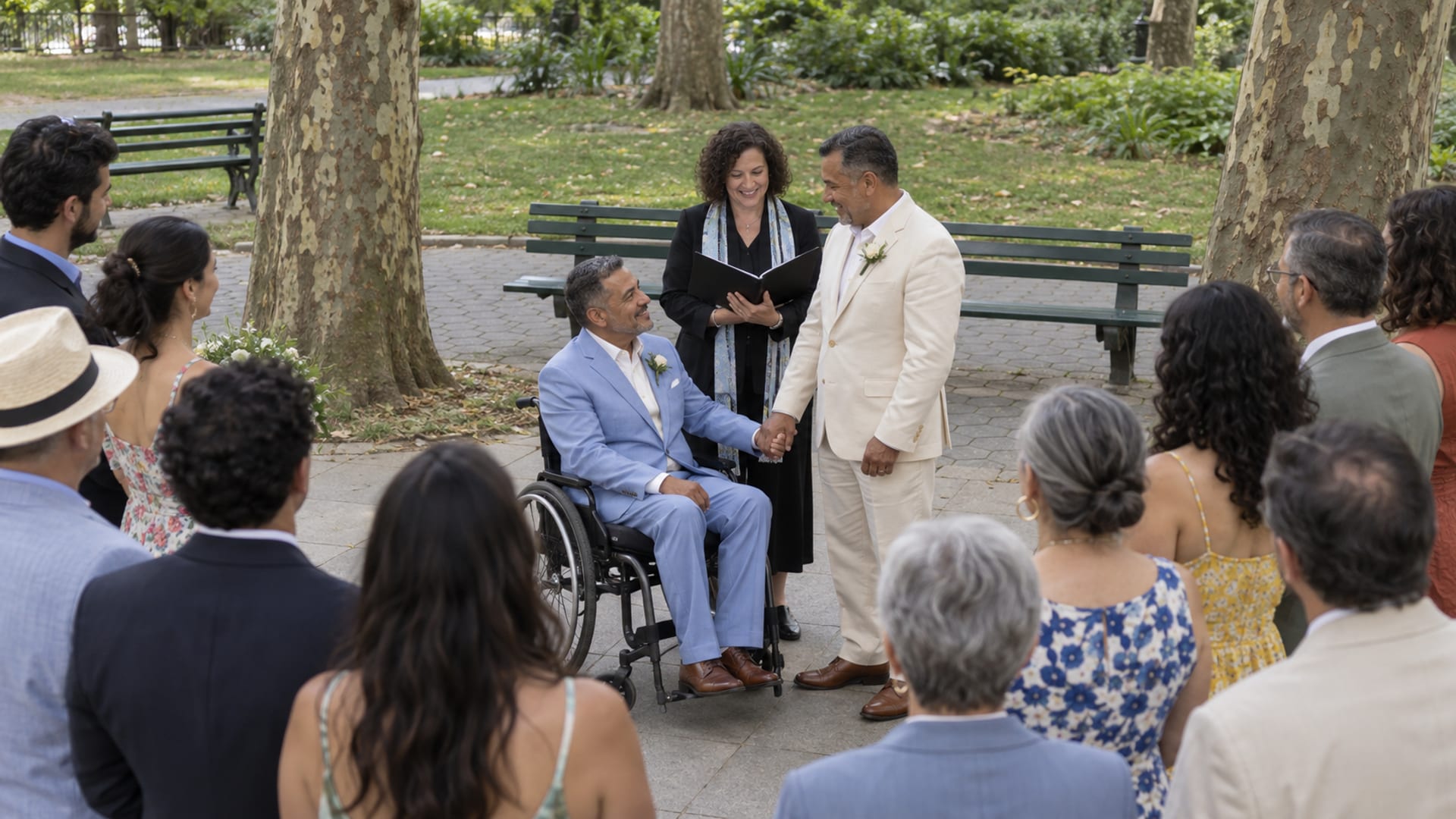
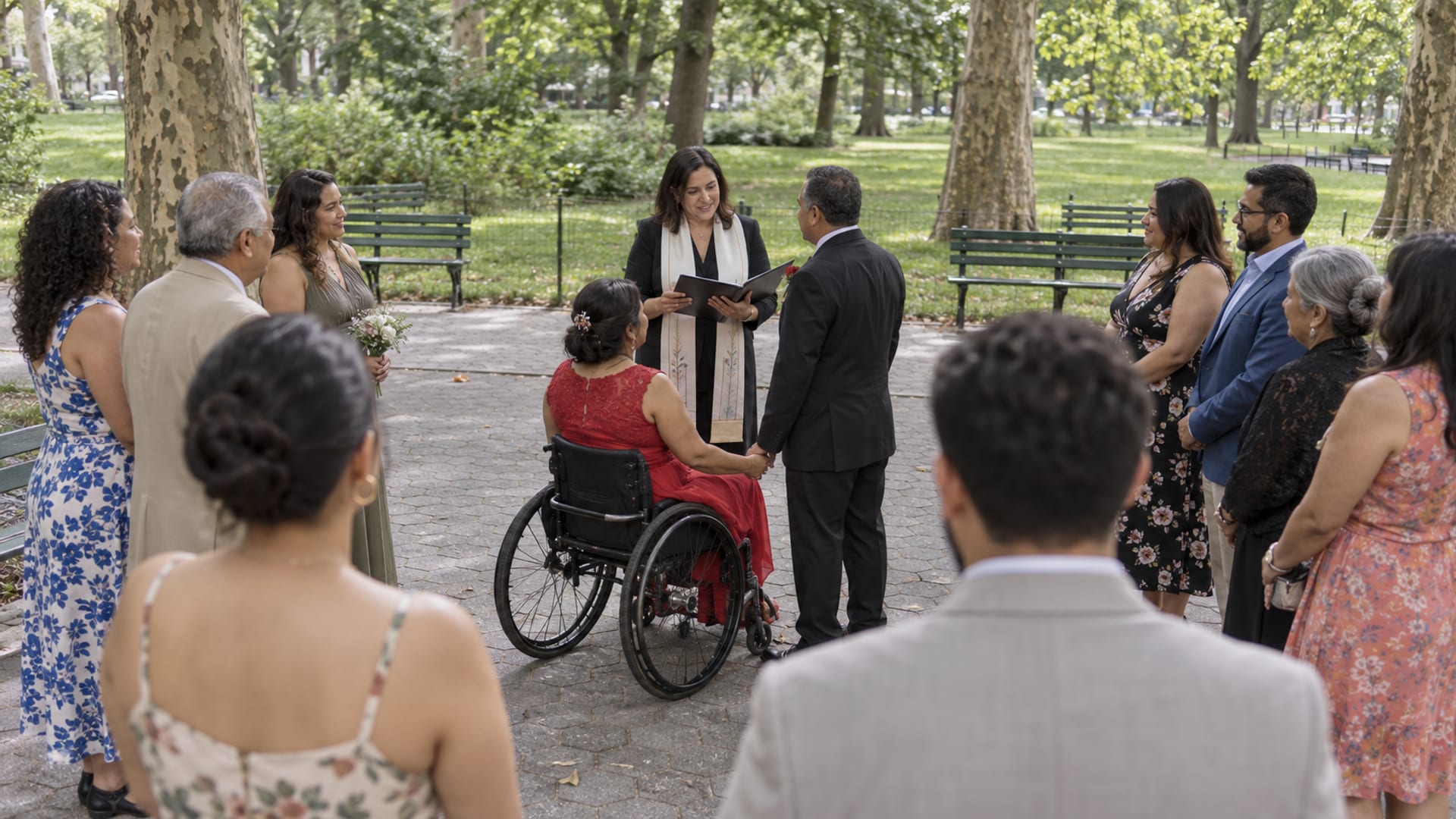
You have two paths. The first is to marry on the roof: get your license, wait 24 hours, and bring an officiant who is authorized to perform marriages in New York. The second is to marry at the City Clerk first. NYC311 says the ceremony costs $25, needs an appointment with no walk-ins, and requires your license, the photo ID you used to get it and at least one witness age 18 or older. NYC311 also says no more than six people may attend, including the couple and the witness; confirm the current limit when you book, because another Clerk announcement words it differently.
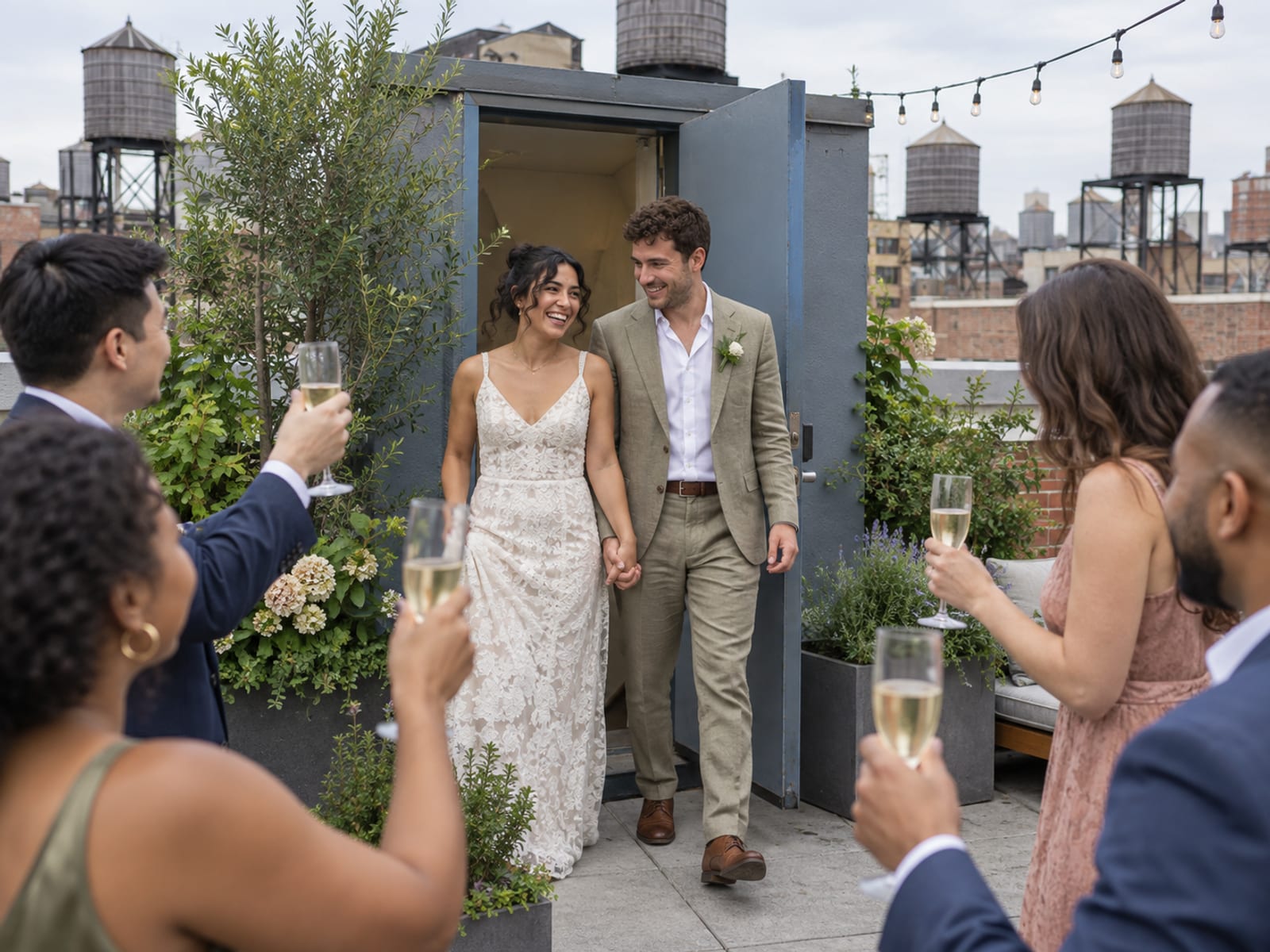
The City Clerk does not come to your roof, so a ceremony upstairs needs your own officiant. For the steps in detail, see the marriage license guide, the City Hall wedding guide, the Project Cupid guide for online appointments and the guide to who can officiate in NYC.
Step by step: marrying on the roof itself
Tap or hover a step to follow the order.
Get your license
A New York marriage license costs $35 in New York City.
Wait 24 hours
The ceremony can't take place until 24 hours after the license is issued, unless a judge grants a waiver.
Book your own officiant
The City Clerk does not come to your roof, so bring an officiant authorized to perform marriages in New York.
Marry upstairs
With the venue's permission, the officiant performs the legal ceremony on the roof.
Questions couples ask about rooftop weddings
These answers cover the details that tend to come up after the venue shortlist is set.
Do vendors and staff count toward the roof's capacity?
They should be part of your count. The expected occupant load includes guests, vendors and staff, and the posted capacity sign is the legal ceiling. Give the venue your full headcount, including your band, photographer and catering team.
Can we use candles on the roof?
Candles and other open flames at a public gathering need an FDNY Open Flame Permit, which costs $210 per setup. Under the Fire Code, candles must be attended, secured against tipping, set on a noncombustible surface and kept at least 3 feet from anything that can burn. Ask the venue whether it holds the permit or whether your florist must.
How far ahead does a rooftop tent need approval?
A Temporary Use Permit is filed by a registered architect or professional engineer no later than 15 business days before the tent goes up. The fee is $100 for the first 30 days and $130 for each additional 30 days, and tents over 400 gross square feet need a DOB permit. Ask the venue who files.
The next step
Pick two or three venues whose capacity fits your guest list and send each the same request: your date or season, guest count, ceremony and reception hours, and a full written quote with the rain plan. While you wait, read the marriage license guide, the officiant guide if you plan to marry on the roof, and the City Hall wedding guide if you would rather make it legal downtown first. The venue directory and the listings for photographers, florists, planners and party rentals cover the rest of the day.
Terms in this guide
Tap a term to see what it means.
Buyout. Renting a whole rooftop or venue for your event, as opposed to a semi-private section.