Choose the hotel area by the venue first, then compare the airport route, subway access, room rate and room-block terms. Manhattan is often simplest for a City Hall ceremony and many Manhattan venues, while Downtown Brooklyn, Long Island City, other parts of Queens, the Bronx, Staten Island, Jersey City and Hoboken work well when the venue or the budget points there. For a benchmark, NYC Tourism + Conventions reported a 2025 citywide average daily rate of $334 and occupancy of 84.2 percent. Before you commit, ask each hotel whether its block is courtesy or contracted, and when unbooked rooms are released.
Key takeaways
Tap a card to bring it forward.
- Start from the venue address, then check the airport route and the subway or train line from the hotel.
- The 2025 citywide average room rate was $334 a night, with 84.2 percent occupancy; your dates will price differently.
- A courtesy block releases unbooked rooms at the cutoff; a contracted block can leave you owing for rooms guests do not book.
- Get the cutoff date and the attrition terms in writing, and set your own guest deadline before the hotel's.
- A whole apartment cannot legally be rented for under 30 days in NYC; a hotel is the simpler default.
- Send guests one clear message with the booking link, code, cutoff, transit notes and a second hotel option.
The short answer: pick the base by the venue
The right hotel keeps the wedding-day trip short and fits what guests can reasonably pay. Start with the ceremony and reception addresses, find the neighborhoods with a direct subway, PATH or commuter-rail line to them, then check which airports guests fly into. Only then does the room rate decide between two areas that both work.
Treat the $334 figure as a sense of scale, not a quote: it is an annual average across every kind of hotel and every night, so your Saturday can land well above or below it. With occupancy that high, rooms on popular weekends fill, which is why the block decision comes early.
Which neighborhood fits your venue
A good base answers four questions: how far is the venue, how do guests get in from the airport, what does a room cost, and can older relatives, young children and guests with disabilities manage the trip. When those pull in different directions, the venue usually wins, because guests make that trip in formal clothes, sometimes late at night.

Staying near an airport shortens the arrival trip but can add a long ride on the wedding day. And while all five boroughs have hotels, room supply and transit vary a great deal by neighborhood, so look at the actual station and route rather than the borough name. The MTA trip planner will give you a hotel-to-venue route for your real addresses and time of day, and the MTA subway map shows which lines connect which areas.
Everyone does not need to stay in one hotel. One central hotel keeps coordination simple, and a second in a different price range or near a different airport can serve the guests the first one does not.
Where guests can stay, borough by borough
Each area below suits some weddings and not others. Transit times change with the address, the hour, transfers and service work, so confirm every route with the trip planner.
Manhattan. Lower Manhattan, the City Hall area, Tribeca, SoHo and the Financial District suit a City Hall ceremony, Lower Manhattan venues and anything near the Brooklyn Bridge. At the City Clerk's office, NYC311 limits the ceremony to six attendees, including the two of you and your witness, so most guests will join you afterward. Midtown suits Midtown, Chelsea, Hudson Yards and many other Manhattan venues, and it generally carries higher rates. Upper Manhattan can work for venues in northern Manhattan or the Bronx.
Brooklyn. Downtown Brooklyn is a practical base for Brooklyn venues and has direct subway lines into Lower Manhattan. The Sheraton Brooklyn describes itself as one train stop from SoHo, Little Italy and Chinatown and says rates vary by date and room type. Williamsburg suits north Brooklyn venues, and Park Slope and Sunset Park suit venues nearby. NU Hotel Brooklyn publishes an offer of discounted rates for blocks of up to twenty rooms.
Queens. Long Island City has quick access to Manhattan and can be practical for guests landing at LaGuardia. Astoria suits Queens venues and has subway service. Jackson Heights and Woodside sit where the Q70 bus from LaGuardia meets the subway and the LIRR. Kew Gardens suits Queens venues and the area along Queens Boulevard.
The Bronx. The Bronx is not one hotel market, so compare hotels near your specific venue and near a subway or Metro-North station. A hotel that is easy for a northern Bronx venue can be a long trip for a City Hall or Lower Manhattan wedding.
Staten Island. Stay here for a Staten Island venue, and plan around parking and whether guests will drive or take the ferry.
Jersey City and Hoboken, across the river. Both can work for Lower Manhattan venues through PATH. Newark suits Newark-area venues or guests focused on Newark Liberty, though it lengthens the trip to most city venues. Check PATH alerts for your date.
What a New York City hotel room costs
The clearest numbers available are citywide annual averages. NYC Tourism + Conventions reported an average daily rate of $303 in 2024, and its 2025 report put the figure at $334, up 5 percent. Occupancy in 2025 ran 87.5 percent at upscale hotels and 76.7 percent at midscale ones.
Tap or hover a row to highlight it.
| Measure | Figure | Source |
|---|---|---|
| MeasureAverage daily rate, 2024 | Figure$303 | SourceNYC Tourism + Conventions |
| MeasureAverage daily rate, 2025 | Figure$334, up 5 percent | SourceNYC Tourism + Conventions |
| MeasureOccupancy, upscale hotels, 2025 | Figure87.5 percent | SourceNYC Tourism + Conventions |
| MeasureOccupancy, midscale hotels, 2025 | Figure76.7 percent | SourceNYC Tourism + Conventions |
Individual hotels show how wide the range runs. Park House Hotel in Brooklyn posted rates, as read September 27, 2026, of $199 plus tax for a single Sunday through Thursday and $229 on Friday, $219 plus tax for a double Sunday through Thursday and $249 on Friday, and $850 plus tax for a two-bedroom penthouse, all subject to change and availability. On the same day, the Sheraton Brooklyn page displayed a rate from $612 a night for the dates shown, a single dated result rather than a typical rate.
Tap or hover a row to highlight it.
| Hotel and room type | Sunday to Thursday | Friday |
|---|---|---|
| Hotel and room typePark House Hotel, single | Sunday to Thursday$199 plus tax | Friday$229 plus tax |
| Hotel and room typePark House Hotel, double | Sunday to Thursday$219 plus tax | Friday$249 plus tax |
| Hotel and room typePark House Hotel, penthouse | Sunday to Thursday$850 plus tax per night | Friday |
Plan with the annual averages and get real quotes for your exact nights. Weekends, major events, lead time, room type and neighborhood all move the price. NYC Tourism + Conventions forecast about 1.2 million regional visitors for the 2026 FIFA World Cup. When you compare, always ask for the rate with taxes and fees included.
Whether to hold a room block, and what to ask first
A room block is a set of rooms a hotel holds for your guests, usually at a group rate, and the two kinds behave very differently. According to Princeton University's group travel guidance, a courtesy block holds rooms until a cutoff date and then releases the unbooked ones with no financial obligation to you. It generally suits smaller groups where guests pay for their own rooms.

A contracted block guarantees a set number of rooms or room nights at a negotiated rate, and you accept a minimum. That minimum is often written as an attrition percentage. Princeton's example: 50 rooms for two nights is 100 room nights, and with 20 percent attrition the group must use at least 80. If guests book only 70, the group may owe for the other 10. So, sign a contracted block only when you are confident about how many guests will actually book.
The cutoff date and the attrition terms are separate things. The cutoff is the booking or rooming-list deadline, and the attrition date or measurement method can be different, as the Blocks.travel contract guide explains. One University of Virginia contract summary describes a four-week cutoff, after which unreserved rooms go back to general inventory, with attrition fees possible after that. These are contract terms, not city law, and they differ by hotel.
A block does not automatically save money, so compare its rate with the public rate and nearby hotels, after taxes and fees. Before you sign, get these in writing:
- Is the block courtesy or contracted?
- The exact rate, which room types it covers, and whether taxes and fees are included.
- The minimum room-night commitment and the attrition percentage.
- How attrition is measured: by room or room night, night by night or overall, at the cutoff or at arrival.
- Whether rooms the hotel resells count toward your total, and whether the block can be reduced at a review date.
- The cutoff date, and what happens to rooms already booked by then.
- The deposit and cancellation schedule.
- Whether the group rate extends to extra nights before or after.
- Breakfast, parking, a shuttle, luggage storage, early check-in and any complimentary rooms or a suite for getting ready.
- How many accessible rooms and adjoining rooms are available, plus cribs and elevator access.
How guests get from JFK, LaGuardia and Newark
Each airport connects differently, and the best one for a guest depends on where the hotel and the venue sit.
JFK. The MTA airport guide describes a subway plus AirTrain route from Grand Central of roughly 60 to 75 minutes, including waiting, connections and walking. The same document lists a $2.75 subway fare and a $5 AirTrain JFK fare, but it is not a current fare page, so check fares before you send them to guests. Hotels near the E, J, Z or 7 trains, or near the LIRR, tend to be easier from JFK, depending on the exact route.
LaGuardia. The Q70 LaGuardia Link runs between the airport and Woodside and Jackson Heights, where guests can change to the E, F, M, R and 7 trains, the LIRR or local buses, and the MTA says the Q70 has been fare-free since May 2022. Recheck that status close to your date. The M60 SBS also connects LaGuardia with 125th Street in Manhattan.
Newark Liberty. AirTrain Newark links the terminals to the airport rail station, where NJ Transit and Amtrak stop. Reaching PATH from the airport usually takes another connection. The Port Authority has issued advisories when airport rail service changes, so guests should check current conditions before they travel.
Inside the city, check MTA planned service changes for your wedding weekend, and PATH's own site for New Jersey service. A car service or wedding shuttle is worth pricing when the venue is hard to reach by transit or older and mobility-limited guests are coming; the directory's transportation listings are a place to start.
Renting an apartment for the weekend
A hotel is the simpler default, because the city's short-term rental law is strict. Under Local Law 18, the NYC Office of Special Enforcement says an entire apartment or home cannot be rented for fewer than 30 days. A stay under 30 days is allowed when the host lives in the same unit during the stay, guests have access to the whole unit, and the stay is limited to two guests, not counting children under four. Hosts must register with the office, and guests cannot sleep in attics, cellars or garages unless the Department of Buildings has authorized it.
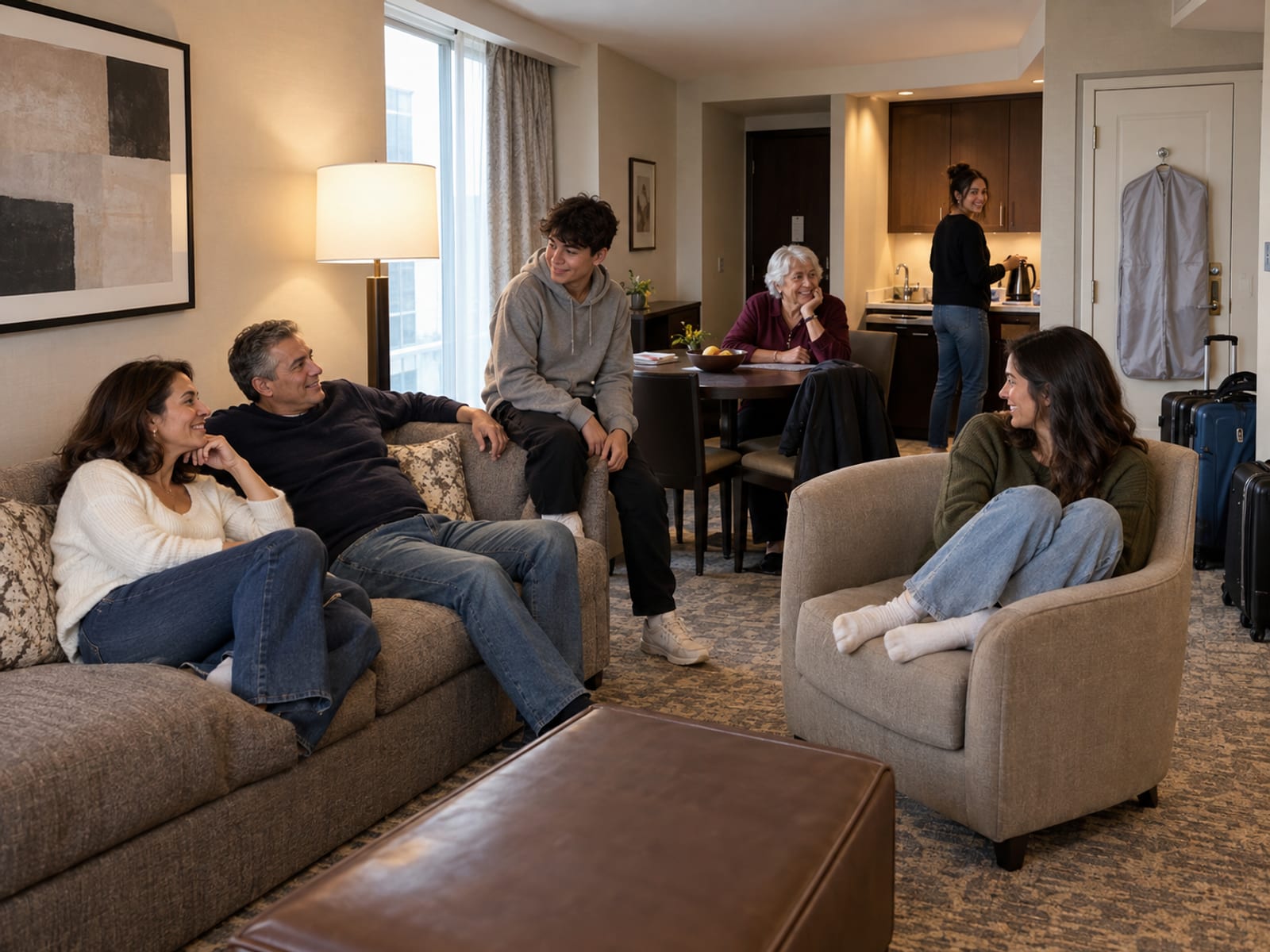
So, a whole apartment for six relatives over a weekend is not something to count on. If a guest wants a kitchen or more space, check that a listing is registered and follows these rules before passing it along, or look at hotel suites. For relatives who read Spanish, send the official links along with the key rules explained in your own message.
How far ahead to book
This is planning guidance rather than a rule. Start comparing areas as soon as the venue and date are fixed, and request block quotes then, especially for popular weekends, larger groups or dates with a major city event. If you can, open the block before invitations go out so the booking details can travel with them.
Then set your own deadline for guests earlier than the hotel's cutoff. That leaves time to count bookings, nudge anyone who has not reserved, and ask about extra rooms before unbooked ones return to general inventory and the group rate may lapse.
Step by step: lining up guest rooms
Tap or hover a step to follow the order.
Fix the venue and date
Write down the ceremony and reception addresses and times; everything else follows from them.
Choose a main area and a backup
Check the route from each area to the venue on the MTA subway map or with PATH for your date and time.
Request block quotes
Ask two or three hotels for courtesy and contracted terms in writing, with the rate after taxes and fees.
Open the block before invitations go out
The booking link, group code and cutoff date can then travel with the invitation.
Set your own deadline
Make it earlier than the hotel's cutoff so you can count bookings and nudge guests who have not reserved.
Recheck close to the date
Look at MTA planned service changes and PATH alerts for the wedding weekend.
What to send guests
Guests book more easily when everything is in one message. Include:
- The hotel name, neighborhood and street address.
- The booking link and group code.
- The dates the rate covers and the cutoff date to book by.
- The rate, with taxes if you know them, and the cancellation policy.
- How to get from the hotel to the ceremony and reception, with the subway or train line and the stop.
- The easiest route from each airport your guests are using.
- A contact for accessible rooms, adjoining rooms or other needs.
- A second hotel option at a different price or location.
A simple folder or accordion organizer keeps confirmations, the block contract and printed directions together; look for labeled sections and a secure closure. Guests traveling with formalwear will want a garment bag with a sturdy zipper, breathable fabric, hanger support and a compact folding design.
Quick check: blocks, rentals and rates
Answer every question to check.
Questions couples ask about guest hotels
These cover the details that come up once the neighborhood is chosen.
Can guests book outside the room block?
Usually guests can book the same hotel or another one at the public rate. Under a contracted block, though, rooms booked outside it may not count toward your minimum, so ask the hotel how it credits them.
How many rooms should we block?
Start from the guests who will actually need rooms, not the whole guest list, and think in room nights. A modest courtesy block carries no penalty if it goes unfilled, while a large contracted one can, so size a contracted block to the pickup you expect. NU Hotel Brooklyn, for one, advertises blocks of up to twenty rooms.
Does the group rate include taxes?
Not always. Park House Hotel, for example, lists its posted rates "plus tax," so ask every hotel for the total per night so your guests can compare fairly.
Is a wedding shuttle worth it?
A shuttle earns its cost when the reception ends late and guests would otherwise scatter across the city at night. Ask whether the hotel includes one as part of a block before you hire a separate transportation company.
Your next step
Write down your venue address, pick one main neighborhood and one backup, and request courtesy and contracted block terms from two or three hotels in each so you can compare the totals side by side. Then check the route from each hotel to the venue on the MTA or PATH site for your wedding date and time. If your ceremony is at the City Clerk's office, read the City Hall wedding and marriage license guides next; for other celebrations, the borough cost guide and the venue guides for the Hudson Valley, Long Island and North Jersey help you line up the rest of the weekend.
Terms in this guide
Tap a term to see what it means.
Room block. A set of rooms a hotel holds for your guests, usually at a group rate.