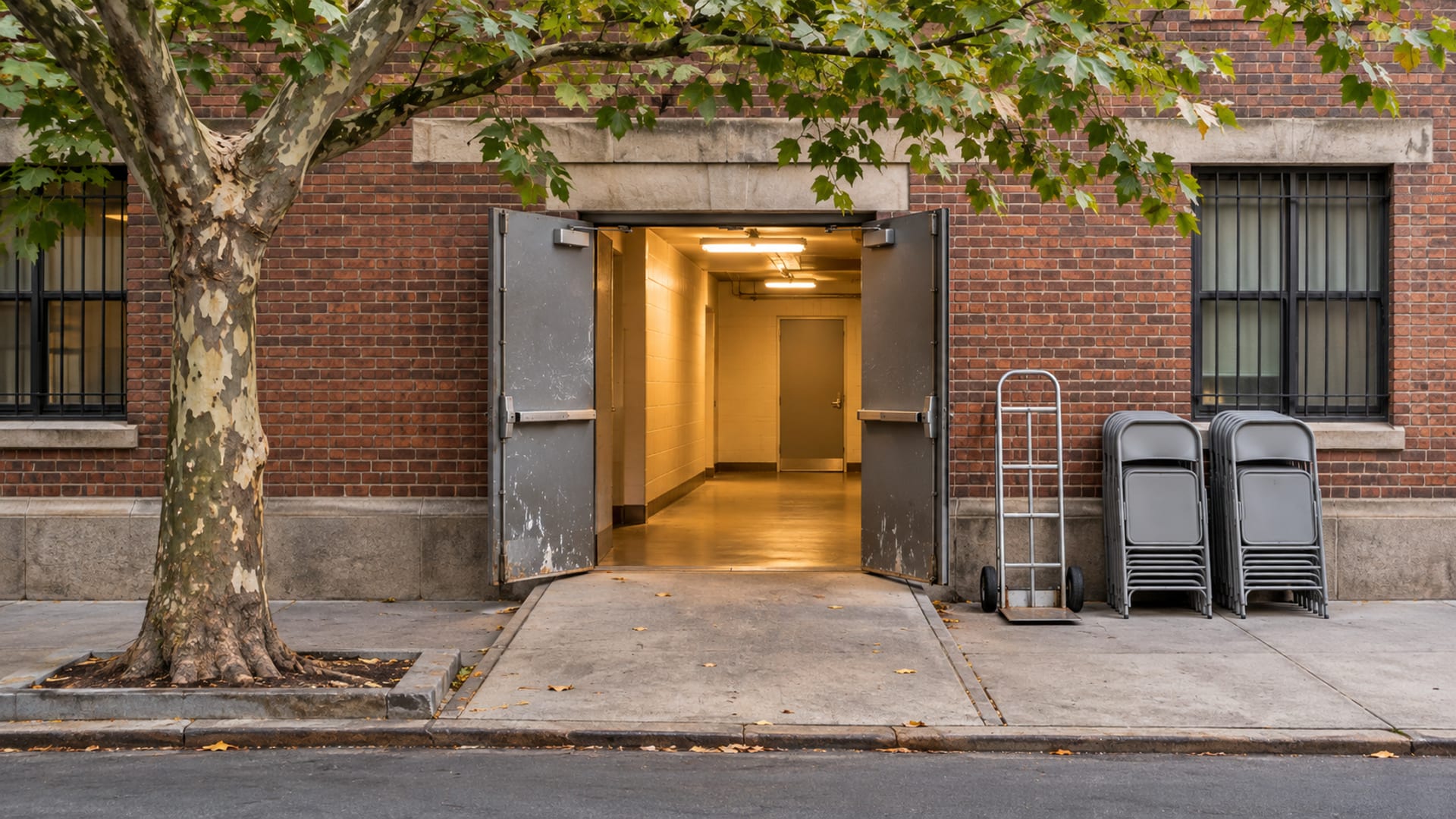
Your venue's load-in plan should settle seven things before you sign: the vendor arrival window, the loading dock or freight-elevator route, vehicle and insurance rules, who sets up, the breakdown deadline, the trash plan, and the overnight-storage rule. Every fee tied to those items belongs in the same plan.
A freight elevator or a curb space is never a promise of access. Flight Deck publishes freight-elevator hours of 8:30 a.m. to 5:30 p.m., asks vendors for a certificate of insurance (COI) in advance, and routes loading through its Depew Place dock. Midtown Loft & Terrace publishes delivery windows of 9 a.m. to noon and 2 p.m. to 5 p.m.
The practical step is the same everywhere. Get the vendor schedule and the list of who does what in writing before the wedding, and give every vendor the same copy.
Key takeaways
Tap a card to bring it forward.
- Ask the venue for its access window, dock or elevator route, and final-exit time in writing.
- Separate when a vendor arrives from when that vendor's setup must be finished.
- Name one vendor for delivery, placement, removal and return of every item.
- Budget for the fees a venue publishes, and ask for the ones it does not.
- Nothing stays overnight and nothing is picked up the next day unless the venue agrees in writing.
- Drivers follow the posted curb signs, whatever anyone promised them.
What the venue's load-in plan must settle before you book
A venue contract is where load-in becomes real. Ask what time vendors may enter, whether that time is earlier than your rental period, and whether setup and breakdown count against your hours. Loft39 says its contract must include enough time for setup, the event, final cleanup and breakdown, and The Foundry says its 12-hour rental has to cover setup, the event and breakdown, with no free day-before setup.
Then get the physical details. Ask for the dock address, the elevator route, and the elevator, doorway and truck dimensions. Ask who supplies carts, dollies and floor protection, who provides labor, and what COI and additional-insured wording the building wants.
The rest of the list is money and time. Ask about overtime, trash, storage, abandoned property, and any freight-elevator or security charge, and ask whether each one appears in the contract, the proposal or the building rules. For who may be hired at all, and the COI basics, see bringing outside vendors to an NYC wedding venue.
When each vendor should arrive
Work backward from the ceremony, and treat arrival time and setup-complete time as two different lines on the schedule. A florist who arrives at noon and a florist who must be finished by 4 p.m. are different promises. The Foundry says setup can take two to four hours and that caterers typically arrive two to three hours before guest arrival.
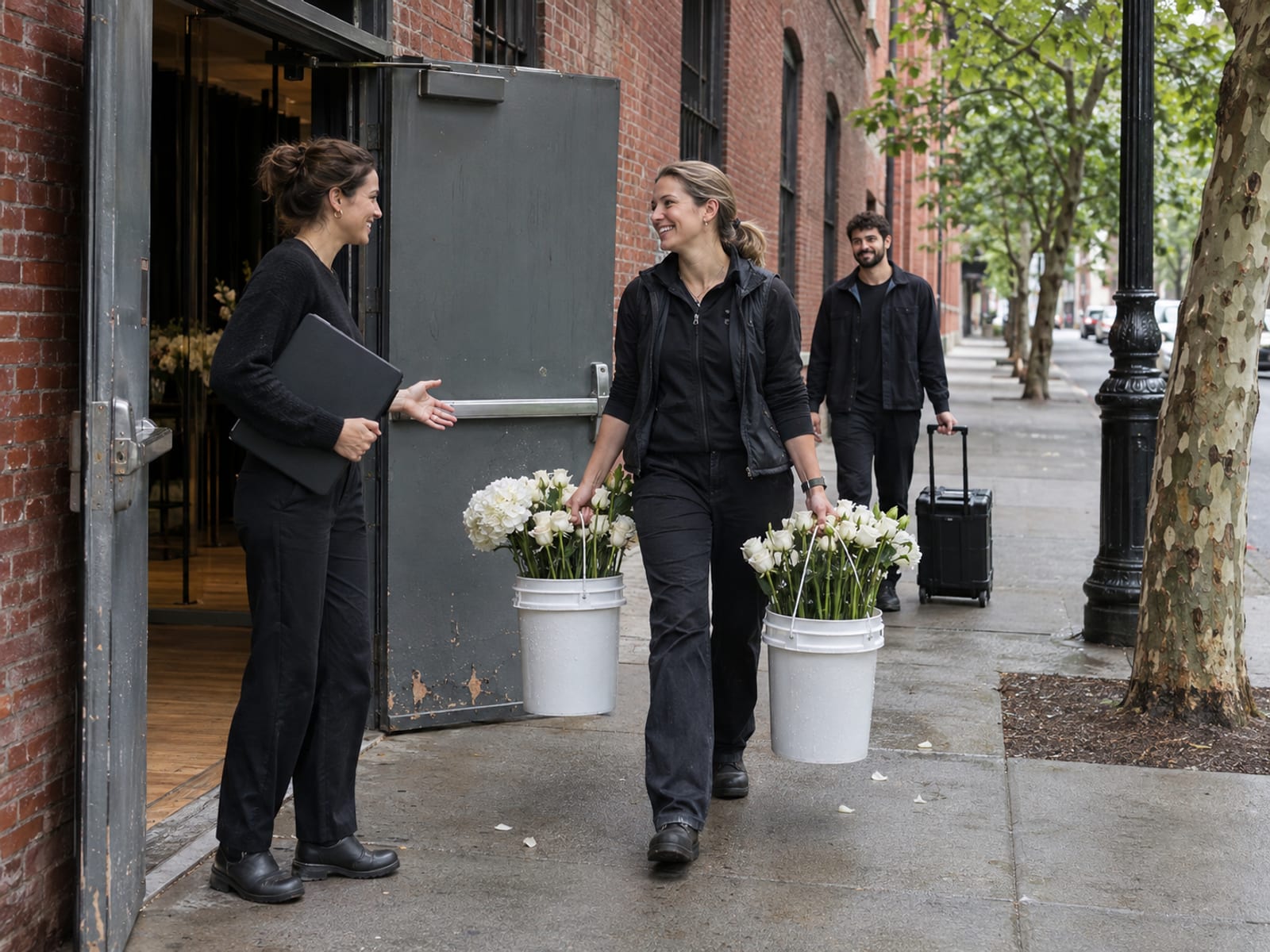
The schedule below is a planning model for a 6 p.m. ceremony, built from the setup and breakdown times The Foundry gives and a sample wedding timeline from Cator Woolford Gardens. Your venue's access window controls. If it opens at 2 p.m., every line moves.
Tap or hover a row to highlight it.
| Time | Who | What happens |
|---|---|---|
| Time10:00 a.m. to noon | WhoRental company, lighting, large decor | What happensFurniture and equipment arrive, if the venue allows early access |
| TimeNoon to 2:00 p.m. | WhoFlorist, decorator | What happensCeremony structure, tables, linens, signage and floral placement |
| Time2:00 to 3:00 p.m. | WhoCaterer | What happensKitchen, bar, table and service setup |
| Time3:00 to 4:00 p.m. | WhoDJ or band, photographer, videographer | What happensSound and lighting setup; final floral and decor touches |
| Time4:00 p.m. | WhoEveryone | What happensSetup-complete checkpoint; the room is inspected and cleared |
| Time4:30 to 5:30 p.m. | WhoWedding party | What happensPrivate preparations, if venue rules allow |
| Time5:30 p.m. | WhoGuests | What happensArrival or pre-ceremony period |
| Time6:00 p.m. | WhoCeremony | What happensRoom reset or cocktail transition follows your floor plan |
| TimeAfter the event | WhoCaterer, rentals, florist, entertainment | What happensStaged breakdown before the final-exit deadline |
The Foundry puts a typical breakdown at about an hour and a half, so build the last line from the venue's real exit time and not from a guess. Put one person on the schedule as the contact for early or late trucks.
Load-in day, in order
Tap or hover a step to follow the order.
10:00 a.m. to noon
Rental company, lighting and large decor arrive, if the venue allows early access.
Noon to 2:00 p.m.
Florist and decorator place the ceremony structure, tables, linens, signage and flowers.
2:00 to 3:00 p.m.
Caterer sets up the kitchen, bar, tables and service.
3:00 to 4:00 p.m.
DJ or band, photographer and videographer set up, with final floral and decor touches.
4:00 p.m.
Setup-complete checkpoint; the room is inspected and cleared.
6:00 p.m.
Ceremony.
After the event
Staged breakdown before the final-exit deadline.
How freight elevators, loading docks and building security work
Many NYC venues sit inside working buildings or hotels, and the building's rules come on top of the venue's. Expect a dock or service entrance, a freight elevator, and a security desk that wants names ahead of time. Shared docks mean staggered arrivals, so a vendor cannot assume the dock is empty at the planned time.
The examples below come from different venues and from documents dated 2024 and 2025. Read them as each place's own terms, and confirm the current version in writing.
Tap or hover a row to highlight it.
| Venue or building | What it publishes |
|---|---|
| Venue or buildingFlight Deck NYC (2024 brochure) | What it publishesFreight elevator 8:30 a.m. to 5:30 p.m.; hourly rate for after-hours load-in or load-out; COI from every vendor in advance; loading through the Depew Place dock |
| Venue or buildingMidtown Loft & Terrace | What it publishesFreight elevator and dock at 1/2 East 29th Street; drop-offs 9 a.m. to noon and 2 p.m. to 5 p.m.; pickups after the event and before the contracted breakdown time |
| Venue or building1133 Avenue of the Americas | What it publishesDock or service entrance; deliveries entered in the visitor system at least 24 hours ahead; freight elevator for delivery staff; preregistration and government-issued photo ID |
| Venue or buildingNew York Marriott Marquis (2025 document) | What it publishesDock requirements due at least 14 days before load-in, with dates, times, vehicle size, number of vehicles and vendor details; shared dock; vendors supply their own carts and dollies |
Notice how different these are. One building wants a day's notice and another wants two weeks, so ask for the deadline in the first week of planning, not the last. For rooftop lifts and access, see rooftop weddings in NYC.
What a vendor vehicle can do at the curb
Your drivers answer to the sign on the pole, not to the venue or to you. NYC DOT lists several kinds of curb space, including commercial metered parking, neighborhood loading zones, truck loading zones, hotel loading zones, and no-parking spots where a driver may load or unload but not park. Its loading-zone map is informational and may not show every posted rule, so the physical sign wins.
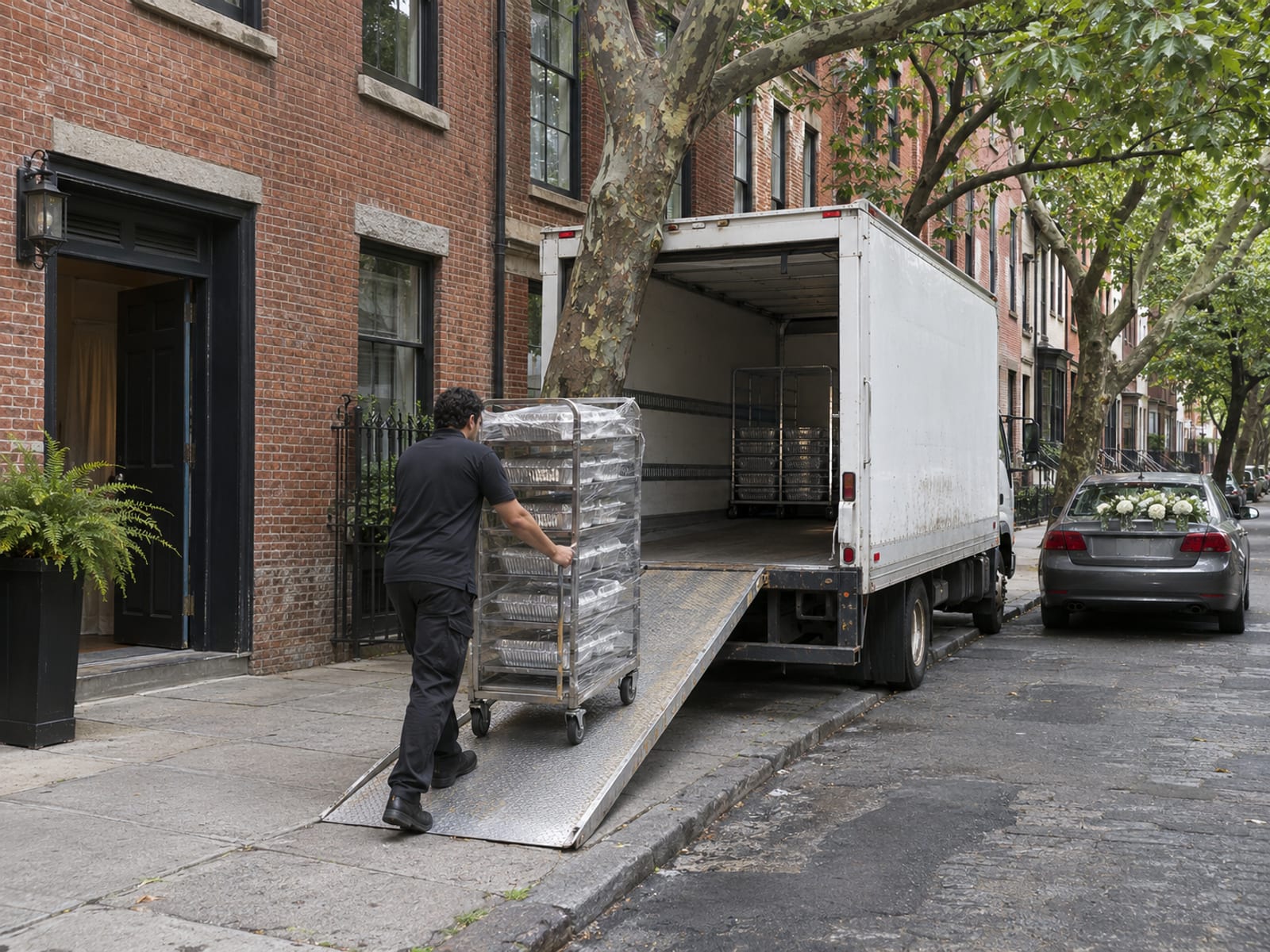
A "No Standing Except Trucks Loading and Unloading" area is for commercial or service vehicles making pickups, deliveries or service calls, under the NYC Traffic Rules. A passenger car carrying centerpieces does not qualify. NYC DOT's truck guidance describes a limited rule for commercial double parking of 20 minutes or less while actively loading, with conditions on available space, roadway clearance, and not blocking a bicycle lane or the only travel lane. Commercial vehicles must also show the registrant's name and address on both sides.
So, do not tell a vendor that double parking is fine. Give each driver the venue address, the dock address, the arrival slot and the vehicle dimensions, and remind them to follow the signs. Do not promise a curb space unless the venue or an authorized agency has confirmed it.
Who sets up and who removes decor, rentals, flowers, catering and entertainment
The simplest rule is the one that holds up in a dispute. The vendor who brings an item is named for its delivery, placement, removal and return, unless the contract says otherwise. Venues write their own versions of this, and the differences matter.

Flight Deck says the client provides decor, event equipment and rentals, and that the venue does not provide servers, bartenders or bussers. The New York Marriott Marquis requires vendors or drayage companies to remove everything they bring and to leave the space, dock, back-of-house areas and service elevators as they found them. Gray Bridge requires the client to remove decorations and the property of guests and vendors, and says the hired florist or the client removes the flowers.
Tap or hover a row to highlight it.
| Item | Who delivers, places, removes and returns it | Confirm in writing |
|---|---|---|
| ItemTables, chairs, linens | Who delivers, places, removes and returns itRental company | Confirm in writingDrop-off window, pickup window, who sets the floor plan |
| ItemFlowers and ceremony structure | Who delivers, places, removes and returns itFlorist or decorator | Confirm in writingPlacement time, removal time, who clears petals and stems |
| ItemCatering equipment and food service | Who delivers, places, removes and returns itCaterer | Confirm in writingArrival time, kitchen access, who removes equipment and packaging |
| ItemSound, lighting, band gear | Who delivers, places, removes and returns itDJ or band | Confirm in writingArrival time, power needs, load-out time |
| ItemSigns, cards, guest book, personal items | Who delivers, places, removes and returns itYou or a named friend | Confirm in writingWho carries them out and when |
| ItemAnything a vendor brought and left | Who delivers, places, removes and returns itThe vendor that brought it | Confirm in writingWho is the final sign-off person |
Add columns for in-event management, packing, trash and final sign-off if your coordinator wants them. The point is one named person on every row.
Who cleans up and removes trash
Cleaning, debris and trash are three separate jobs, and a venue fee may cover only some of them. Roulette charges a mandatory $220 post-event maintenance fee that includes mopping, bathroom cleaning, routine maintenance, and moving trash and recycling from the basement to the street. The client still clears debris and carries trash and recycling to the refuse room.
Ask the venue where food waste and recycling go, who supplies bags and bins, and who hauls boxes and packing material. If an event takes place on public property, NYC's Department of Sanitation says the producer may be billed for the personnel and equipment needed if cleanup is not done.
Tap or hover a row to highlight it.
| Venue | Published term |
|---|---|
| VenueRoulette | Published term$220 mandatory post-event maintenance fee; client still clears debris and moves trash to the refuse room |
| VenueGray Bridge | Published term$750 optional excess-trash disposal service; $750 charge for items left at the venue; $850 main-house cleaning fee; $500 flat fee when a day-of timeline change adds staff time |
| VenueThe Foundry | Published term$1,000 per hour for a guest-curfew extension |
| VenueFlight Deck | Published termHourly rate for freight-elevator or dock activity after 5:30 p.m.; ask for the amount |
These are one venue's terms each, not a citywide price list, and several come from older documents. Confirm the current figure before you rely on it. For setup and breakdown in a blank space, see loft and raw-space weddings in New York City.
Overnight storage and next-day rental pickup
Assume nothing stays and nothing is collected later until the venue says so in writing. Gray Bridge requires everything brought by the client, guests or vendors to leave before access hours end, charges $750 for items left behind, and may dispose of items not retrieved within one business day. Midtown Loft & Terrace requires rental pickup after the event and before the contracted breakdown time, and its FAQ allows no exceptions to the drop-off and pickup schedule. The New York Marriott Marquis does not allow overnight parking of production vehicles on hotel property.
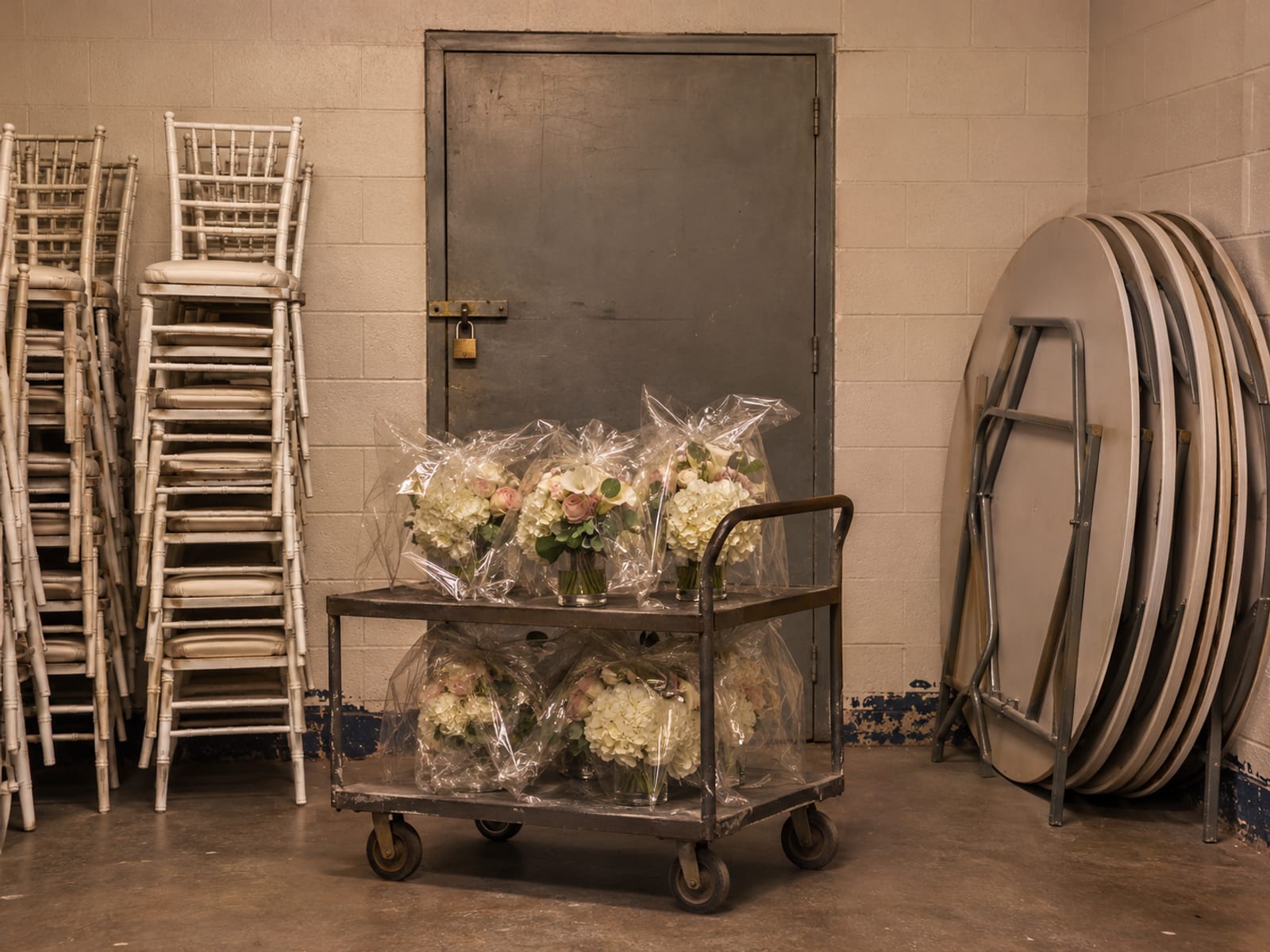
If you do need a rental company to come back the next morning, ask for a short storage agreement. It should name the location, who has access and when, the security, the fee, the pickup window, and what happens to anything left after that.
Questions to ask at the final walkthrough
The walkthrough is the last easy moment to fix a gap. Bring the contract, the vendor schedule and the responsibility chart. A tabbed, waterproof document folder is worth having for the contract, COIs, dock instructions, floor plan and contact sheet. A folding hand truck is worth buying only if the venue allows client-supplied equipment and it fits the elevator, doorways and load limits.
- What is the access start time, and what is the final-exit time?
- What is the dock address, and what is the freight-elevator route?
- What are the elevator, doorway, truck and equipment dimensions?
- Is the dock shared, and when is the dock schedule and vehicle information due?
- What COI and additional-insured wording does the building require, and who registers vendors and drivers with security?
- Who supplies carts, dollies, ramps, floor protection and labor?
- Who is assigned to every rental, floral, decor, catering and entertainment item for setup, breakdown, packing and return?
- What are the cleanup, trash, overtime, elevator, security, storage and abandoned-property fees?
- Can anything stay overnight or be picked up the next day, and where is that written?
- Who is the on-site contact if a truck arrives early or late?
- Who gives final sign-off after every item and all trash have left?
Venue and city pages are in English. If English is not your first language, ask the venue for the access instructions, COI wording and cleanup terms in writing, and ask for a translation if you need one.
Quick check: load-in and cleanup
Answer every question to check.
Questions couples ask about load-in and cleanup
These are the quick answers for the questions that come up most after the schedule is drafted.
Does a freight elevator mean vendors can come whenever they like?
No. Midtown Loft & Terrace restricts deliveries to two fixed windows, and Flight Deck's elevator runs 8:30 a.m. to 5:30 p.m. with an hourly charge after that. Ask for the window in writing, and ask what happens to a vendor who misses it.
Who supplies carts and dollies?
It may be the vendor. The New York Marriott Marquis says it does not provide carts, hand trucks or dollies. Ask each venue the same question, and ask about floor protection while you are there.
Do all vendors need a COI?
Not everywhere, but many commercial buildings ask for one. Flight Deck wants a COI in advance from every vendor using its freight elevator or dock. Ask the venue for the exact wording, then pass it to each vendor's insurer.
Is cleanup included in the venue fee?
It depends on the venue. At Roulette a $220 fee covers specified cleaning and trash removal, but the client still clears debris and carries trash to the refuse room. Ask for a line-by-line description of what the fee covers.
Who makes the vendor schedule?
The venue manager, planner or day-of coordinator should give everyone one written schedule with arrival, setup-complete, breakdown and final-exit times. If you have no planner, ask the venue who owns that document. Ask for it before you sign.
Your next step
Before you sign, send the venue the question list above and ask for the answers in writing. Then build your vendor schedule from the venue's real access window, fill in the responsibility chart with a name on every row, and share the same copy with every vendor.
When the venue replies, check each fee against your budget and each deadline against your calendar. A quiet week of questions now is far easier than a blocked dock on the day.
Terms in this guide
Tap a term to see what it means.
Load-in. The arrival of vendors and their items at the venue, through a dock or service entrance.