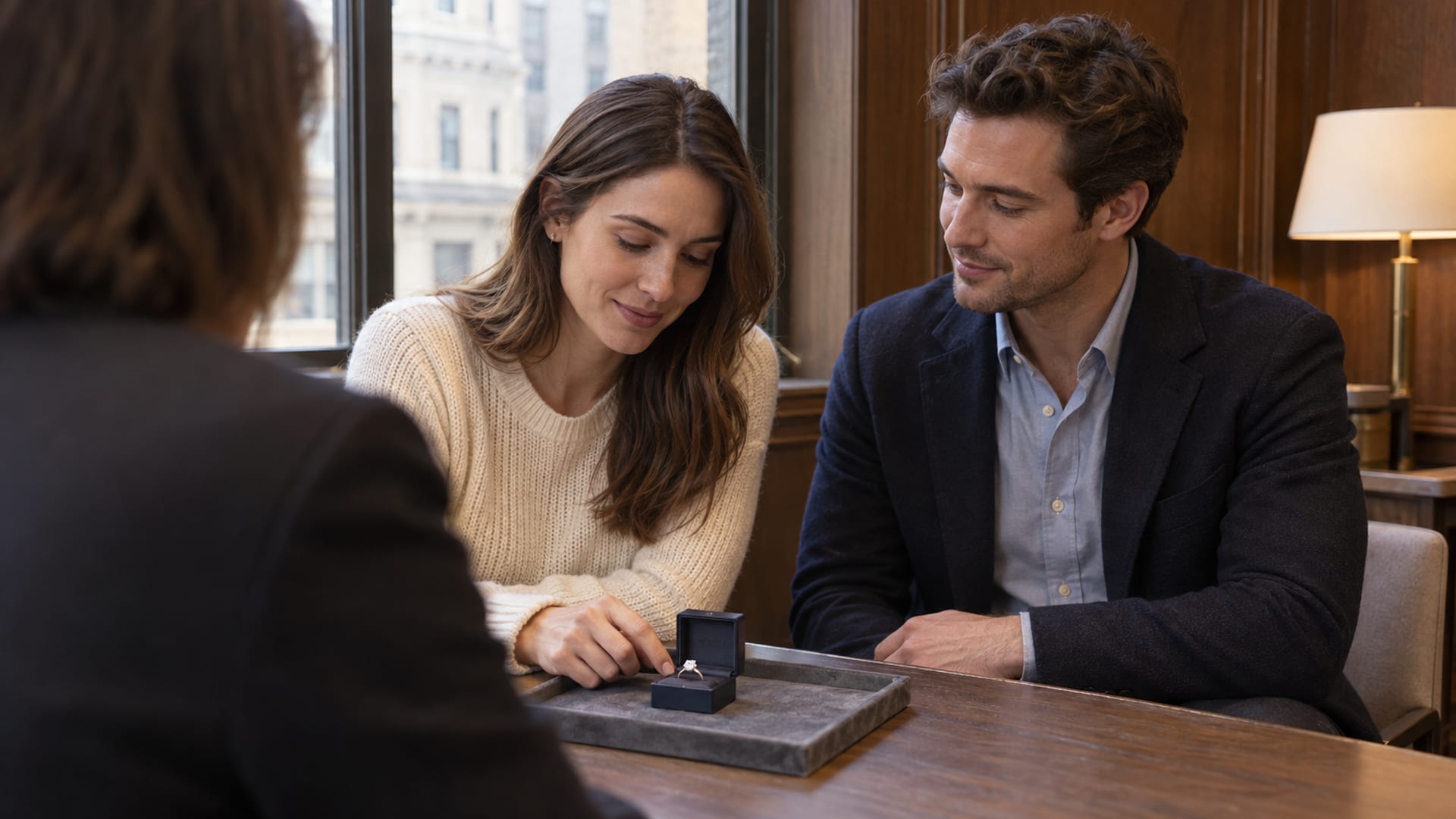
Shopping for an engagement ring in New York City comes down to four kinds of places: the Diamond District on West 47th Street, independent studios in Manhattan and Brooklyn, designer boutiques, and antique or estate dealers. Wherever you go, the fair way to compare is the same. Look at the exact stone with a report from a recognized laboratory such as GIA or IGI, get the origin and any treatments in writing, read the return policy, keep a complete receipt and confirm the production date. The Diamond District is a marketplace of many independent businesses on one block, not a single store with one wholesale price, and every price you see is an example that can change.
Key takeaways
Tap a card to bring it forward.
- The Diamond District sits on West 47th Street between Fifth and Sixth Avenues and is made up of many separate businesses, each with its own prices and policies.
- Compare two diamonds by their full reports and report numbers, not by carat weight alone.
- Laboratory-grown diamonds are diamonds; imitations such as simulants are a different thing, and the seller has to say which one you are buying.
- Get the price, tax, stone details, origin, treatments, deposit terms, return policy and ready date in writing before you pay.
- Custom rings commonly take 4 to 8 weeks or longer, so give the jeweler your proposal date at the first appointment.
How the Diamond District works
The Diamond District is concentrated on West 47th Street between Fifth and Sixth Avenues in Midtown Manhattan. The city's small business agency lists the 47th Street Diamond District Partnership as a business improvement district covering two block faces, with approximately 2,600 ground-floor retail businesses.
Along the block you will find street-level storefronts, upper-floor showrooms and trade offices, and exchange buildings where many separate businesses rent booths under one roof. Booths often specialize, one in loose stones, another in finished rings, another in estate pieces, settings or repairs, and the same stone may be shown by more than one intermediary.
Two things follow from this. First, prices are retail. The concentration of sellers creates competition, and quotes are often negotiable, but you should not expect an automatic wholesale price. Second, every booth sets its own return, deposit and warranty terms. Write down the business name and exact address of each seller you talk to, because "the third booth on the left" will not help you later.
Choosing where to shop: West 47th Street, a boutique, a Brooklyn studio or an antique dealer
Each kind of shop suits a different kind of day, and you can visit more than one before deciding.
West 47th Street gives you the widest selection in the shortest walk. It suits a visitor with one efficient Manhattan day, or anyone who already knows the stone specification they want and is ready to compare quotes on it. The pace is faster, and you will do more of the sorting yourself.
Independent studios in Manhattan and Brooklyn tend to be lower-volume and appointment-based, which often means more time for questions and design. Examples include custom-focused Manhattan studios such as Ken & Dana Design and Brooklyn studios such as N+A in Industry City and Fitzgerald Jewelry in Williamsburg. Smaller designers may offer CAD previews of a custom ring, recycled metals, alternative stones or laboratory-grown diamonds.
Designer and luxury boutiques on Fifth Avenue and around Midtown sell branded settings with higher design, service and overhead costs built in. Their published pricing may not make it easy to compare the center stone on its own, so ask for the stone's report and specifications separately.
Antique and estate dealers carry Art Deco, Edwardian, Victorian, Georgian and old-mine styles, and auction houses and curated marketplaces such as 1stDibs list NYC pieces too. With an older ring, ask the seller to document the age claim, the stone's identity, any treatments, the ring's condition, past repairs, any replaced parts and the return terms.
What to decide before you book an appointment
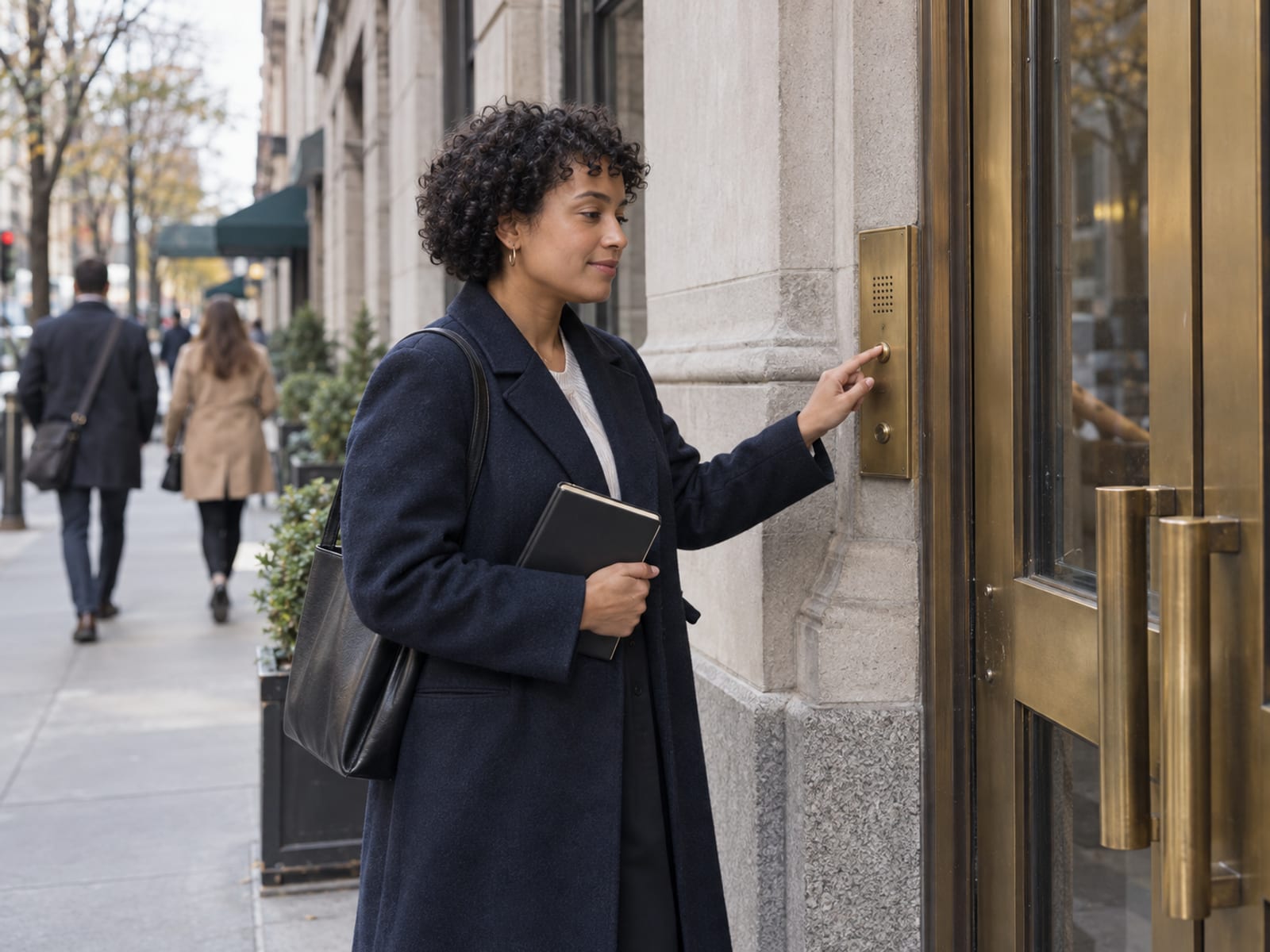
A little preparation turns an appointment from browsing into comparing. Settle these before you go:
- A total budget. The "two months' salary" guideline is not a rule from any consumer authority; your budget is your own decision. Decide whether your number includes the setting, tax and any resizing.
- Natural, laboratory-grown or another gemstone. Knowing which you are open to cuts the options in half.
- Shape and setting. Round brilliant, oval, emerald cut, cushion, pear, marquise, princess and radiant are all shapes; solitaire, halo and three-stone are common settings. Metal is part of this choice too.
- Ring size. If the proposal is a surprise, a borrowed ring the person already wears or a simple ring-size gauge can give you a starting estimate, and you can confirm resizing terms later.
- Your proposal date. This decides whether custom work is realistic.
- Whether you are shopping together or alone. Shopping together makes size and style easy; shopping alone means you need the return and resizing policy even more.
When you book, confirm the address, whether the seller works by appointment, and whether someone can help you in Spanish if you prefer.
How to compare two diamonds fairly
Carat weight is the number everyone quotes, but it is only one of several characteristics a laboratory grades. A GIA natural Diamond Grading Report evaluates shape, color, clarity, cut, carat weight, proportions, finish and treatments, with a plotted diagram of the stone's features. IGI reports document origin, the 4Cs, measurements and, where it applies, growth method or treatments. Two stones of the same weight can differ sharply in cut, color and clarity, and so in price.
To compare fairly, line up the two reports side by side and check:
- The laboratory that issued each report.
- The report number, verified online with the laboratory.
- Whether a laser inscription on the stone matches the report number.
- Origin: natural or laboratory-grown.
- Shape and measurements, not just carat weight.
- Cut, color and clarity grades.
- Treatments, fluorescence and any comments.
Then look at the stones themselves. "Eye clean" is a seller's phrase, not a formal grade. If one seller shows you a stone with a GIA report and another with an in-house certificate from a source you cannot verify, the comparison is not equal yet. Ask the second seller for an independent report.
A note on AGS: AGS Laboratories closed in 2022. You may still see an older AGS report, which you can verify, and the current AGS Ideal report is a digital supplement issued through GIA for eligible stones, listed at an additional US$25 on the AGS page.
Keep in mind what a report is and is not. A grading report documents a stone's characteristics. It is not an appraisal, and it is not a promise of market or insurance value.
Natural, laboratory-grown and imitation stones
These three words mean different things, and the seller has to be clear about which one you are buying. FTC consumer guidance explains that laboratory-created gems have the same chemical, physical and visual properties as natural gems, while imitation gems do not. GIA adds that laboratory-grown diamonds need specialized testing to tell apart from natural ones.
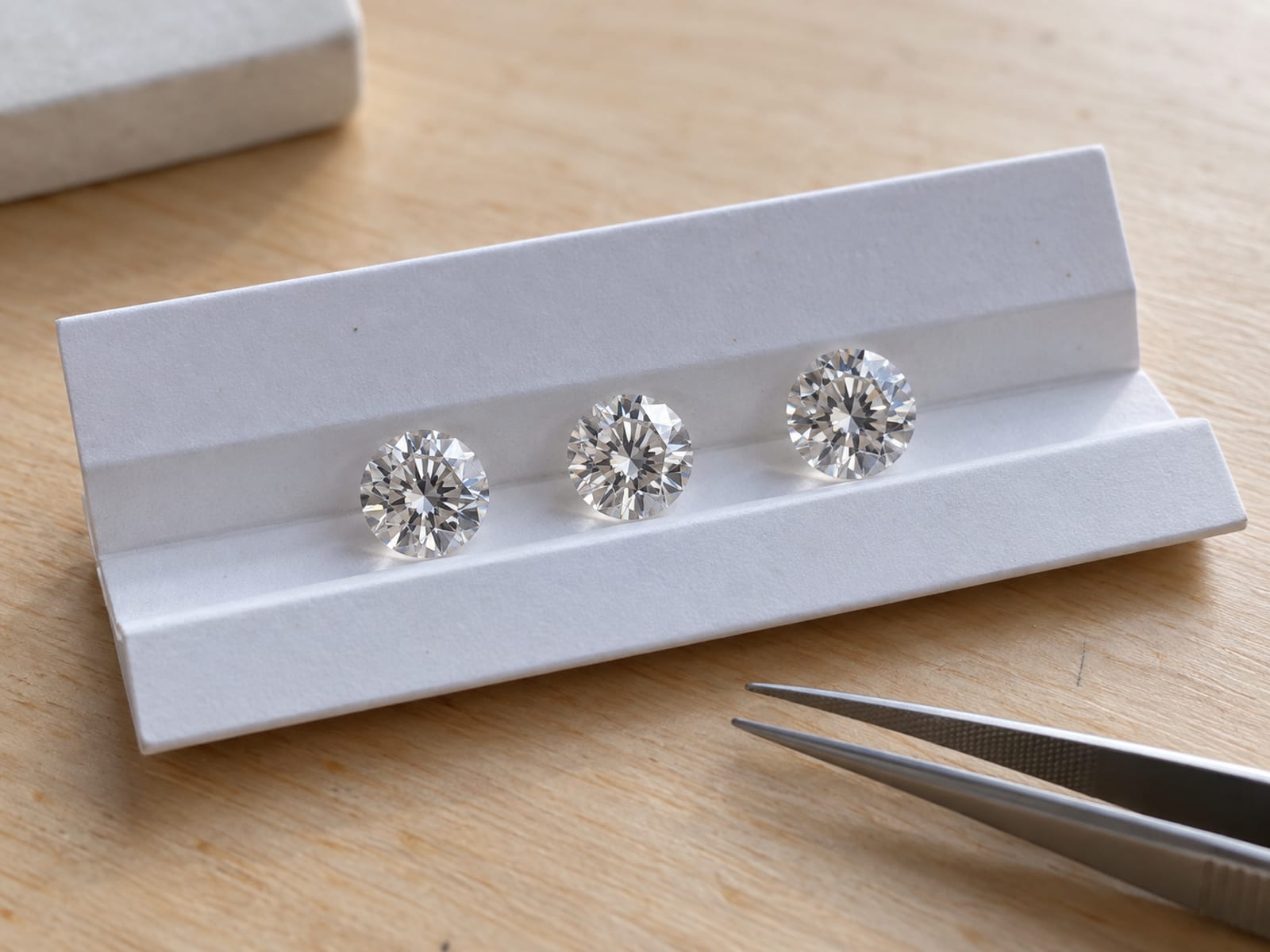
In practice, a laboratory-grown diamond is a diamond made in a factory setting rather than mined. An imitation or simulant, such as moissanite, looks similar but is a different material. The FTC's Jewelry Guides require sellers to disclose clearly whether a stone is mined, laboratory-created or simulated, and to represent its type, grade, quality, size, weight, treatment, origin and price truthfully.
Price is where the difference shows most. Axios reported in December 2025 that a generic 3-carat natural diamond averaged about 16 times the price of a comparable laboratory-grown one, and that The Knot's latest study found 52% of engaged couples had laboratory-grown stones. Resale is different too: do not assume a laboratory-grown diamond has the same resale market as a natural one. If trade-in or resale matters to you, ask the seller about it before you buy.
What the seller should put in writing
A verbal description is not enough. The FTC recommends that your sales documents include what the seller told you about the stone, including origin, weight, size, treatments and any special care. Before you pay, ask for a written quote that covers:
- The full price, and whether it includes the setting, labor, tax, shipping and any rush charge.
- The stone's identity, laboratory and report number.
- Origin and any treatments.
- The metal and setting.
- The date the ring will be ready.
- Resizing cost and time.
- The warranty and any repair restrictions.
- Whether the deposit is refundable.
- The return and exchange window, and whether custom, engraved, resized or modified pieces are excluded.
New York City adds its own rules. According to the city's Department of Consumer and Worker Protection (DCWP), stores may set their own refund policies but must post the conditions near the register. If no refund policy is posted, an unused item may generally be returned within 30 days for your choice of cash or credit. Businesses must post prices and may not charge more than the posted price. A purchase over $20 must come with a receipt automatically, and one between $5 and $20 on request, showing the business name and address, the item amounts, the total, the tax and the date.
Custom pieces are where return terms matter most. Ken & Dana Design's published policy, for example, excludes customized, engraved, repaired or resized pieces from returns.
How long a custom ring or resizing takes
Timelines vary a great deal from one business to the next, so treat these published policies as examples and confirm your own date directly before paying.
Tap or hover a row to highlight it.
| Seller and service | Published timeline |
|---|---|
| Seller and serviceKen & Dana Design, custom designs | Published timeline8 weeks to 6 months, depending on the request |
| Seller and serviceKen & Dana Design, usual production | Published timeline4 to 5 weeks; some rush orders about 2 weeks |
| Seller and serviceS. Kind & Co, production | Published timeline4 to 8 weeks after final design approval |
| Seller and serviceFitzgerald Jewelry, custom work | Published timelineGenerally 6 to 8 weeks; asks for 8 weeks of lead time |
| Seller and serviceMartin Busch Jewelers, resizing and adjustments | Published timeline1 to 2 weeks |
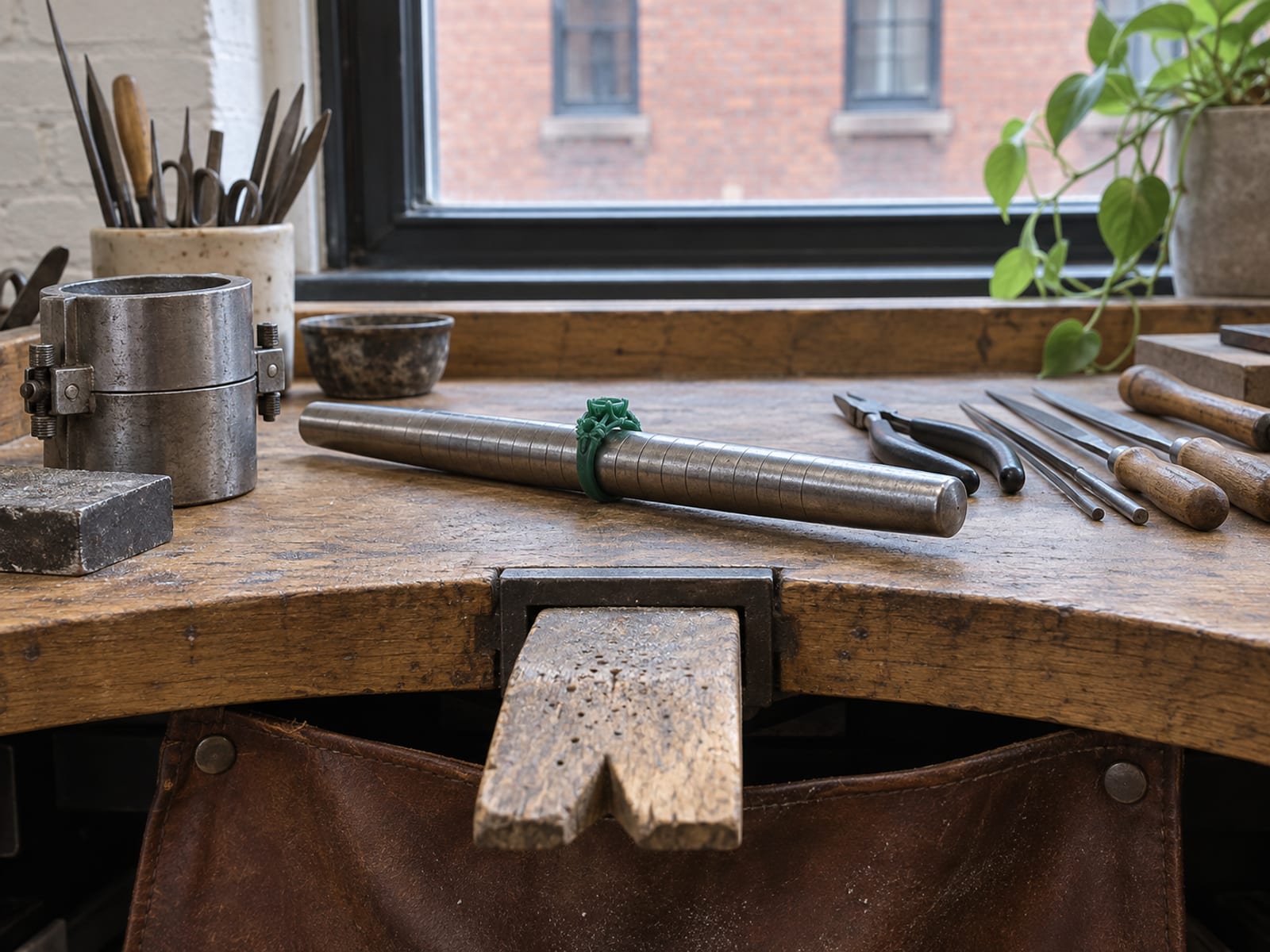
A custom ring passes through several stages: consultation, finding the stone, CAD approval, revisions, casting, setting, finishing, inspection and insured shipping or pickup. When you talk to a jeweler, tell them your proposal date, ask whether the clock starts at your deposit or at final design approval, ask whether the center stone is in stock, and get the deadline in writing. If the proposal is weeks away rather than months, a ready-made ring or an in-stock stone in an existing setting may be the realistic route, with resizing afterward.
Dated NYC price examples
These are published listings, read on September 28, 2026 unless another date is shown. They are examples only, not market averages, and they are not directly comparable, because the reports, settings, metals, designs and policies differ. Confirm the current price with the seller before you plan around any of them.
- Martin Busch Jewelers, complete rings: a 1.25 total-carat natural diamond ring at $3,725, a 1.50-carat natural solitaire at $8,595, a 1.57-carat laboratory-grown solitaire at $2,159 and a 1.00-carat laboratory-grown round solitaire at $999.
- N+A, Brooklyn, solitaires: 0.5 carat from $4,800, 0.8 carat from $8,200 and 1.0 carat from $12,000.
- Zack & Elle, price guide dated July 6, 2026: laboratory-grown rings from $695 for a 1-carat oval solitaire to $1,995 for a 5-carat round solitaire, which the seller describes as IGI-certified stones set in 14K gold.
When you compare quotes of your own, note whether each price is for a complete ring, a center stone alone or a setting alone.
Warning signs to watch for
A few checks protect your money. Slow down or walk away if you see:
- An unclear answer about whether the stone is natural, laboratory-grown or an imitation.
- No independent report, or a vague "certificate" from a source you cannot verify.
- A report number that does not match the laser inscription or the stone's shape, weight and measurements.
- Vague grades, or grades that appear only in conversation.
- An appraisal or insurance value presented as proof of what the ring is worth.
- A price higher than the posted price.
- No written return policy, or unclear deposit terms.
- Promises that are not on the receipt or quote.
- Pressure to pay before you have compared the report and the written terms.
- A receipt missing the business name, address, amounts, tax or date.
Leaving without buying is normal. "Thank you, I'm comparing a few quotes, can you write this one down for me?" is a complete answer, and a written quote is the most useful thing to walk out with.
If something goes wrong after you buy, keep the report, receipt, written quote, messages and photos. Contact the seller first. After that, you can turn to DCWP, which offers mediation and explains its complaint process in Spanish, the FTC or the New York Attorney General, depending on the problem.
Quick check: buying rules in NYC
Answer every question to check.
Questions about buying an engagement ring in NYC
These are the questions buyers ask most once the basics are clear.
Can you negotiate in the Diamond District?
Negotiation is common in the trade, and quotes on West 47th Street may be negotiable. A discount only means something when you compare it against written quotes for the same stone specification, so get each offer on paper with the report number.
Is IGI acceptable, and how do I check a report?
Both GIA and IGI grade natural and laboratory-grown diamonds. Enter the report number on the laboratory's website and confirm that the shape, weight, measurements and grades match the stone in front of you, including any laser inscription.
Can I shop for a ring in Spanish?
Yes. Ask when you book whether someone can help you in Spanish. Useful terms include "informe de graduación" for the grading report, "diamante cultivado en laboratorio" for a laboratory-grown diamond, "política de devolución" for the return policy and "recibo" for the receipt, and the FTC publishes its jewelry-buying advice in Spanish.
Should I insure the ring?
You can, and it helps to plan for it early. Insurance and appraisal are separate from the grading report, so ask the jeweler what appraisal documentation they provide after purchase, and keep the report, receipt, quote and warranty together in one place.
Your next step
Once you have a shortlist, book two or three appointments, bring your budget and proposal date, and ask each seller for a written quote with the report number. Keep your documents together, and carry the ring in a travel case with a secure closure if you are taking it on a trip. From there, the site's guide to where to propose in New York City can help you choose the moment, the engagement photos guide covers proposal and ring photography, and the jewelers directory lists NYC jewelers to contact.
Terms in this guide
Tap a term to see what it means.
Diamond District. West 47th Street between Fifth and Sixth Avenues, a marketplace of many independent businesses, each with its own prices and policies.